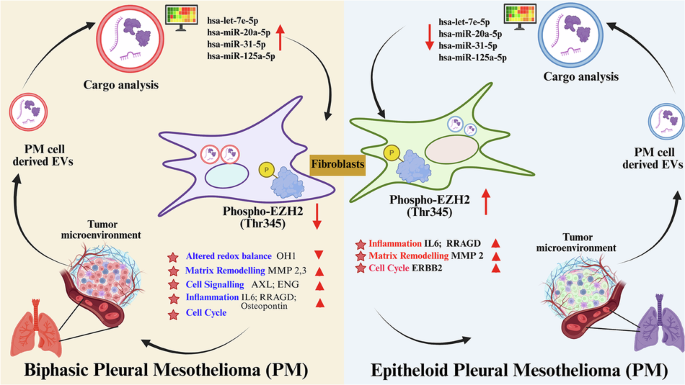
Pleural mesothelioma—an aggressive cancer closely linked to asbestos exposure with notoriously low survival rates—progresses by actively reprogramming the cellular environment around it, according to new research published in Nature.
Profiling Microscopic Cargo in Mesothelioma Subtypes
The study profiles the microscopic cargo carried by extracellular vesicles released from pleural mesothelioma cells, offering a clearer picture of how this malignancy builds a supportive habitat within human tissue.
The research examined how extracellular vesicles, or EVs, transport microRNA directly into fibroblasts, which make up the predominant cell type in the tumour microenvironment. Through high-throughput profiling, investigators discovered that EVs derived from epithelioid and non-epithelioid pleural mesothelioma carry distinct microRNA cargoes that differ from each other and from non-malignant controls. The data show that oncogenic microRNAs were upregulated while tumour-suppressive counterparts were suppressed inside these vesicles.
Isolating Distinct Molecular Signatures
Investigators also isolated microRNAs unique to specific histological subtypes. These distinct molecular signatures could eventually serve as clinical biomarkers to help differentiate between epithelioid and non-epithelioid pleural mesothelioma, potentially guiding treatment choices for clinicians managing these complex cases.
Treating Human Fibroblasts Alters Intracellular Signaling Pathways
To understand what happens when these vesicles reach surrounding tissue, researchers treated human fibroblasts with isolated pleural mesothelioma EVs, followed by comprehensive RNA sequencing and molecular analysis. Integrative microRNA-mRNA profiling predicted that the delivered cargo alters multiple signaling pathways inside the receiving cells.
Gene set enrichment analysis pointed to significant upregulation in pathways governing the cell cycle, neutrophil and extracellular trap formation, and EZH2-regulated networks. Molecular testing confirmed that treated fibroblasts shifted into an inflammatory cancer-associated fibroblast-like phenotype. This shift showed rising levels of markers such as IL-6 and IL-8, MMP-1 and MMP-3, ICAM1, ENG, and RRAGD, alongside enhanced oncogenic signaling molecules like Osteopontin, thrombospondin, Cystatin C, autotaxin, AXL, and ERBB2.
Epigenetic Shifts Across Subtypes
| Mesothelioma EV Subtype | Observed Epigenetic Effect | Downstream Cellular Impact |
|---|---|---|
| Epithelioid EVs | Increased p-EZH2 levels at Thr345 | Fibroblast reprogramming, enhanced tumor cell migration and proliferation |
| Non-Epithelioid EVs | Decreased p-EZH2 levels at Thr345 | Fibroblast reprogramming, enhanced tumor cell migration and proliferation |
Beyond inflammatory changes, the study reveals that these vesicles tinker with epigenetic regulation by altering EZH2 phosphorylation at Thr345, though the direction depends on the subtype: epithelioid EVs increased phosphorylation, while non-epithelioid EVs decreased it. Ultimately, this vesicle-mediated reprogramming encourages both tumor cell migration and proliferation, establishing a microenvironment primed to support cancer growth.