
The Sacramento National Wildlife Refuge serves as a seasonal engine for avian migration, shifting from a summer sanctuary to a hub for birds. The refuge—which acts as the headquarters for a complex of five national wildlife refuges and three wildlife management areas—manages a cycle of flooding and drawdowns to support these populations throughout the year.
For the ducks and geese that rely on the Central Valley, the refuge is a piece of ecological infrastructure. The refuge supports a network of species that range from neotropical songbirds to raptors.
The Seasonal Pulse of the Wetlands
Visiting the refuge in July is a different experience than visiting in November. Waterfowl populations mirror the flooding of the landscape. In the heat of summer, only 15% of the wetlands are flooded, and waterfowl counts dip to as low as 6,300. During this period, the focus shifts to habitat maintenance, including irrigation to mature food plants and grazing to keep invasive species from choking out native vegetation.
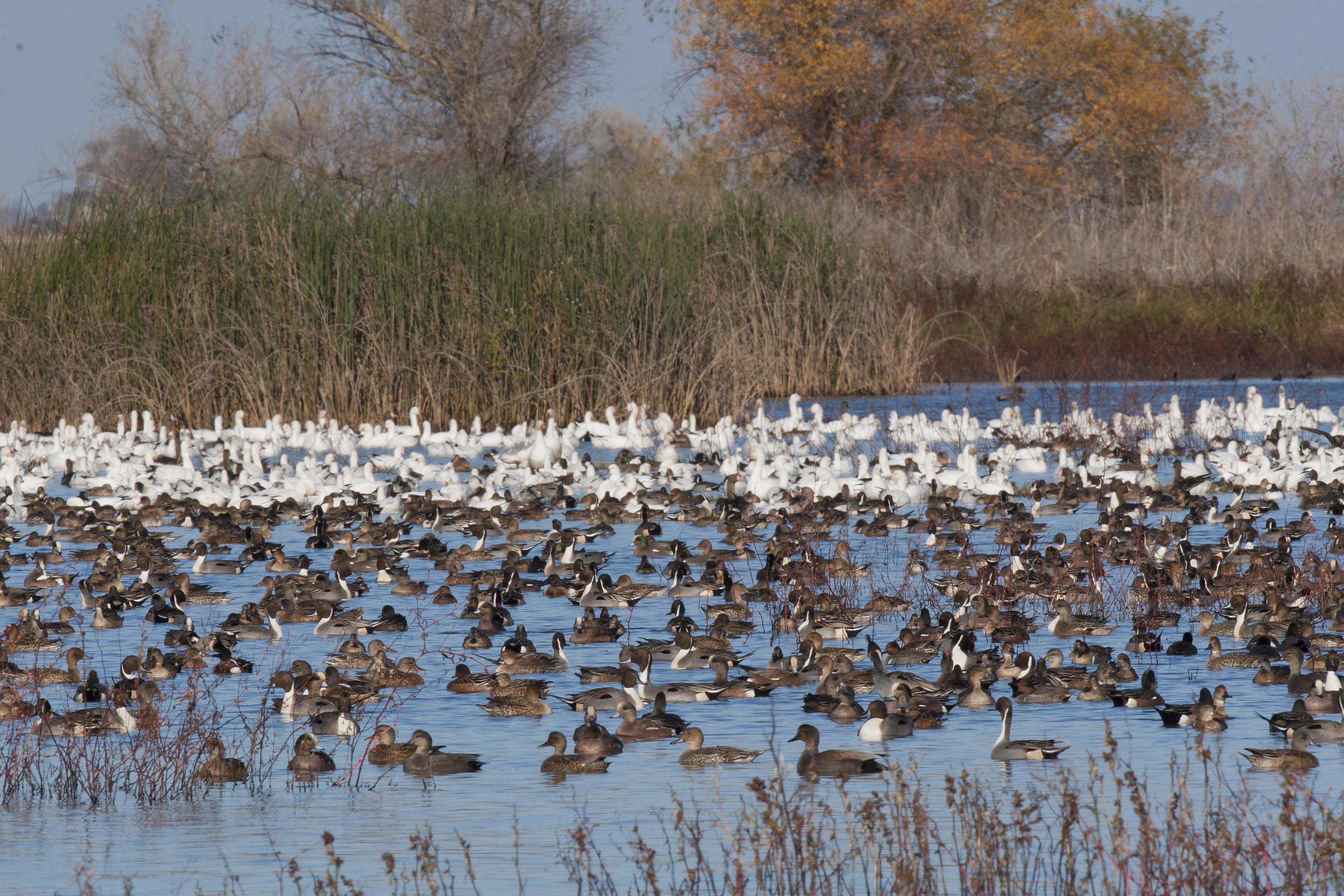
As autumn arrives, the scenery transforms. By October, 75% of the wetlands are flooded, and ducks arrive by the thousands, bringing the average count to 1.5 million. This peak culminates in November and December, when waterfowl numbers hit an average of 1.8 million in November. The volume of birds creates a spectacle known as the evening fly-off, where flocks leave the refuge at dusk to feed in nearby rice fields.
| Month | Avg. Waterfowl Count | Wetlands Flooded |
|---|---|---|
| May | 6,700 | 15% |
| August | 23,000 | 15% |
| October | 1,500,000 | 75% |
| November | 1,800,000 | 95% |
| December | 1,400,000 | 100% |
Managing a Multi-Refuge Complex
The Sacramento National Wildlife Refuge doesn’t operate in isolation. It anchors a broader complex designed to provide diverse habitats across the region. This network includes the Delevan, Colusa, Sutter, and Sacramento River National Wildlife Refuges, along with the Llano Seco Unit (STNCV WMA), Butte Sink WMA, and Willow Creek-Lurline WMA. While the headquarters in Willows, California, provides a visitor center and educational programs, the other sites in the complex offer their own trails, auto tours, and bicycling opportunities.
The management strategy is precise. In February, winter burning is conducted to rejuvenate nutrients in the soil. By March, “drawdowns” begin—the intentional draining of water to germinate the food plants that will sustain the next wave of migrants. This cycle ensures that when the shorebirds and neotropical songbirds arrive in April, the environment is primed for their specific needs.
Public Access Ends Where Wildlife Management Begins
For the public, the refuge offers a range of access points, from observation decks and photography blinds—which require reservations—to seasonal bicycling. There is even a live web-cam provided by the Friends of the Sacramento National Wildlife Refuge for those wanting to check bird activity or weather before making the trip. However, there is a hard line where public interaction ends and wildlife management begins.
One of the most frequent points of friction for visitors is the desire to help injured animals. The refuge is explicit: the refuge does not rescue, rehabilitate, or accept animals. Those who find injured or orphaned wildlife are directed to the California Department of Fish and Wildlife’s Native Wildlife Rehabilitation resources.
Comparing Regional Conservation Models
While the Sacramento complex focuses on the water-based migration of waterfowl, other federal refuges employ different strategies based on their geography. For instance, the National Elk Refuge in Wyoming focuses on the movement of large mammals. Their winter strategy involves managing elk, bighorn sheep, trumpeter swans, and bald eagles as they move from higher elevations in Grand Teton National Park and the Bridger Teton National Forest down to the lower elevations of Jackson Hole to escape deepening snow.
The contrast is stark: where Sacramento manages the “flood-up” of wetlands to attract ducks, the National Elk Refuge manages the “snow line” to protect elk. Both serve as safety valves for wildlife that would otherwise struggle to survive the extremes of the American climate.
The Sacramento National Wildlife Refuge sustains nearly two million birds in a single month because of the scale of federal land management in the Central Valley. It is a balance of fire, water, and timing that turns a stretch of California land into a crossroads for migration.



