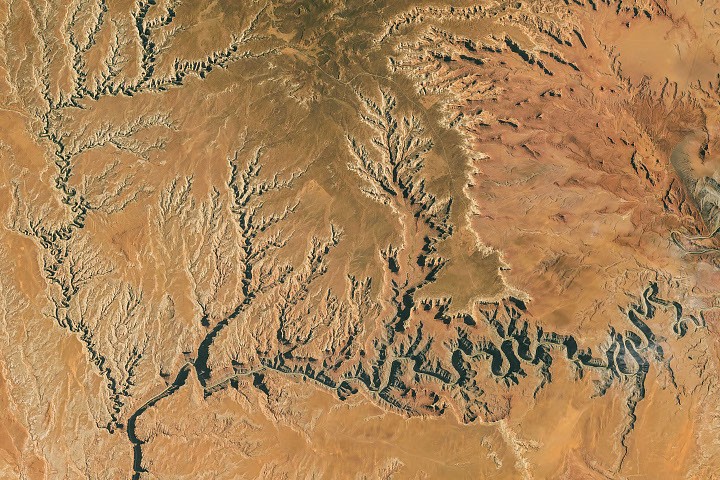
Long ago, across what is presently southern Utah shared some of the traits seen in the modern Mississippi River some tens of millions of years in the past. In a bygone geologic era, the river flowed across a relatively flat plain that formed in an ancient marine environment. Unencumbered by rugged terrain, it was free to take a long, meandering path on its gradual journey downslope.
That ancient landscape changed drastically when geologic forces pushed the Colorado Plateau upward. Beginning approximately 20 million years before present, the elevation of the plateau lifted the source of the San Juan, thereby steepening the channel’s slope and accelerating the current, as reported by NASA Science. Consequently, the liquid’s capacity to erode intensified, prompting the waterway to slice its twisting course progressively deeper into strata aged 300 million years.
Today, on its westward path to Lake Powell, the San Juan River cuts through a striking sequence of deeply incised bends referred to as goosenecks. An astronaut aboard the International Space Station photographed this stark desert topography on October 6, 2026. In Utah’s Goosenecks State Park, the river runs through a canyon 1,000 feet deep. In places, it nearly loops back on itself, making horseshoe-shaped bends. One section is so curvy that the river travels 5.5 miles between two points that are only 1.3 miles apart.
Daytime visitors marvel at the peculiar rock formations of the goosenecks, whereas nighttime observers are treated to a magnificent display of the region’s dark skies. Citing DarkSky International, the site secured its status as an International Dark Sky Park in 2021 thanks to its isolated high-desert setting and unobstructed horizon views in every direction. Without the aid of telescopes, stargazers at the park can spot celestial highlights such as the Double Cluster located in Perseus alongside the Messier 24 star cloud nestled within the Milky Way’s Sagittarius spiral arm.
November 2026 brings distinct viewing opportunities for stargazers, with several meteor showers reaching their peaks throughout the month, including the Northern Taurids, Southern Taurids, and Leonids.

An Expedition 75 crew member captured astronaut photograph ISS075-E-188830 on October 6, 2026, utilizing a Nikon Z9 digital camera set to a 400-millimeter focal length. It was provided by the ISS Crew Earth Observations Facility and the Earth Science and Remote Sensing Unit at NASA Johnson Space Center by a member of the Expedition 75 crew. The image has been cropped and enhanced to improve contrast, and lens artifacts have been removed. You can browse more photographs taken by spaceflyers by visiting the NASA/JSC Gateway to Astronaut Photography of Earth.