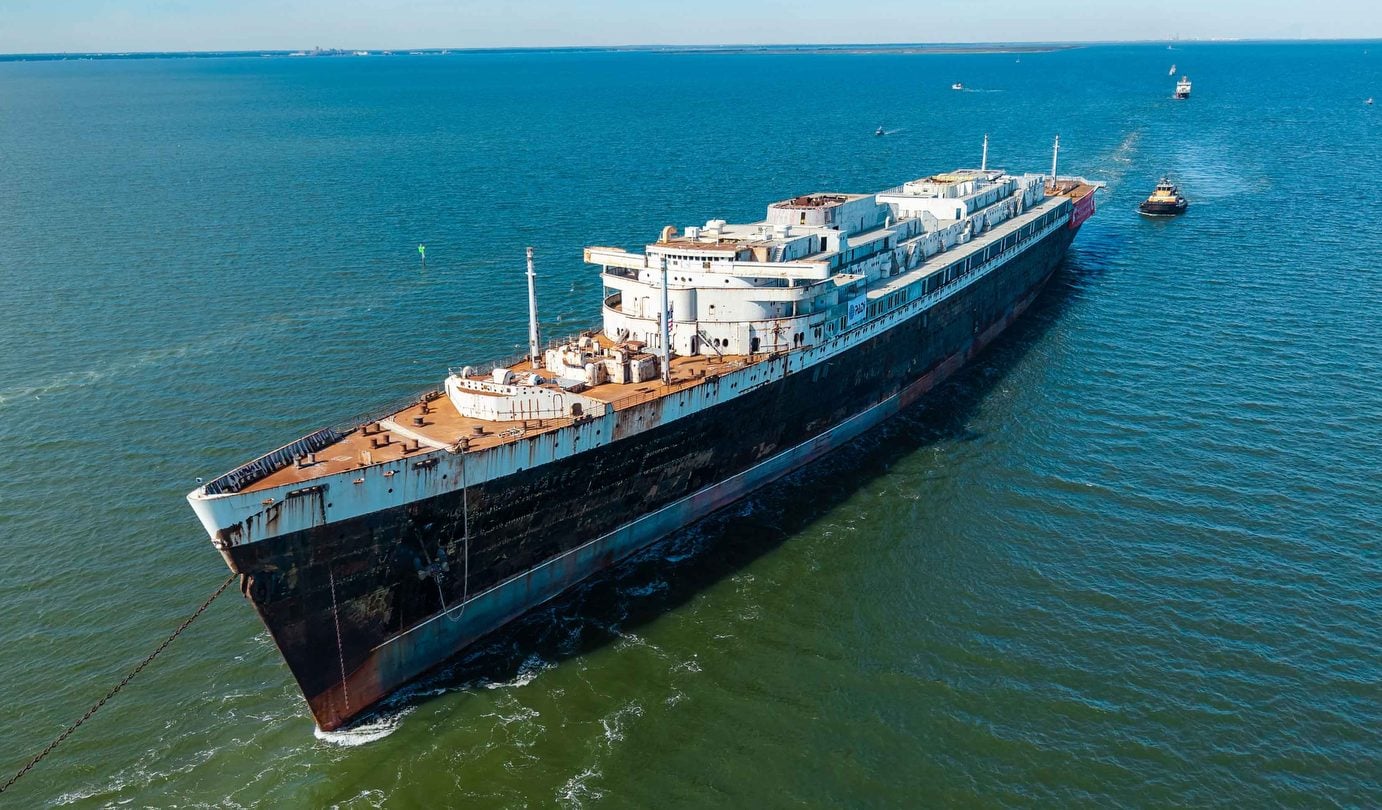
Workers opened water valves on the SS United States in the Gulf of Mexico on Wednesday afternoon, beginning the deliberate sinking that transforms the mid-century ocean liner into the world’s largest artificial reef.
A fleet of five tugboats moved the ship from Mobile, Alabama, to a site about 25 miles southwest of Destin, Florida, where crews prepared the vessel for scuttling.
Federal environmental and explosives rules barred workers from using demolition charges, prompting contractors to remove water-cooling tanks, cut ten-foot-square openings across internal decks, and take out more than 400 portholes. Organizers had moved the schedule forward by a day due to incoming forecasts of heavy winds and unsafe weather.
An official on the livestream operated by the city noted the deployment’s start, stating “Two of the valves have been opened. The deployment process has started,” according to broadcast coverage.
Okaloosa County Board Chairman Trey Goodwin stated in a release that safety is a top priority, adding that the weather change provided a meaningful date for the historic occasion.
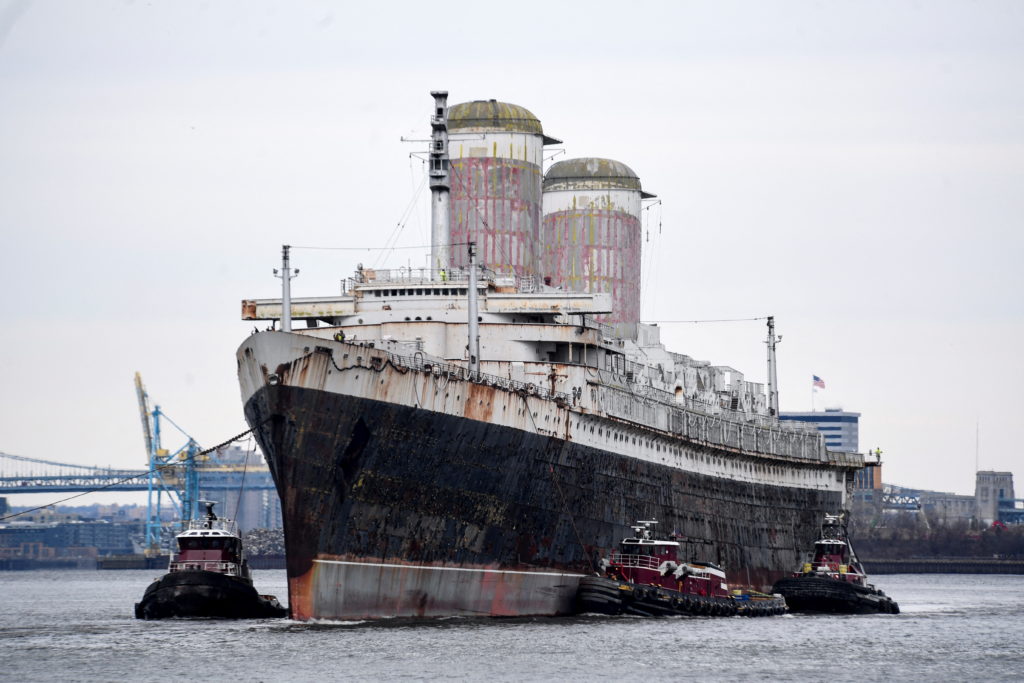
Built by more than 3,000 workers in Virginia in 1950 and 1951, the 990-foot ship measured 108 feet longer than the Titanic and featured a hull made of two-inch-thick, battle-grade steel.
Its maiden voyage in July 1952 set a transatlantic speed record of three days, ten hours, and forty minutes at an average of nearly 36 knots, besting the RMS Queen Mary. The vessel carried presidents and Hollywood stars before commercial air travel rendered it economically unviable.
Among the notable figures who traveled on board in its early decades were President John F. Kennedy, former King Edward VIII, Grace Kelly, Elizabeth Taylor, and Salvador Dali. Future president Bill Clinton also took the ship when traveling to Oxford University in 1968. On its first voyage, 1,700 passengers included an Associated Press reporter and President Harry Truman’s daughter, Margaret.
Withdrawn from service by United States Lines in 1969, the ship spent nearly three decades docked at Philadelphia’s Pier 82. After port authorities doubled daily dockage fees to $1,700 in 2021, the conservancy said it could not afford the amount, leaving the vessel destined for the scrap yard until Okaloosa County purchased it for $1 million in 2024.
The multi-million-dollar project to clean, remediate, tow, and submerge the vessel totaled roughly $13.5 million. Funding included $1.5 million from Pensacola tourism officials and $500,000 from Coastal Conservation Association Florida.
While preservationists sought to establish a floating hotel or museum, high costs and legal battles stalled those efforts. The SS United States Conservancy ultimately supported the transfer to Florida.

It was our goal to make sure that she wasn’t lost forever.
David Lawrence, SS United States Conservancy board member
Susan Gibbs, granddaughter of the ship’s designer William Francis Gibbs, expressed gratitude regarding the preservation of parts of the vessel.
While she will soon rest beneath the waves, her story will live on.
Susan Gibbs
The vessel settled on the sandy floor at a depth of roughly 180 feet, with its top decks resting approximately 55 to 60 feet below the surface to accommodate beginner and experienced scuba divers.
Okaloosa County officials said that the site joins about 500 existing artificial structures in the region. The new reef will join the USS Oriskany, a 911-foot aircraft carrier sunk as a dive site in 2006.
Project organizers salvaged the ship’s twin 65-foot smokestacks prior to scuttling. Those structures will anchor a planned shore-based museum showcasing artifacts and the history of the transatlantic liner.