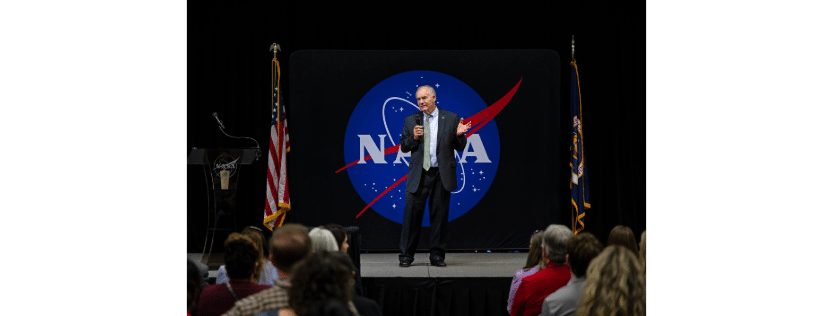
Just a couple of weeks ago, Stephen Cash was a retiree from the Marshall Space Flight Center. Last Monday, that changed when he was named director of the NASA center.
“Some of y’all may be as surprised as I am to be here,” Cash said Tuesday at the opening of the 26th Von Braun Space Exploration Symposium. “I am humbled to be here.”
A Return to the Helm After Four Decades
Having started his professional journey more than 40 years ago at the facility, aerospace executive and veteran NASA engineer Cash came back to assume leadership of the center.
“This is a job I’d do for free,” Cash said. “I appreciate being back at Marshall and with you guys today. What I love about Marshall is we’re truly a family.”
Focusing on Artemis and Sustainable Lunar Infrastructure
Carrying the title “Accelerating Exploration,” the current year’s symposium places a heavy emphasis on advanced space propulsion, sustainable lunar infrastructure, humanity’s return to the moon, and the changing space workforce. The event, hosted on the University of Alabama in Huntsville campus, is organized by the American Astronautical Society in collaboration with the Marshall Space Flight Center.
UAH President Donald Leo noted that the university serves a specific role in supporting these federal initiatives. “UAH was founded to move the nation’s space mission forward,” Leo said. “We’ve always been a bridge from government and academia to the space industry.”
Shifting Operations for an Agile Space Program
In his first public appearance since being named Marshall director, Cash addressed the operational shifts currently underway at the agency as it prepares to return to the moon and beyond.
“We’re making NASA more agile,” Cash said. “We’ve been doing the same thing for a long time and we need to be doing it differently.”
Laying Out the Industry Priorities
Ron Birk, president of the American Astronautical Society, pointed to a broader industry checklist during the opening sessions. “We are at a pivotal time in space exploration,” Birk said. “We need to continue to look forward.” Birk outlined a “slate of eight” priorities for the space program, encompassing commercial space, space traffic management, human space experience, and space nuclear power and propulsion.
Sessions and events on the symposium schedule include discussions on Artemis II and III, space propulsion flash talks, establishing utilities and infrastructure for sustainable lunar operations, supply chain resilience for moon bases, space nuclear technology, oversight of the new NASA workforce, and engineering the future, along with awards presentations and keynotes.
Closing out his remarks on Tuesday, Cash emphasized that accelerating exploration depends on strong partnerships among government, academia, and industry. “I want to be a part of this,” Cash said regarding the return to the moon. “That’s one of the reasons I came back. I’ve been in this business 46 years; it’s all about partnerships. If anyone wants to talk, my office is always open.”