The 4,000-Year-Old Alpine Village Shattering Rocky Mountain History
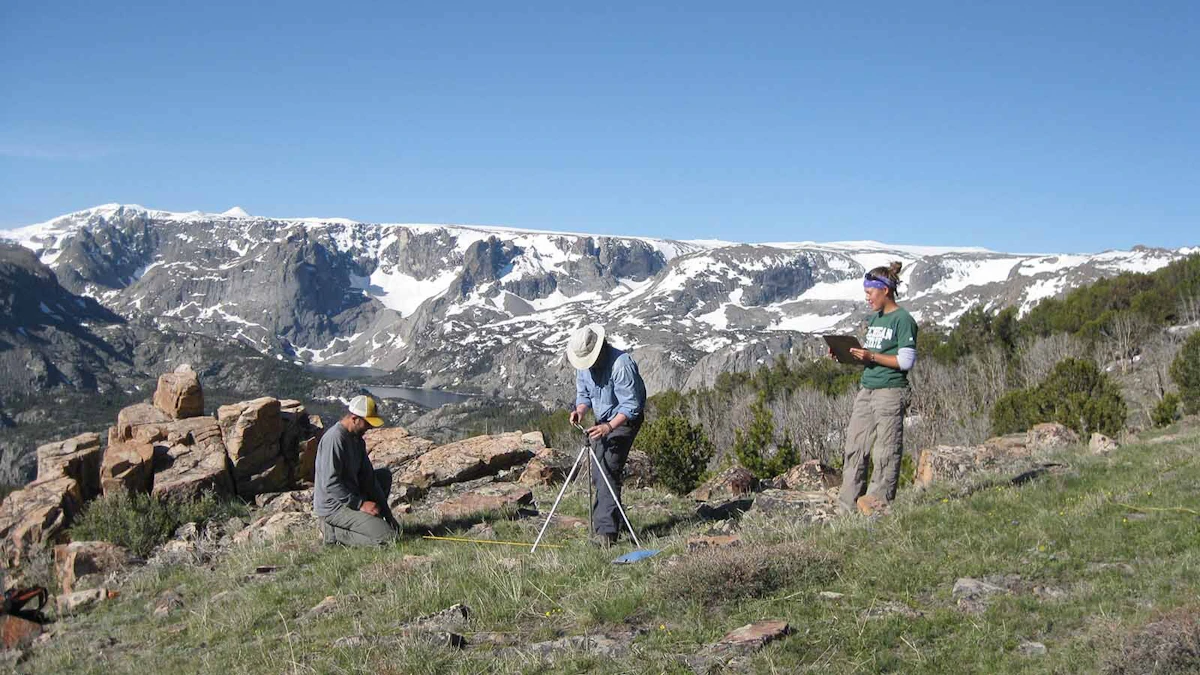
Imagine stopping for lunch on a jagged mountainside and realizing you are standing right in someone’s ancient front yard. That exact realization hit Wyoming archaeologist Richard Adams on a summer day in 2006, when he and a research team were surveying the rugged Wind River Range south of Dubois. As cowboystatedaily.com reported, a routine breather near a mountain spring turned into a historical pivot point when Adams spotted an unusually smooth sandstone surface. It was a metate, worn down by generations of domestic food preparation.
Then collaborator Tory Taylor found a projectile point. Moments later, Joyce Evans pointed out a circular depression in the earth. Adams was standing directly inside an ancient stone circle, but it was no ordinary teepee ring. It was a structured cut-and-fill lodge, meticulously dug out on the high side, reinforced with rock and timber on the low side, and designed to withstand brutal alpine elements.
That single discovery unlocked a sprawling prehistoric settlement that would fundamentally rewrite the timeline of human survival in the Rocky Mountains. By the end of that first day, the team located 28 lodge pads. By the following day, that number doubled to 60. The High Rise Village eventually spanned 26 acres, cementing its status as the largest alpine village ever documented in North America.
Challenging Long-Held Mountain Assumptions
For generations, archaeological consensus held that high-elevation environments in the American West were far too hostile for extended, semi-permanent human habitation. Traditional theories argued that ancient groups only ventured into the high country during brief summer windows under extreme population pressure or food scarcity. High Rise shattered that model completely.

Radiocarbon testing of charcoal pulled from the lodge sites yielded dates reaching back 4,000 years. While inhabitants could theoretically have burned older, deadfall wood, the sheer scale of the architecture points to deliberate, recurrent occupation. People were not just fleeing into the mountains out of desperation; they were being drawn there by abundance.
Well-known archaeologists have argued that the ancestors of the Shoshone were pushed up there by an influx of people into Wyoming,
Adams told cowboystatedaily.com. I argue the opposite, that people were pulled into the mountains because it’s a whole lot better. Millions of people don’t flock to Wamsutter every year to see it, but they sure do go to the mountains.
An Ecosystem of Alpine Abundance
The geography of the Wind River site explains the historical attraction. Situated well above 11,000 feet, the alpine villages were flanked by reliable water springs and an influx of seasonal wild game, including bighorn sheep and elk. Summer brought edible roots and berries, while autumn provided a rich harvest of pine nuts from whitebark pines.

I’ve done experiments with students, and you can shell a cupful — although it’s hard, because they’re really tasty,
Adams said. They’re every bit as good as the pine nuts you get at Costco.
This seasonal round allowed ancient populations to exploit high-altitude resources systematically. Following the 2006 discovery, undergraduate student Matt Stirn developed a predictive computer model factoring in elevation, slope, sun exposure, and vegetation. Fieldwork across 2010 and 2011 validated the model, identifying more than 50 new archaeological sites, including 13 additional alpine villages mirroring High Rise.
The Human Toll of Extreme Archaeology
Uncovering the Machu Picchu of Wyoming demanded extraordinary physical endurance. High Rise earned its evocative name from the staggering 300-foot vertical drop between its lowest and highest lodge sites—the equivalent of a 30-story apartment building perched in thin air.

Researchers routinely hiked ten miles a day up steep, unforgiving terrain at elevations reaching 11,000 feet. Heavy field equipment had to be packed in via stringers of horses because the site sat squarely within a designated wilderness area. Lacking institutional grants during the early phases of the project, Adams financed much of the pioneering fieldwork himself on a Visa credit card.
Because funding remained tight, much of the High Rise site remains intentionally untouched. Adams deliberately left structural segments and potential trade artifacts undisturbed, preserving a pristine archaeological window for future, better-funded teams to study the critical transition from pedestrian lifestyles to equestrian cultures, and ultimately to the reservation era.
Twenty years after that initial lunch break near a mountain spring, the photograph from the day of discovery remains Adams’s computer screensaver. High up in the Wind River Range, the silent stone circles continue to watch over the alpine terrain, holding the enduring secrets of a people who mastered life 11,000 feet above sea level.