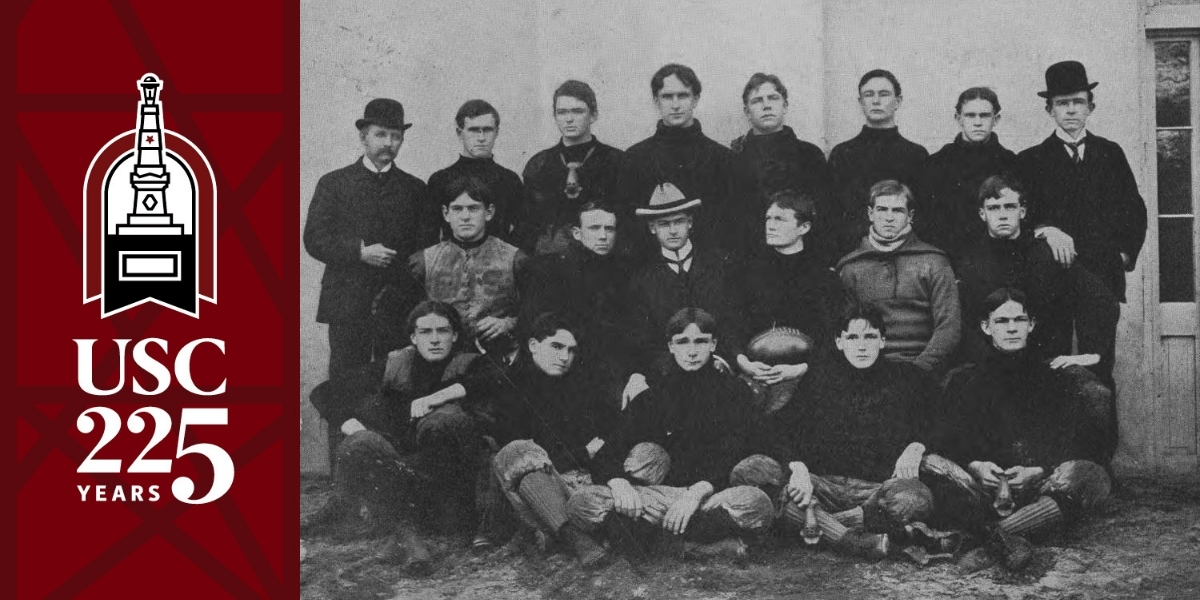
The modern image of University of South Carolina football—defined by the roar of Williams-Brice Stadium and the rhythmic intensity of “Sandstorm”—stands in stark contrast to its chaotic, amateur beginnings. Long before the program became a powerhouse, it was a struggle for legitimacy where players paid their own train fare and some hid their identities to avoid parental wrath, as detailed in a historical retrospective reported by the University of South Carolina.
The Era of the College Boys
The program’s origin story is far from the polished professionalism of the current era. According to historian Daniel Walker Hollis in his 1956 work, The University of South Carolina, Volume II: College to University, the university’s first intercollegiate football game took place on Christmas Eve in a Charleston baseball park. The squad, dubbed the “College Boys” by the News and Courier, lacked a coach and a formal name.
The result was a disaster. The College Boys surrendered 44 unanswered points to Furman, a team known as the “Mountain Boys” who benefited from actual practice and a coach—professor H.P. Young—who also played quarterback. The stakes were purely personal; players funded their own travel to the “Holy City,” and the atmosphere was one of tentative experimentation rather than established tradition.
Fear of the sport was a tangible reality for students. Hollis notes that one athlete, Singleton Green, played under an assumed name because his father was opposed to football. This was not an isolated sentiment. While the university magazine, Carolinian, championed the gridiron, other writers at the time lamented that few colleges in the state took as little interest in athletics as South Carolina did.
President Woodrow Resists Varsity Teams to Protect Student Experience
The struggle to grow the program wasn’t just about talent; it was a fight against the university’s own leadership. Before 1895, the trustees prohibited any sporting events played outside of Columbia, effectively banning official travel. This policy was rooted in the philosophy of President James Woodrow, who viewed sports through a strictly egalitarian lens.
Woodrow feared that “picked groups”—the precursors to modern varsity teams—would prioritize fame and “gate money” over the general student experience. In a November 16, 1892, meeting with trustees, Woodrow argued that athletics should be for all students, not for elite “crews” or “nines” wandering the country for laurels. In a world of modern Name, Image, and Likeness (NIL) deals, Woodrow’s vision of sports as a non-commercial, intramural activity seems an ancient relic, yet it was the dominant administrative philosophy of the 1890s.
The impact of this restriction was felt immediately. On November 3, 1894, the “S.C.C. Boys” hosted the University of Georgia at the state fairgrounds on Elmwood Avenue. Despite the home-field advantage, Carolina was shut out 40-0. The program remained in a state of stunted growth until vocal faculty members finally convinced the trustees to allow travel in 1895.
The Birth of the Palmetto Rivalry
The transition toward a competitive program began not with football, but with baseball. The “Carolina Nine” made their first real road trip in the spring of 1896, beating Furman in Greenville. These early trips began to cultivate a dedicated fanbase; Carolinian reports that students from Converse College attended a game in Spartanburg wearing garnet and black, signaling the start of the university’s visual branding.
Football finally found its footing in the fall of 1896 with the arrival of W.H. “Dixie” Whaley, a former star from the University of Virginia. Whaley provided the tactical leadership the program had lacked for years. His arrival coincided with the first meeting between Carolina and Clemson, an event Hollis described as “the gaudiest spectacle in South Carolina.”
Two thousand fans paid 25 cents each to watch the matchup at the Elmwood fairgrounds. Whaley’s squad defeated Walter Riggs’ Clemson team 12-6, changing the program's direction. This single victory transformed the program from a punchline into a competitor and established a rivalry that remains a cornerstone of South Carolina culture.
The physical home of the team eventually shifted to what is now Williams-Brice Stadium. The original structure was built in 1934, funded by the federal Works Project Administration and known then as Columbia Municipal Stadium. The journey from a nameless squad paying their own train fare to a federally funded stadium reflects the broader American shift toward the professionalization and commercialization of college sports.

Ultimately, the “College Boys” were defined by a willingness to play despite having no coach, no funding, and an administration that viewed their ambition as a distraction.



