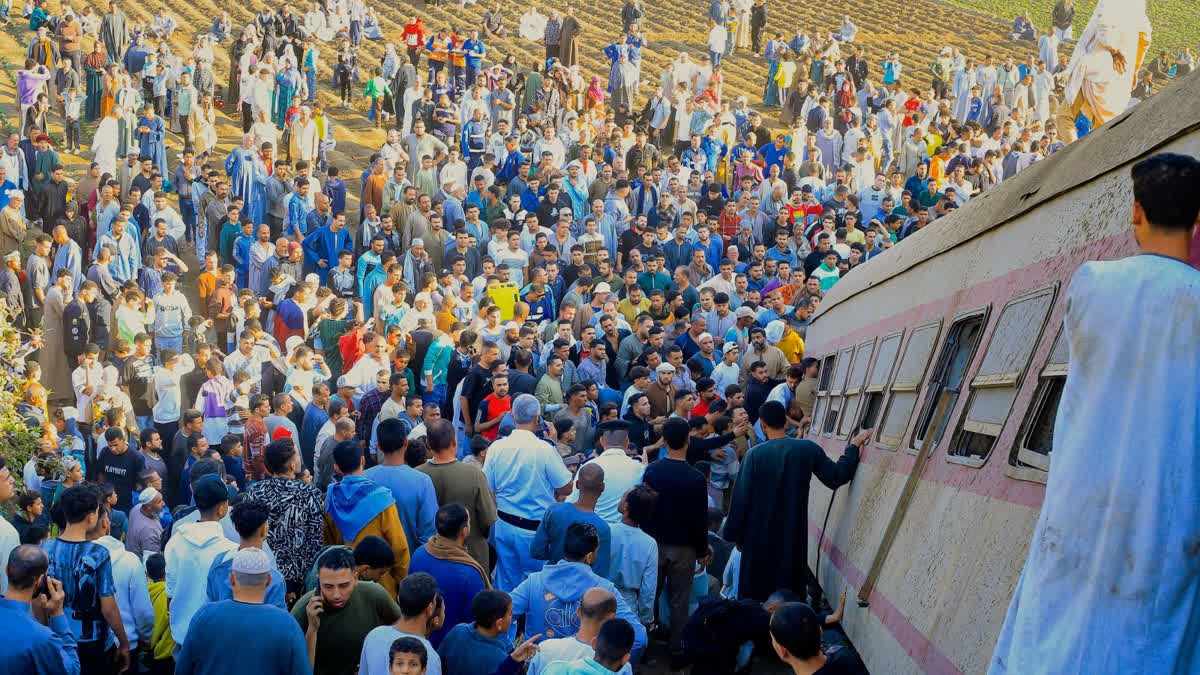
Seven people died and 125 others sustained injuries when two passenger trains collided south of Cairo on Sunday, November 8, 2026.
The collision occurred in the al-Ayyat district of Giza province, roughly 52 kilometers south of the Egyptian capital, according to the country’s Health Ministry.
The crash involved a train traveling from Giza to Fayoum that struck the rear of a stationary Cairo-to-Aswan train on the same track. The Egyptian National Railways Authority reported that several carriages derailed between the Kafr Ammar and Al-Raqqa stations, disrupting service on the main rail artery linking Cairo to southern Egypt.
Local residents rushed to the tracks following the impact. There were other cars that were completely mangled,
, said in an interview published by Etvbharat. Survivors described passengers struggling to breathe amid dust kicked up by the impact before nearby villagers pulled them from the wreckage.
Ayman Gamal, a resident of Kafr Girza in al-Ayyat where the crash happened, recounted how people living nearby rushed directly to the site to pull survivors from the wreckage and dial for ambulances.
Officials stated that the incident happened when the Giza-Fayyoum service struck the rear carriage of the stationary Cairo-Aswan train, which was positioned on the identical rail line and heading in the same direction. Some passengers were trapped inside that carriage and were already dead when rescuers pulled them out.
The Health Ministry dispatched ambulances and rescue crews to the site immediately after the crash, deploying a total of 72 ambulances to transport the injured to nearby medical facilities in Al-Ayyat, Al-Wasta, and Atfih. Health authorities confirmed that 71 of the injured patients recovered sufficiently to be discharged, while the remaining patients were still being treated.
The Ministry of Social Solidarity mobilized the Egyptian Red Crescent alongside other relief organizations to support operations at the scene and assist affected families. Meanwhile, the state railway operator dispatched heavy cranes and emergency repair crews to clear debris and inspect the track before attempting to restore normal service.
Directives were also issued for appropriate bodies to swiftly investigate the root cause of the disaster, with the added warning that any proven negligence would lead to strict penalties for those at fault, as those responsible would be held strictly accountable.

The train’s conductor was among the dead.
In September, a train driver and his assistant were injured after two freight trains collided in the same district of al-Ayyat, though nobody died. The area previously witnessed one of the worst rail disasters in the country’s history in 2002, when a fire broke out on an overnight train journeying from Cairo to southern Egypt, killing more than 300 people.
Twenty-five individuals lost their lives during 2019 when an unmanned locomotive smashed into the protective barriers at Ramses station in Cairo and triggered a blaze. In 2009, another collision at al-Ayyat killed dozens of people. The government has announced modernization plans in recent years, yet in a country of more than 110 million people, the deterioration of the existing rail network remains an unresolved challenge.