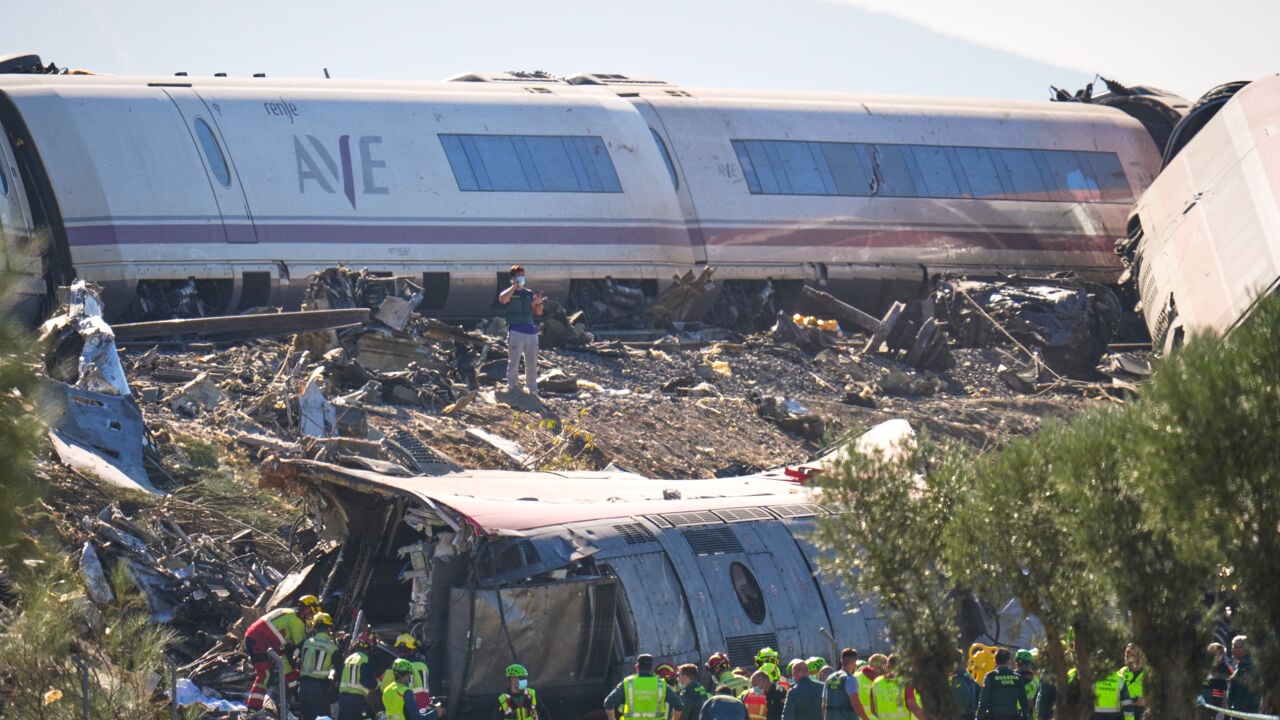
Two high-speed trains carrying nearly 500 passengers collided near Urda in Toledo on Wednesday, leaving at least 69 people dead and roughly 60 hospitalized. Leaked audio recordings point to a human error by traffic control, which ordered the trains to proceed at normal speed despite an active safety system failure.
The disaster unfolded on Wednesday morning around 08:54 in the Spanish province of Toledo, between the towns of Los Yébenes and Urda. Two high-speed trains — an AVE service operated by Renfe carrying 397 passengers, and an Iryo train carrying 147 passengers — collided after a technical failure crippled station Urda’s signaling network.
Emergency crews spent the entire night searching through the wreckage under the glare of construction lamps, utilizing heavy machinery to cut into the twisted metal of derailed wagons. The official death toll stands at 69, with approximately 60 victims receiving hospital treatment for their injuries. Authorities have not yet confirmed how many passengers remain unaccounted for.
Audio Evidence Points to Traffic Control Protocols
Audio transcripts and recordings obtained by investigative journalists reveal a breakdown in communication and protocol inside the traffic control center. Following the initial LZB safety system failure at station Urda, dispatchers instructed both train operators to bypass the automated safety controls and resume travel at normal speed under an alternative protection system known as BSL.
Onder normale snelheid?
AVE train machinist, via NOS
The dispatcher answered affirmatively. Minutes later, the Iryo train driver radioed in to report that her train was still stationary at the Urda signal because the LZB system restart had been denied. The dispatcher handling the call failed to connect the overlapping reports, responding simply with instructions to let them know if problems persisted. Barely five minutes later, the AVE train plowed into the stationary Iryo service at high speed.
Minister Puente Defends Railway Safety Standards
Transport Minister Puente condemned the dispatchers’ instructions as incomprehensible during a public briefing, noting that procedures strictly demand a maximum speed of 40 kilometers per hour to allow a machinist to stop for obstacles when automated signals fail.
No decision is made to travel at an adjusted speed. That is a speed at which the machinist can still stop the train if there is an obstacle on the track, a maximum of 40 kilometers per hour. Minister
Despite mounting public fury, Puente insisted that the national railway network adheres to rigorous standards.
There are systems, rules, protocols. Mistakes can happen, but I want to emphasize that our railways are just as safe as in surrounding countries. Minister
Investigators from the Spanish police have initiated formal interrogations of all personnel present in the control room during the disaster.
Spain Declares Mourning as Sports Matches Are Canceled
In response to the tragedy, the Spanish government declared three days of nationwide mourning. Major sports institutions also halted operations, with the Royal Spanish Football Federation canceling all 24 Copa del Rey matches scheduled for Wednesday. Fixtures involving clubs such as Real Betis, Valencia, and Celta de Vigo were postponed, while top-flight clubs including Real Madrid, FC Barcelona, and Atlético Madrid issued formal statements of condolence.
Meanwhile, passenger chaos rippled through transport hubs like Madrid’s Atocha station, where crowds queued outside Renfe offices to secure ticket refunds. Staff used megaphones to inform travelers that refunds would be honored up to three months after purchase, though no immediate alternative rail transport was available. For passengers facing urgent travel, railway personnel advised relying on pre-scheduled buses, private ride services, or commercial flights.