
The federal government released three historical files from the U.S. Forest Service’s so-called “Bigfoot/Sasquatch Records” on October 15, bringing decades of internal correspondence and field investigation reports into public view.
The 1982 Mill Creek Watershed Investigation
The most detailed operational file in the release documents a June 1982 investigation by the U.S. Forest Service in the Mill Creek Watershed of Umatilla National Forest. USDA officials tasked wildlife biologist Rodney L. Johnson with examining reported footprints discovered across three different sites along Low Creek and Low Ridge.
The investigation was initiated on June 17, 1982, after reports of tracks were flagged to the agency. Site “A,” located approximately 1.5 miles above Mill Creek, contained six identifiable tracks that extended along a muddy trail for roughly 25 feet.
Investigators took color photographs and produced plaster casts of several impressions. Johnson recorded right-foot prints measuring approximately 15 inches long and 7 inches wide at the widest point, noting that forest litter near the tracks showed obvious signs of having been brushed aside beforehand.
The biologist observed that the tracks extended into thick brush, where vegetation was disturbed for another 30 to 40 feet, indicating the passage of something. He specifically noted a deformation of the second toe on one footprint, though he observed that the small toes lacked a definite pad at the tips, which he expected to see if a foot were rotating forward and gripping the ground.
Disagreement Among Federal Investigators
While Johnson acknowledged that the craftsmanship involved would make the prints very hard to duplicate, he ultimately concluded that the physical evidence did not point to a living biological creature. Johnson concluded in his six-page memo that the marks were made by something other than a heavy bipedal being, citing a stride that did not change with slope and boot impressions that sank deeper into the mud than the purported Sasquatch foot.

He noted that the tracks appeared to have been rocked back and forth to create the imprints. He further observed that the stride remained roughly four feet across different slopes and that some impressions appeared isolated rather than forming a continuous trail.
“It is my opinion that the tracks observed … were made by something other than a 300 pound plus two footed being,” said Paul Freeman, Watershed rider.
A U.S. Border Patrol tracker, Joel Hardin, examined the site and reached an even more definitive conclusion in a memorandum dated July 28, 1982. Hardin wrote to the Forest Service that the tracks were a very clever attempt to penetrate a hoax created using a soft-plaster or rubber-coated artificial foot, intended to lend credibility to the creature’s existence in the eyes of the public.
After a brief field discussion, the four men present agreed they had no interest in following the trail to its source and opted to turn back.
Historical Montana Accounts in the File
Beyond the Oregon and Washington border region, the agency’s released bundle includes archival accounts from western Montana dating back to the 1940s. One document preserves a typewritten report by Leo T. Kinney, who was a longtime resident familiar with the Petty Creek and Alberton area.
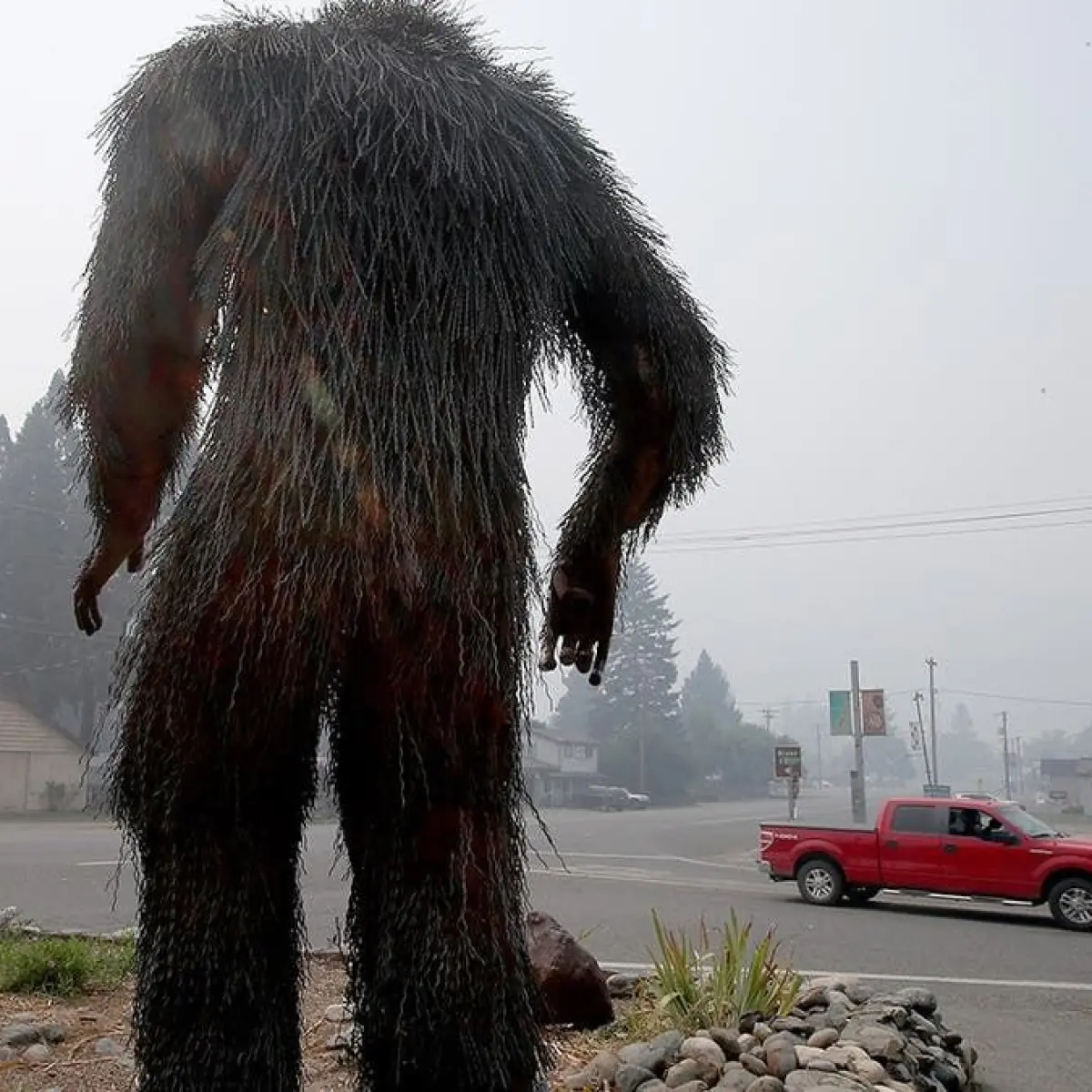
Kinney described an encounter from 1941 where he and three other hunters found massive tracks near a harvested six-point bull elk carcass. He reported that whatever had taken the elk had picked it up whole and clear off the ground. The party also reported hearing loud grunting noises and smelling a strong odor.
“At this point we held a conference and decided that we were not particularly anxious to catch up to whatever it was, and though we didn’t confess it at this time, in later conversations we found out that we all had a very uneasy feeling and could feel chills running up and down our backs,” Kinney said.
The files also include a reference to a man named Schmitz, who reported finding similar tracks, smelling a strong odor, and hearing grunting noises while hunting in the nearby Bills Creek area.
A separate news clipping from the Clark Fork Valley Press details a January 2003 discovery in Plains, Montana, where residents measured hundreds of snow prints spanning 16.5 inches long and 8.5 inches wide before rain washed them away. In that instance, witnesses estimated the creature might weigh between 800 and 1,000 pounds, though no physical measurement confirmed that figure.
Investigators Question Evidence of Biological Origin
Rodney L. Johnson documented several inconsistencies that led him to doubt the authenticity of the tracks. He noted that the stride remained consistent regardless of the steepness of the terrain, and there was no evidence of heel or toe slippage on the gradient.

These observations suggested to the biologist that the imprints were likely manufactured, though he admitted that if the tracks were faked, the creator went to a great deal of trouble and detail.
Other investigators highlighted the lack of tracks leading into or away from the sites, which they found highly unusual. Border Patrol tracker Joel Hardin argued that the fixed spacing and pressure patterns indicated the use of artificial tools, such as rubber-coated feet.
Montana Hunters Encounter Unusual Forest Activity
The files also detail a disturbing 1940s incident near Petty Creek, Montana, reported by Leo T. Kinney. The hunters initially suspected a bear had disturbed their site, but they questioned this theory because bears do not typically walk on their hind legs for extended distances or carry heavy carcasses whole.
Kinney wrote that the animal possessed the strength to lift the elk clear off the ground, a feat that left the hunting party feeling uneasy.
The account describes how the group eventually turned back, having no interest in pursuing the source of the sounds and the strong, unpleasant odor they encountered. These Montana records, along with the Oregon investigations, are now listed in the Forest Service’s Freedom of Information Act reading room.
Public Questions Timing of Cryptid File Release
The release of these files has prompted questions regarding the timing of the disclosures. Jeremiah Byron, representing the Bigfoot Society, expressed both skepticism and curiosity regarding why federal agencies were making cryptid-related records available at this time. While the U.S. Forest Service has historically treated such reports as local folklore, the inclusion of these files in an official reading room has led to broader public speculation.
Despite the release, the agency has not taken an official position on whether the creature exists. A spokesperson stated that the USDA posts records online when it expects strong public interest.
Other internal activities have included a forum titled “Bigfoot in Your Backyard,” held in October 2026 at California’s Stanislaus National Forest, where staff members discussed creature-related traits like wood knocking and whistling. The files themselves remain a collection of reports, photographs, and investigator doubts rather than scientific evidence of the creature’s existence.