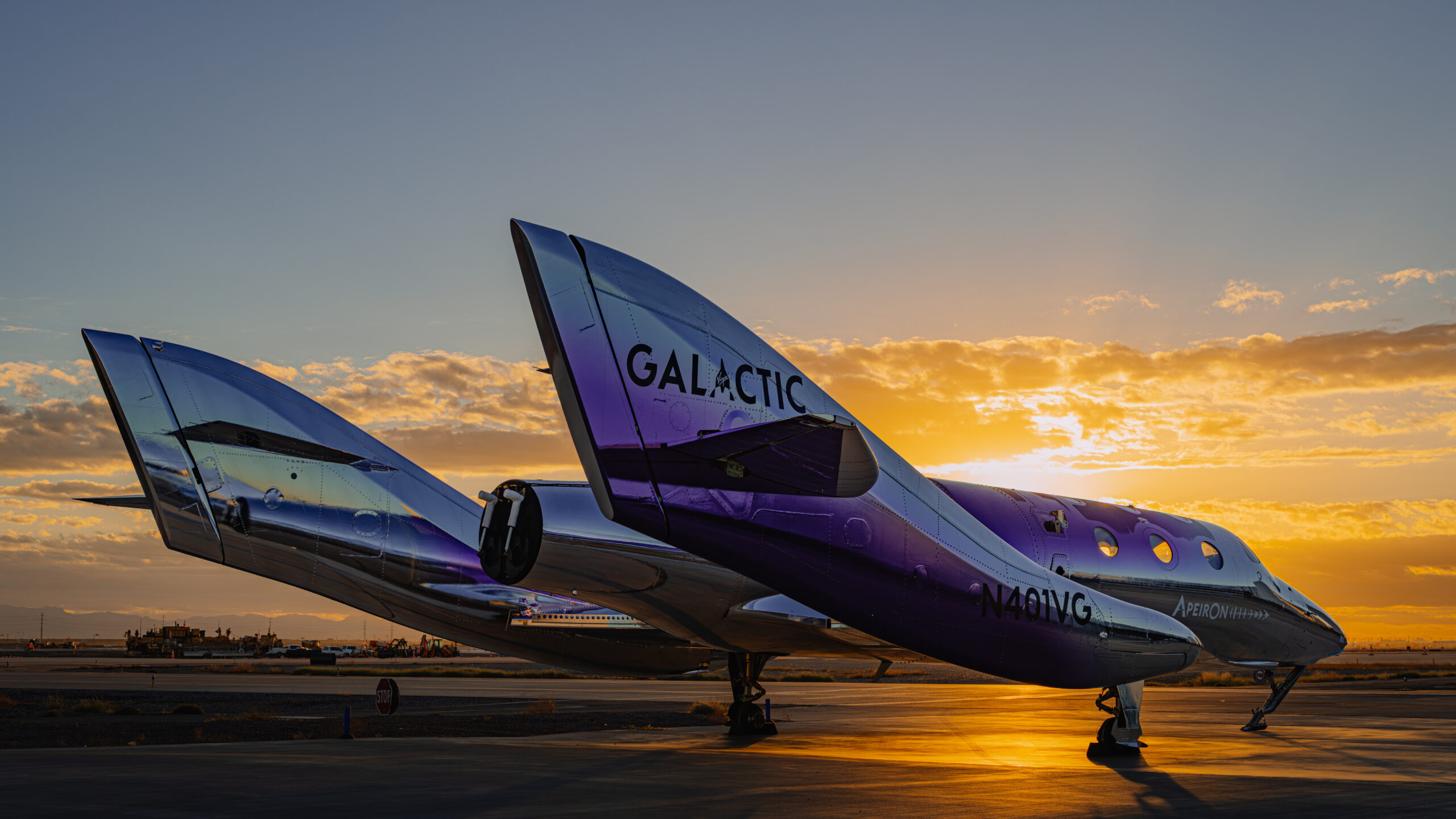
Virgin Galactic has moved its lead “Apeiron” spaceplane from a factory in Mesa, Arizona, to Spaceport America in New Mexico, signaling a concrete step toward resuming commercial flights. While the vehicle won’t fly immediately, the move marks the beginning of a critical testing phase that the company hopes will lead to paying passengers by early 2027.
This development arrives during a period of profound stagnation for the suborbital tourism sector. It has been nearly a year since the last commercial space tourism flight took place, and the industry is currently split between established players fighting for survival and new startups attempting to undercut them on price and reliability. For the wealthy few eyeing the edge of space, the stakes are no longer just about the experience, but whether these companies can actually maintain a safe, repeatable flight cadence.
Apeiron moves to New Mexico for flight software tests
The transition of Apeiron is less of a victory lap and more of a technical migration. Once the vehicle is transported by the VMS Eve aircraft, engineers in New Mexico will focus on the vehicle’s flight software and avionics equipment. The roadmap is methodical: ground tests will lead to captive carry tests, then a drop test, and finally a powered flight exceeding 80 kilometers.
Chief executive officer Michael Colglazier noted that the name Apeiron was chosen by people who share the company’s excitement for the future. However, the timeline for commercial service—slated for the second quarter of 2027—carries a heavy caveat. In the aerospace world, projected dates are notoriously fluid. Even if the 12-to-18-month window for paying customers holds, Virgin Galactic faces a steep climb to prove its commercial viability.
The financial collapse of the space tourism bubble
The contrast between the industry’s hype and its current financial reality is stark. At the peak of the 2021 euphoria, Virgin Galactic’s stock hit a valuation of $1,118 a share. Today, that figure has plummeted to approximately $2.50. Investors have grown weary of a business model that requires flawless durability and high-frequency flights to turn a profit.
JUST IN: Virgin Galactic's $SPCE first next-generation Delta-class spaceplane, named “Apeiron,” has taken flight for the first time.The spacecraft is flying beneath its carrier aircraft, VMS Eve, from Arizona to Spaceport America in New Mexico, where it will begin preparations… https://t.co/bfIZwoWkMu
The sector’s struggles aren’t limited to balance sheets. Technical failures and regulatory hurdles have plagued the leaders. A fatal accident in 2024 grounded the VSS Unity for several months, while Blue Origin’s New Shepard, which resumed flights in 2023, has since paused operations to implement vehicle upgrades.
Stratos Horizon enters the fray with Aurora-1
While Virgin Galactic pivots toward its Delta-class ships, a new contender is attempting to disrupt the market. Stratos Horizon, a startup founded in 2021 by former NASA engineers, recently rolled out its Aurora-1 prototype onto a runway in Mojave, Arizona. Unlike the air-launch system used by Virgin Galactic, Aurora-1 is designed for vertical takeoff and horizontal landing.
Welcome home, Spaceship Apeiron.Our newest spaceship completed its first flight today, from our factory in Mesa to Spaceport America in New Mexico. Details → https://t.co/f91NrhKECf pic.twitter.com/0KLw4tZLeW
A battle of ticket prices and turnaround times
If Stratos Horizon can move beyond the prototype stage, it intends to trigger a price war. The company is targeting a ticket price of $250,000, significantly lower than the $450,000 charged by Virgin Galactic or the $300,000 reported for Blue Origin. To make the math work, Stratos Horizon aims for 50 flights per year by 2027, carrying six passengers per trip.
| Company | Vehicle | Estimated Ticket Price | Flight Profile |
|---|---|---|---|
| Virgin Galactic | Apeiron / Delta-class | $450,000 | Air-launch / Horizontal Landing |
| Blue Origin | New Shepard | $300,000 | Vertical Launch / Vertical Landing |
| Stratos Horizon | Aurora-1 | $250,000 | Vertical Launch / Horizontal Landing |
The skepticism of the aerospace market
There is also the issue of infrastructure. Stratos Horizon plans to operate from Spaceport Arizona, a facility that has struggled to attract tenants since it opened in 2022. While the 12,000-foot runway is ideal for glide tests, the site currently lacks the infrastructure required for high-cadence commercial operations. The company’s plan to invest $50 million in a new hangar and mission control center is contingent on the success of upcoming glide tests.

“We’ve seen what happens when you push too fast with unproven technology,” said Elena Vasquez, CEO of Stratos Horizon. “Aurora-1 is the product of a decade of incremental testing and a refusal to compromise on safety.”
The path forward for both the established giants and the new startups is narrow. To survive, these companies must transition from the “euphoria” of the early 2020s to a boring, predictable operational rhythm. Whether that happens in 2027 or not remains a gamble that investors are increasingly unwilling to take.
The current state of the industry is a far cry from the 2021 peak when Virgin Galactic’s valuation suggested a future of routine space travel for the masses.



