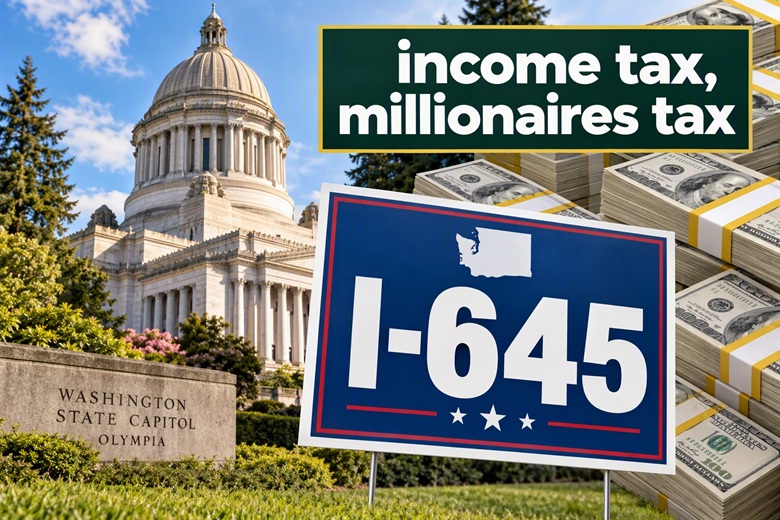
Washington voters face a consequential choice on the November 3 general election ballot regarding Initiative 645, a statewide measure that asks the public to either repeal or maintain a newly enacted 9.9% income tax on earnings above $1 million. The tax itself was passed by the Washington Legislature in March 2026 through Senate Bill 6346, signed into law by Bob Ferguson, and structured to generate an estimated $3 billion for the state treasury during its first operational year. While collections are not scheduled to begin until 2029 based on income earned starting January 1, 2028, the legal and political battle over its existence is coming to a head right now.
The Mechanics of Initiative 645 and the Million-Dollar Threshold
Passed under Senate Bill 6346, the tax targets an estimated 20,000-25,000 households by applying a 9.9% rate exclusively to income remaining after a $1 million deduction. Because the Washington state Constitution prohibits an income tax, the statute immediately sparked intense legal scrutiny. A lawsuit challenging the tax was filed in April, setting the stage for what will likely be a constitutional ruling by the Supreme Court of Washington. Coincidentally, the November 3 ballot also features election contests for five of the nine seats on that very court.
When EverettPost.com reached out to campaigns on both sides of the issue, the groups opposing I-645—specifically the “No 645” campaign and Defend Washington—did not return repeated interview requests over several weeks. Consequently, EverettPost.com proceeded with reporting based on the campaign that did respond: the “Vote Yes on 645” effort, represented by Jamie Herrera-Beutler.
Arguments Over Future Threshold Reductions
Herrera-Beutler argues that voters are being misled about the permanence of the $1 million threshold. She points out that when the Legislature passed the bill in March 2026, majority Democrats rejected several amendments that would have required binding protections to keep the deduction at $1 million or mandate a public vote for any future expansions.
“I think the average person would say, ‘gosh, that doesn’t pass the straight face test’. And that’s the big point,” Herrera-Beutler said during her interview with EverettPost.com, adding that lawmakers “voted to ensure that they could easily expand it without a vote of the people.”
To support her warning that the threshold could drop, Herrera-Beutler highlights recent comments from State Representative Cindy Ryu, a Democrat running for a state Senate seat in Shoreline. During an early October debate on KUOW, Ryu suggested that a fair income tax level might be $250,000 rather than $1 million, remarking, “Let’s take a look at how well can most of us live? Pretty well at $250,000.” Herrera-Beutler notes that top Democratic leadership and the governor offered no public pushback to Ryu’s remarks, treating the silence as an indicator of future policy intent.
Budget Realities and the State Employee Pension Debate
Another major point of contention centers on where the projected $3 billion in annual revenue is directed. Proponents argue the funds will support education and health care, but Herrera-Beutler disputes this, asserting that the legally binding portions of the bill do not explicitly earmark the money for K-12 education or healthcare. She points out that legislative amendments attempting to dedicate specific percentages of the revenue to those programs were voted down.
Herrera-Beutler highlights a structural change tucked into the fine print of the legislation: the removal of long-standing tax protections for public-employee pension funds.
Herrera-Beutler contends that voters are being misled to believe the tax will only apply to millionaires, pointing to a lawmaker suggesting a lower threshold and arguing that lawmakers intend to expand it. A “yes” vote on I-645 repeals the 9.9% income tax entirely, while a “no” vote keeps the tax law in place ahead of its scheduled implementation. Ballots must be postmarked or submitted to a county ballot box by 8 p.m. on November 3.