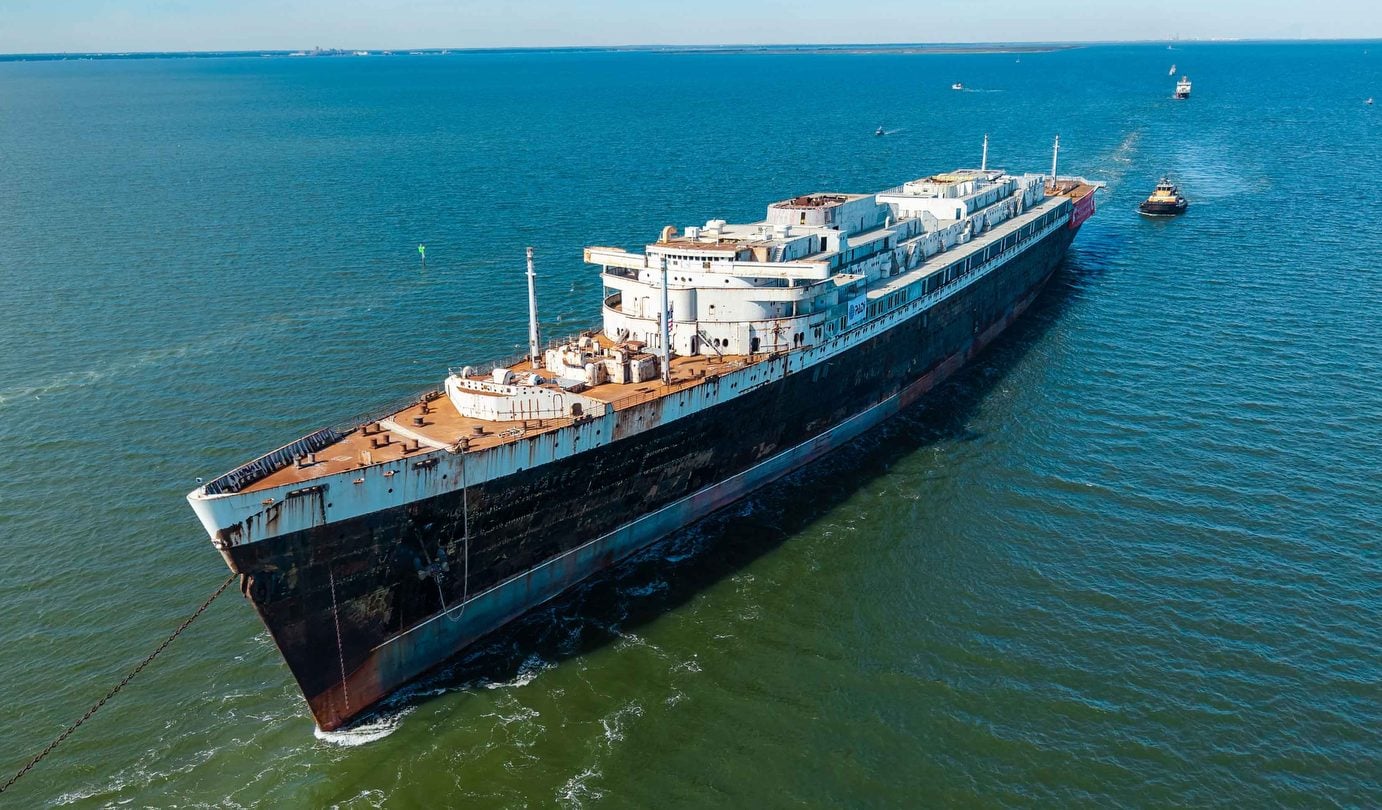
Valves opened Wednesday afternoon off the Florida Panhandle, sending seawater rushing into the hull of the SS United States as crews began scuttling the historic ocean liner to create the world’s largest artificial reef.
Towing From Mobile and the Precision Sinking Operation
A fleet of five tugboats moved the rusting vessel from Mobile, Alabama, on Monday for its journey to a destination 25 miles southwest of Destin, Florida, where it settled in about 180 feet of water. Federal environmental and explosive rules prevented the use of explosives to sink the ship.
Workers instead removed internal tanks and cut large holes into the decks to allow seawater to flood the hull naturally. Concerns about inclement weather prompted officials to move the sinking up by one day from its initially planned date of November 12. Officials confirmed the ship was fully flooded by Wednesday evening.
More than 3,000 workers helped construct the massive liner in Virginia across 1950 and 1951. Measuring approximately 990 feet in length, the vessel features a hull constructed from 2-inch thick, battle-grade steel. Before its final journey to the seafloor, remediation crews spent months removing hazardous materials from the lower compartments and cutting more than 400 portholes.
Tim Mullane, chief operating officer of Coleen Marine—the company tasked with sending the ship to the ocean floor—noted that the structure would serve a second life without destroying anything. Farrell noted during earlier towing operations that the ship remained in remarkably good structural condition despite decades of sitting stagnant.
From Atlantic Speed Record Holder to Artificial Reef
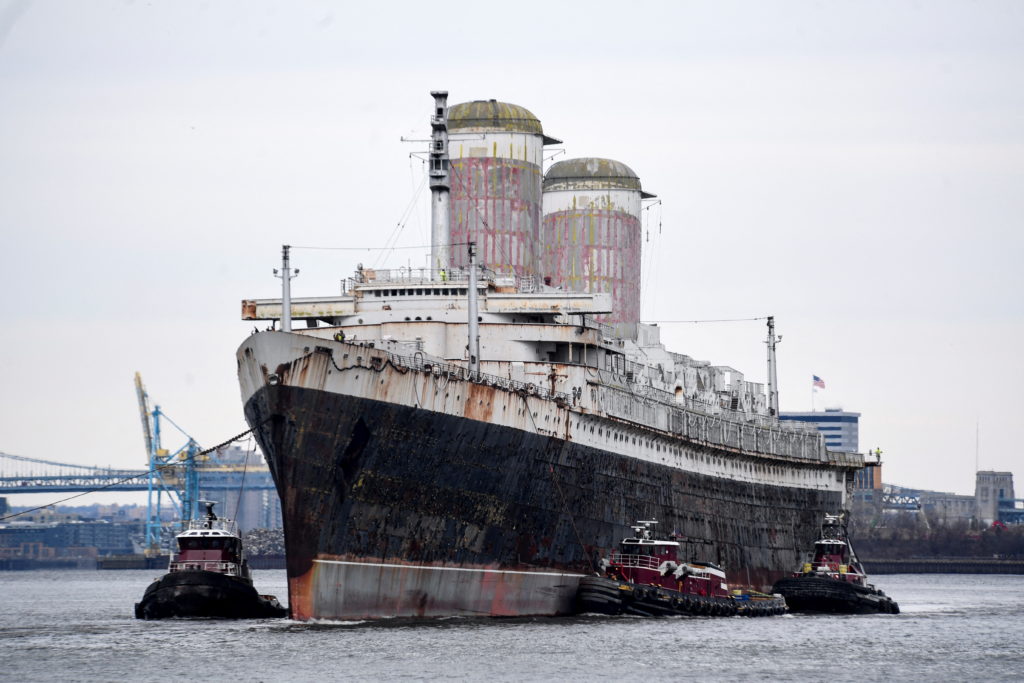
Launched in July 1952, the SS United States captured the transatlantic speed record on its maiden voyage by crossing from New York to Europe in three days, 10 hours and 40 minutes at an average speed of almost 36 knots. The luxury liner measured 990 feet long, surpassing the Titanic in length, and carried presidents, Hollywood stars, and immigrants across the Atlantic.
Among the 1,700 passengers aboard its historic first voyage were an Associated Press reporter and Margaret Truman, daughter of President Harry Truman. Over its commercial lifetime, the vessel ferried notable figures including President John F. Kennedy, former King Edward VIII of Britain, Grace Kelly, and Elizabeth Taylor.
Changing travel trends and high operating costs forced its retirement from commercial service in 1969. The vessel sat docked along Philadelphia’s Delaware River waterfront from 1996 until February 2025, mired in preservation debates and legal disputes over rising docking fees—such as port authorities doubling daily fees to $1,700 in 2021—before Okaloosa County purchased the ship to advance the reef project.
Funding Supports the Reefing Project
The $13.5 million reefing project received backing from multiple sources, including a $1.5 million contribution from Pensacola tourism officials and a $500,000 donation from Coastal Conservation Association Florida. Preservation groups fought to save the ship, culminating in a federal lawsuit filed on November 3 by the SS United States Preservation Foundation against the U.S. Army Corps of Engineers and Okaloosa County.
The suit sought a temporary restraining order and preliminary injunction to halt the tow and sinking, alleging inadequate environmental review regarding hazardous materials such as chromium-bearing coatings. U.S. District Judge M. Casey Rodgers of the Northern District of Florida Pensacola Division denied the emergency motion, allowing the deployment to proceed as planned.
It was our goal to make sure that she wasn’t lost forever.
David Lawrence, board member for the SS United States Conservancy
Marine Habitat Integration and Shore-Based Museum Plans
The submerged liner joins roughly 500 artificial reefs in Okaloosa County waters, sitting near the USS Oriskany, an aircraft carrier scuttled as a dive site in 2006. “This saves the ship from being scrapped for metal or meeting some other demise,” Okaloosa County Commission Chairman Trey Goodwin said.

While the hull rests on the seabed at a depth where its top deck sits roughly 60 feet below the surface—making it accessible to recreational divers—organizers removed the ship’s 65-foot smokestacks to anchor a planned shore-based museum that will feature historical artifacts and the bar from the vessel’s smoking lounge.
“No, it won't be sailing the sea, but it will still be at sea. This honors it. It lives on,” Trey Goodwin, the chairman of the Okaloosa County Commission, told Northeastern Global News.
While she will soon rest beneath the waves, her story will live on.
Susan Gibbs, president of the SS United States Conservancy
Earlier coverage: SS United States Sinking Begins to Become World's Largest Artificial Reef