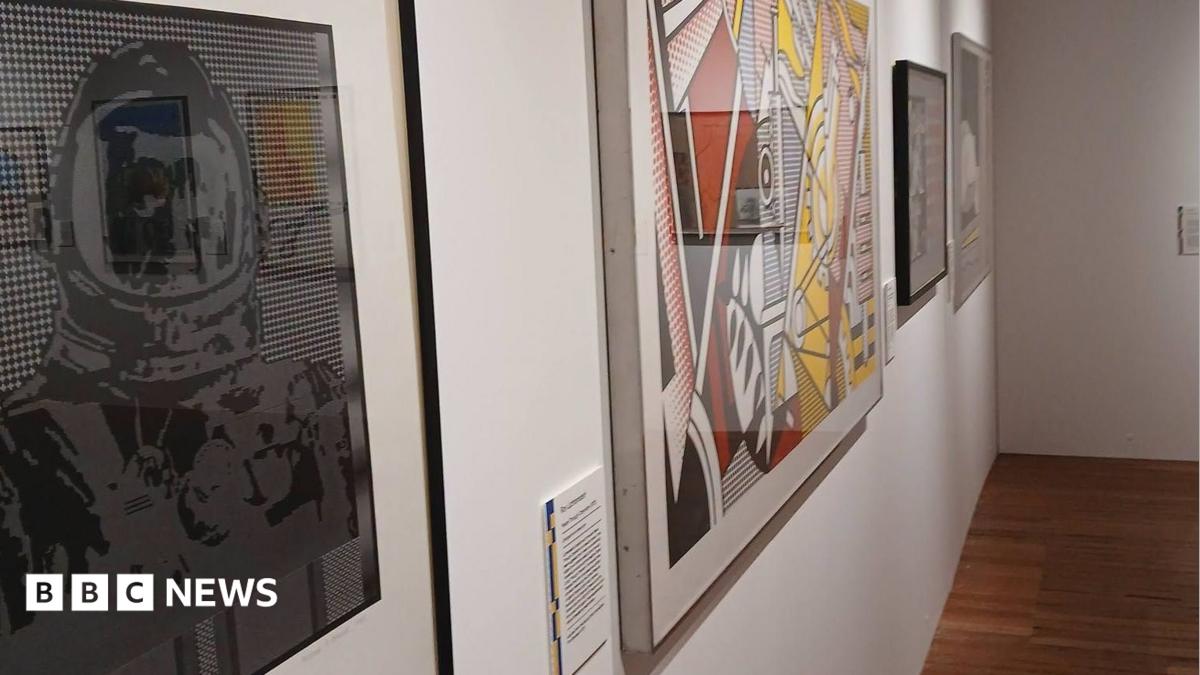
A screen print commissioned by NASA in the early days of space exploration has been uncovered and placed on display at Cartwright Hall in Bradford.
Created in 1962 by artist Michael Fossick, the piece honors the Komtek I, a microcomputer produced by Komtek Technologies Ltd in Hong Kong that helped the early space program. Fossick studied at the Bradford School of Art and was born in Sheffield. His artwork formed part of a broader NASA initiative to document the historic effort to send the first humans to the moon.
In March 1962, NASA administrator James Webb awarded commissions to 38 artists to record the achievements of the space agency. The initiative coincided with rapid milestones in American space flight. John H. Glenn became the first American to orbit the earth on February 20, 1962, setting the stage for the Mercury program, the subsequent Apollo missions, and Neil Armstrong’s historic moon landing in 1969.

Rather than illustrating a rocket launch or an astronaut suit, Fossick focused on the underlying computational technology of the era. He constructed a screen print built from what curator Jill Iredale described as a very early computerized image.
Fossick submitted his piece to the First British International Print Biennale held at Cartwright Hall in 1968, where the work won a prize. The print now takes center stage in the current Pop Art at Cartwright Hall exhibition, which explores the history of the Biennale—an event that ran at the Bradford gallery on 11 occasions between 1968 and 1990. The exhibition is scheduled to run until March 2027.
It’s a completely bizarre sort of connection somehow that an artist born in Sheffield that went to Bradford School of Art was somehow commissioned by Nasa.
Jill Iredale, Curator
At the height of the Biennale, the event gathered more than 500 works selected from over 3,000 entries. The gallery’s permanent collection retains works by prominent artists who participated, including Andy Warhol, Roy Licthenstein, and David Hockney. Hockney served as a judge for the inaugural 1968 biennial and designed its official poster, which is also included in the display.
The explosion of pop art in Bradford arose partly as a cultural reaction to the seriousness of World War II, paired with a sudden expansion in commercial print culture and a surge of post-war youth.
Bradford had quite a strong, experimental kind of light, pretty kind of DIY aesthetic with artists and with the college as well.
Jill Iredale, Curator
The current exhibition features major pop art figures alongside pieces that local audiences may not recognize. Iredale noted that visitors will encounter definitely stuff that people won’t have seen before
as the gallery displays the lesser-known historical threads connecting regional printmakers to international space agencies.