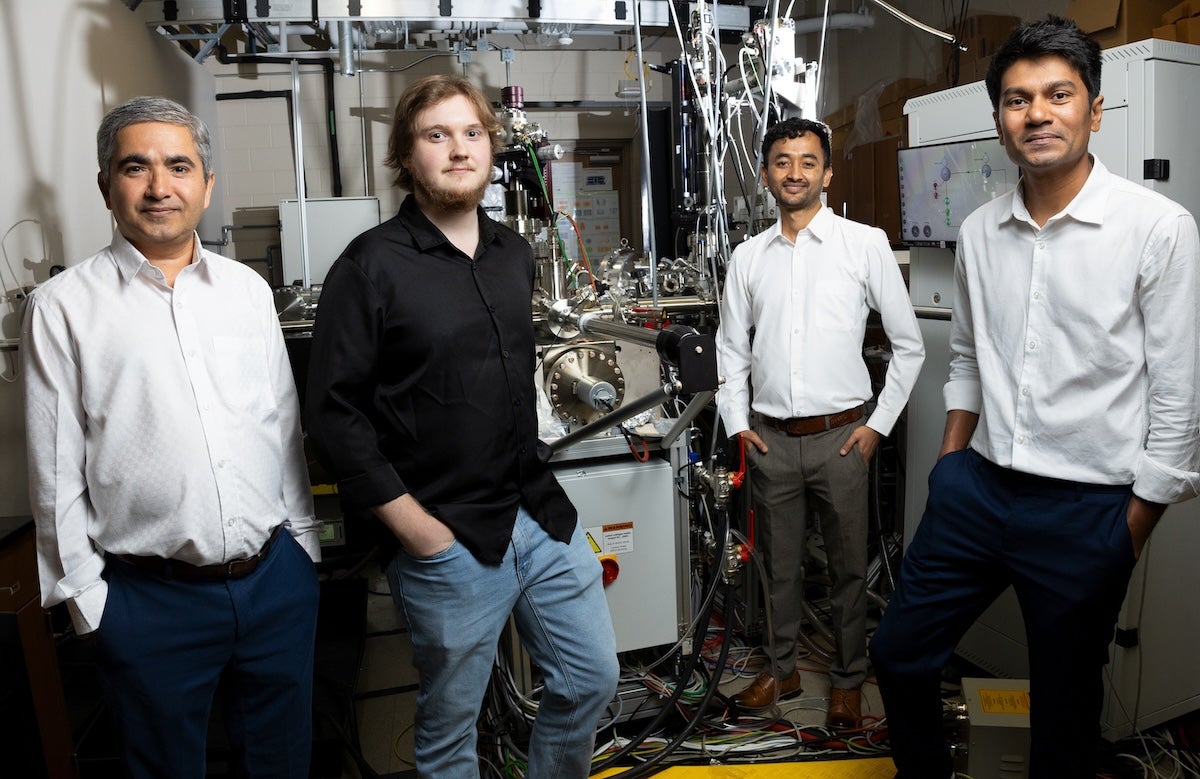
The discovery combines properties of ferromagnetism and antiferromagnetism, offering a promising path toward ultrafast memory devices, spintronics, and energy-efficient electronics without disruptive magnetic fields.
Experimental Evidence of Altermagnetism in Co₁/₄TaSe₂
A team of researchers headed by UCF Professor of Physics Madhab Neupane identified experimental signatures of altermagnetism in a layered material. The findings, published in the journal Nature Communications, demonstrate that this emerging magnetic state bridges two familiar extremes.
Ferromagnetism aligns magnetic moments in the same direction to produce a macroscopic magnetic field, which is useful in hardware but creates stray fields that can interfere with neighboring components. Antiferromagnetism points magnetic moments in opposing directions so they cancel out, successfully avoiding stray fields but sacrificing valuable electronic characteristics.
Altermagnets unite the advantages of both states. Like antiferromagnets, they avoid generating unwanted stray fields, yet they can also generate and detect spin currents—the movement of electron spins through a material—that scientists want to harness for next-generation computing hardware.
Mapping Electronic Structures Through Advanced Spectroscopy
To determine whether Co₁/₄TaSe₂ exhibited altermagnetism, the research group examined electron behavior using angle-resolved photoemission spectroscopy, known as ARPES, to map the material’s electronic structure.
The team first detected a characteristic splitting in the material’s electronic bands. They then applied spin-resolved ARPES to verify whether those split states carried opposite spin polarizations. Because photoemission measurements are extremely sensitive to surface conditions, UCF researchers carefully screened samples for ultra-clean surfaces before mapping behavior. Measurements for the project were performed at national synchrotron facilities, including the Advanced Light Source at Lawrence Berkeley National Laboratory and the Stanford Synchrotron Radiation Lightsource.

Why Layered Materials Matter for Future Computing
Traditional computing hardware relies entirely on the electrical charge of electrons to process and move data. To build the ultrafast computers of the future, scientists are looking beyond charge to electron spin, an intrinsic quantum property that could reinvent how information travels through a circuit.
The material studied by the team, Co₁/₄TaSe₂, is a layered structure containing magnetic cobalt atoms. By combining the absence of stray fields with spin-current capabilities, the discovery opens a promising path toward future spintronics and alternative electronic designs.
Converging Evidence and Practical Applications
The research team gained confidence in their findings once empirical data aligned with theoretical projections.
With independent pieces of evidence converging on a genuine layered altermagnet, the team highlights several broad technological domains suited for the material. According to the published findings, the newly identified properties position these compounds for deployment in spintronics, ultrafast memory devices, terahertz networks, and energy-efficient electronics.