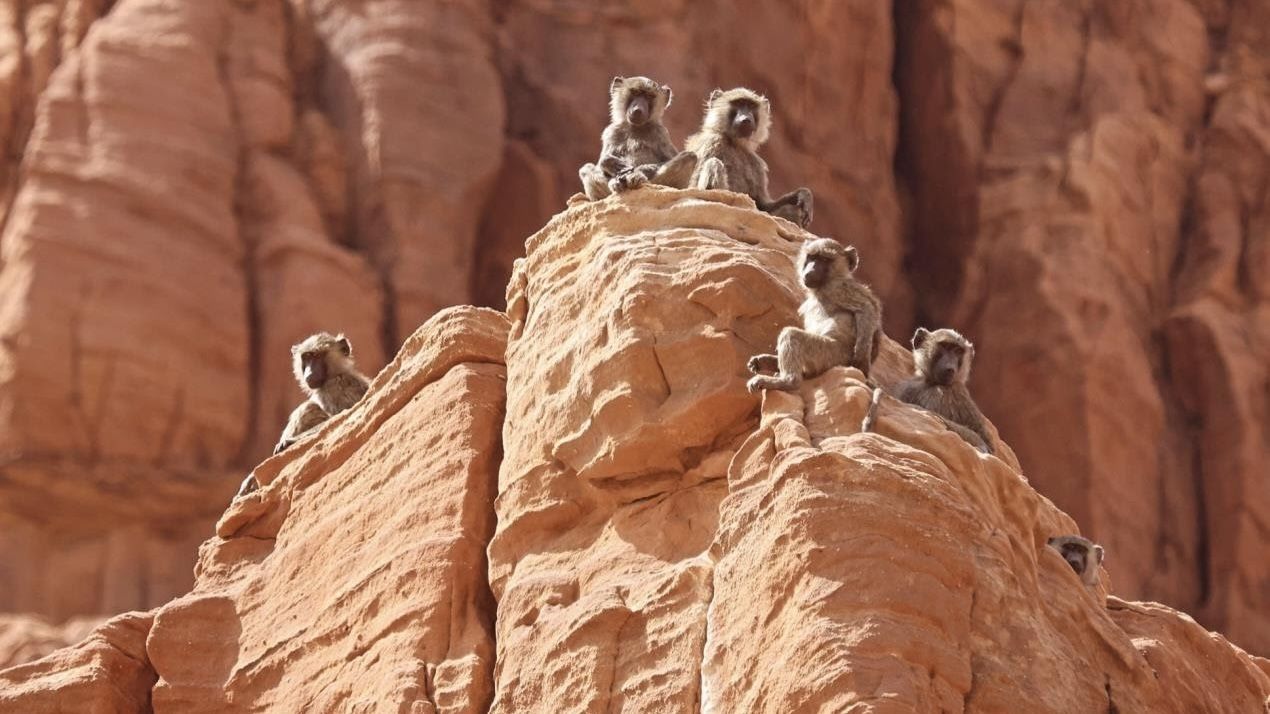
Verreaux’s eagles in the Sahara are killing adult male olive baboons that weigh as much as early human ancestors, upending the long-held assumption that primates above 13 kilograms were too heavy for raptors to hunt.
Researchers working in Chad’s Ennedi plateau recovered the remains of nine olive baboons between February 2025 and June 2026. Eight were adult males with a mean estimated body mass of 22.2 kilograms; the largest reached 26.2 kilograms — nearly the weight of the Australopithecus afarensis fossil known as Lucy.
The skulls bore round puncture holes through the eye sockets, and the shoulder blades showed deep raking marks consistent with eagle talons. The study, published November 18 in the American Journal of Biological Anthropology, identifies Verreaux’s eagles as the likely predator.
“We saw the eagles while we were searching for the baboons, but we never imagined that they might be a threat to them,” said Catherine Hobaiter, a primatologist at the University of St Andrews and lead author of the study. “Then we found the first skull with a puncture mark, and then another, and another.”
Eagles shatter the 13-kilogram ceiling
For decades, primatologists treated 13 kilograms as a functional ceiling for avian predation on primates. No confirmed kill above that threshold existed in the literature. The Ennedi baboons shatter it. The study’s sample of nine individuals includes eight adult males averaging 22.2 kilograms, and the postscript recovery in June 2026 pushed the maximum to 26.2 kilograms.

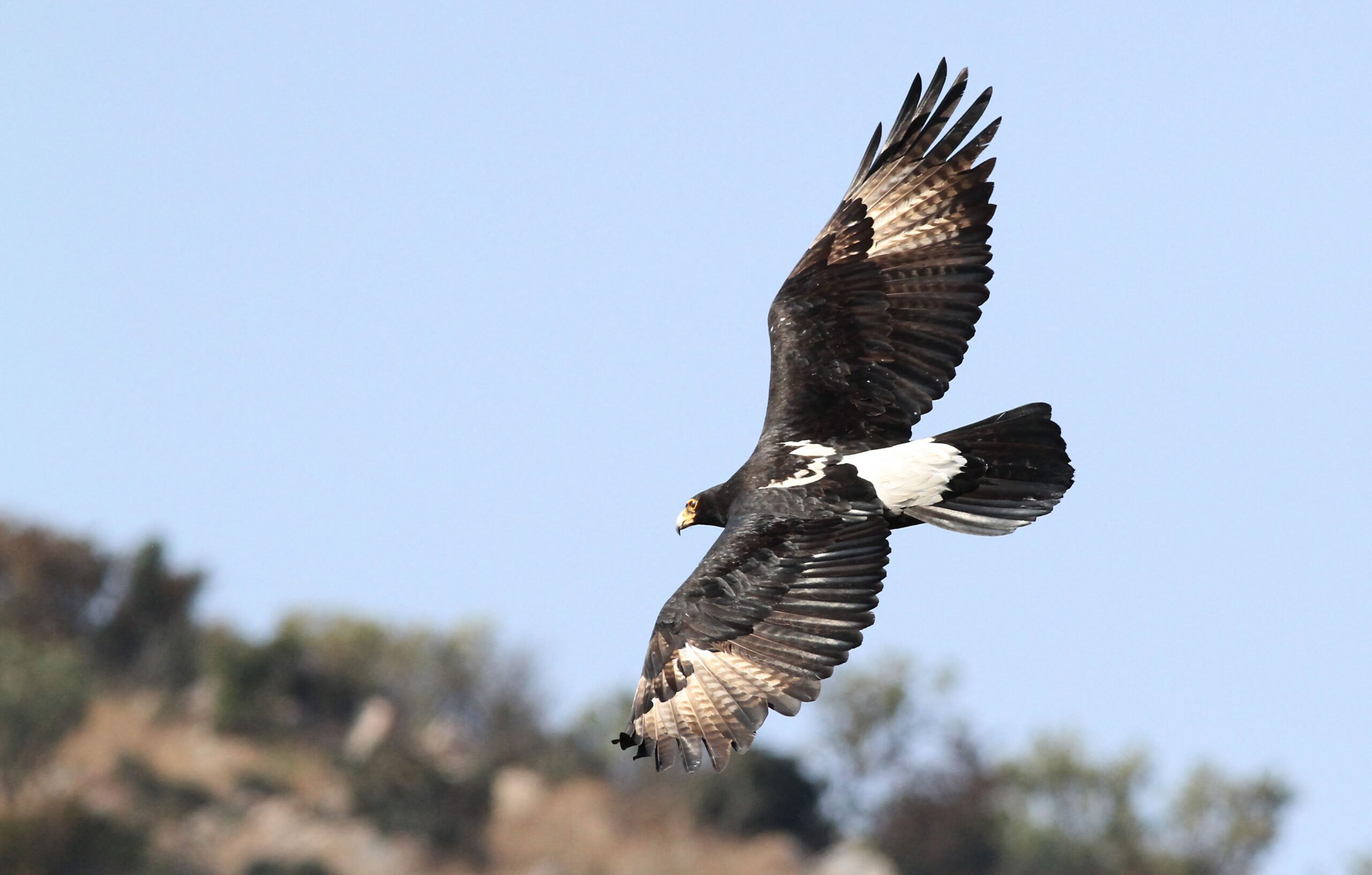
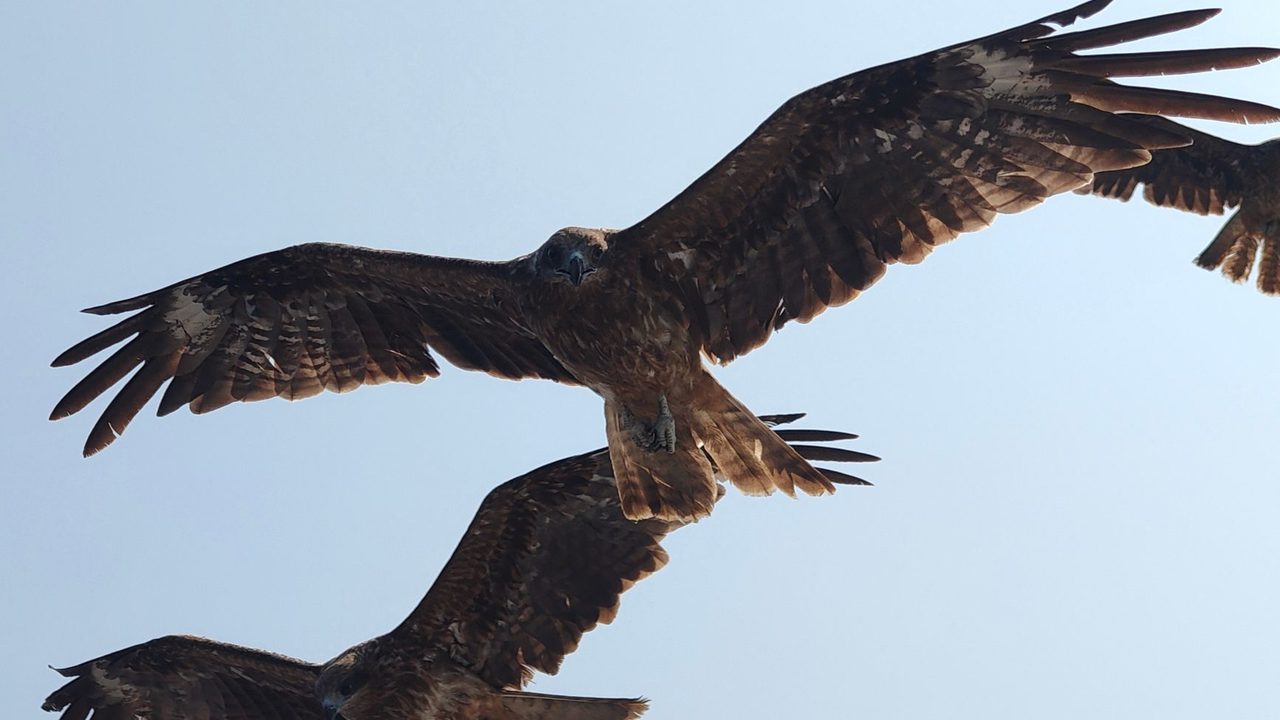
Verreaux’s eagles themselves weigh only 3 to 7 kilograms, with a wingspan of 1.8 to 2.3 meters. They do not need to carry the whole carcass; the talon punctures and scapular raking indicate the eagles kill on the ground or on cliff ledges and transport pieces back to their nests.
“At first, the idea of eagles hunting adult male baboons seemed to exist on the thin edge of possibility, until it didn't,” said Nathaniel Dominy, professor at Dartmouth College and senior author. “Our skepticism slowly gave way to acceptance. The evidence was convincing.”
Isolation drives the shift
The Ennedi plateau is a sandstone massif roughly the size of Switzerland in the middle of the Sahara. Its olive baboons live in isolation from other primate species, sharing the same cliffs and the few permanent water pockets, called gueltas, with the eagles. In more diverse habitats, Verreaux’s eagles focus on rock hyraxes.
“In this dry desert environment, the prey available to the Verreaux's eagles is limited, which has forced them to take on larger, more dangerous prey than is typical for a 9-pound eagle,” said Robert Simmons, a researcher at the FitzPatrick Institute of African Ornithology at the University of Cape Town who wasn’t involved with the study, speaking to Live Science.
Male bias points to predation
Eight of the nine baboons were adult males. That skew argues against scavenging, which would not favor one sex, and toward active predation. Yet the reason eagles target males remains unclear. The researchers also observed the baboons’ own anti-predator behavior: when a pair of Verreaux’s eagles flew overhead, the troop gave alarm calls and dropped for cover, while ignoring other large raptors.
Implications for human evolution
Early hominins such as Australopithecus afarensis and A. africanus fell squarely in the 20-to-30 kilogram range — the same weight class as the Ennedi baboons.
The Taung Child, a juvenile A. africanus from South Africa dated to roughly 2.8 million years ago, has long been the only fossil candidate for eagle predation, based on similar puncture damage to its eye sockets. The new findings make it plausible that adult hominins, not just juveniles, were vulnerable to aerial attack.
“Hominins may have been particularly attractive targets because of their relatively small body size,” the study says. If eagles could kill a 26-kilogram baboon, they could have threatened an adult A. afarensis like Lucy, estimated at 29 kilograms.
“As long as there have been primates, there have been raptors killing and eating them, and that's been going on for 55 million years,” said Scott McGraw, a primatologist at Ohio State University who was not involved in the research. “The notion of a raptor disabling a victim of that size and ferocity — it would have been a wonderful fight.”
Experts urge caution
Not every expert reads the bones the same way. Jesús Bautista-Rodríguez told Live Science in an email he was “much more cautious about interpreting the remains described in this paper as evidence that the eagles actively killed healthy adult male baboons weighing over 20 kg [44 pounds].” He noted the marks could also have been produced during handling and feeding of individuals that were already dead, dying, or severely weakened.
The study authors acknowledge the sample is small and geographically restricted. No one yet knows whether Verreaux’s eagles take adult baboons elsewhere in their range. The team plans to continue monitoring the Ennedi population, and 3D scans of the marked skulls and scapulae have been deposited in public archives for independent verification.
“Baboons are some of the best-studied monkeys in Africa, but our very first observations from Ennedi upended all sorts of notions about what these baboons should be doing — from their diet to their social lives,” Hobaiter said. “I can't wait to see what new 'rules' they'll break next.”