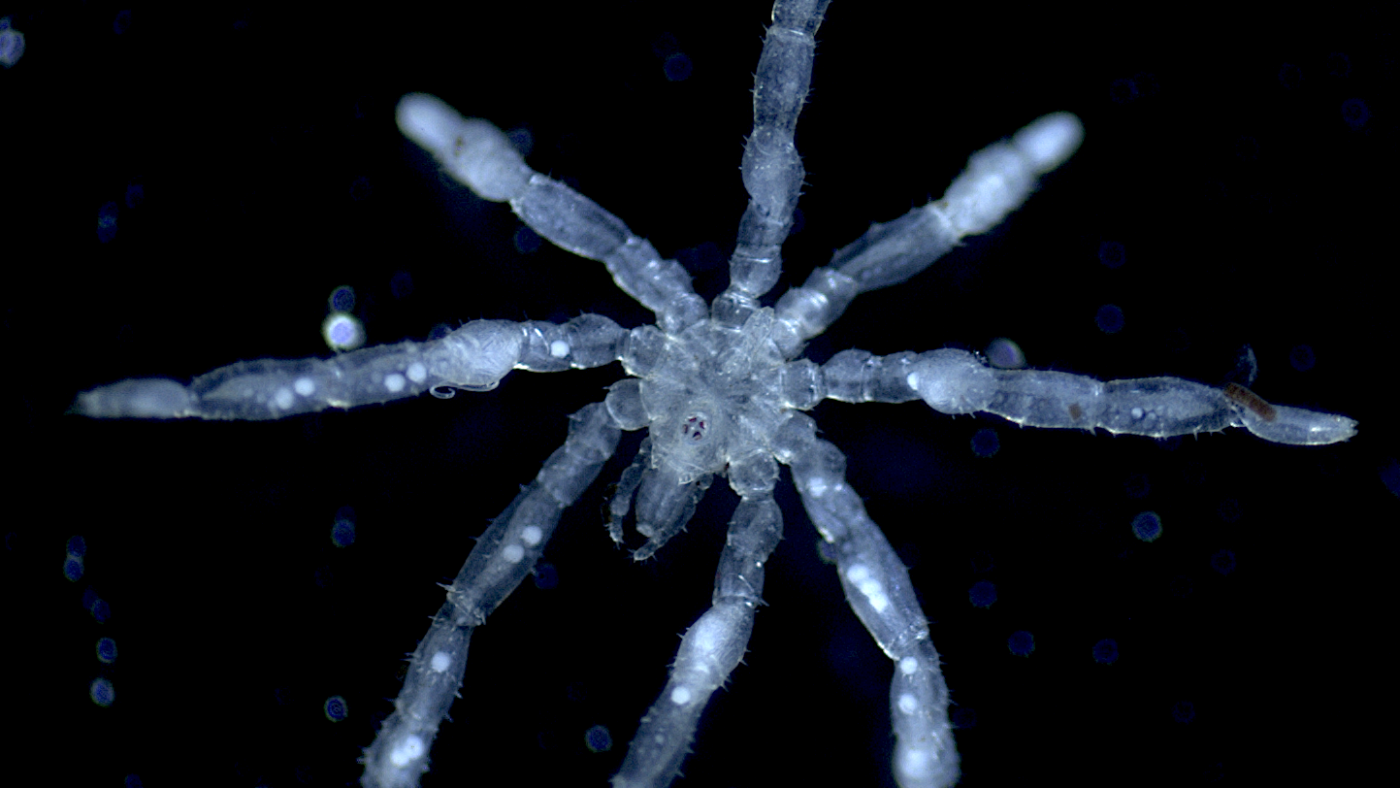
Researchers at the University of British Columbia have discovered two new species of sea spiders in the Salish Sea between Washington State and British Columbia, marking the first time sea spiders have been identified in the region in over a century.
Marine researchers scouring the shallow waters off Vancouver and Quadra islands have brought two previously unknown sea spider species to light. Collected between September 2023 and August 2024 by University of British Columbia zoology master’s student Cormac Toler-Scott, the specimens mark a rare regional milestone: the first sea spiders officially cataloged in the Salish Sea in more than 100 years, according to the researchers.
Callipallene Pilosupedes and Tanystylum Kiixin: Anatomy of the New Finds
Measuring roughly a centimeter across, the two newly described marine arthropods belong to the Pycnogonida class. Although they share an eight-legged silhouette with terrestrial arachnids, scientists emphasize that these creatures never made the transition to land, needing to remain in the water where they move rather slowly and crawl on the seafloor.
Red eyes, a curved spine that arches over its legs, and a triangular, three-lipped mouth characterize the initial species, Callipallene pilosuspedes. Under a microscope, researchers observed the single specimen using its belly limbs called ovigers to meticulously groom itself and comb off dirt as well as algae, with Toler-Scott noting that they are very clean and that not all sea spiders can do this.
The second species, Tanystylum kiixin, takes its name from an ancient Indigenous village near where it was found. Unlike its counterpart, T. kiixin possesses shorter and stockier legs coming out of its chest that cannot be used to clean themselves, leaving specimens visibly covered in dirt and debris when found, according to Toler-Scott.
Parasitic Feeding Habits and Tiny Freeloaders
Unlike land spiders that make a web and eat their dinner, these marine invertebrates lead a sedentary life on the seafloor, moving slowly across the ocean bed. Researchers discovered that each of the two newly identified types was anchored to a colony-forming marine animal that resembles a plant, known as a hydroid. The sea spiders navigate these colonies like a maze to feed.

They’re both living on that and feeding on that, kind of walking through it like a maze, and they just kind of poke a hole into the hydroid itself, and then they suck the juices out of it, like the cells out of the hydroid. That’s how they get their food.
Cormac Toler-Scott, lead researcher at the University of British Columbia
Lacking venom or fangs, the transparent creatures rely heavily on camouflage, taking on the color of whatever they have eaten to evade predators. In an unexpected twist, microscopic analysis revealed that Tanystylum kiixin—already acting as a parasite upon its hydroid host—harbored its own protist parasites, creating a multi-layered biological ecosystem on a single centimeter-wide arachnid.
Targeted SCUBA Diving and Biodiversity Realities Along the British Columbia Coast
The discovery, detailed in a study published in the journal Organisms Diversity & Evolution, underscores the efficacy of targeted SCUBA diving in exploring shallow coastal waters. The research team ultimately cataloged seven sea spider species in total from the area, creating an identification guide to assist future researchers working in the inland sea shared by Washington State and British Columbia.

Despite scientists having discovered more than 1,300 species of sea spiders globally, Toler-Scott told NPR that it is everyone’s dream to find new species, but it is pretty uncommon. Toler-Scott also pointed out that securing financial support for this sort of research is challenging because you enter into it uncertain of what your final results will be.
Anticipating more underwater excursions, investigators from British Columbia foresee uncovering additional sea spider varieties ahead of permanent ecological shifts in local marine habitats caused by climate change and human pressures.