“Imagine a book where a huge section in the middle has been ripped out,” said Santosh Dhungana, a PhD candidate at the University of Wollongong in Australia.
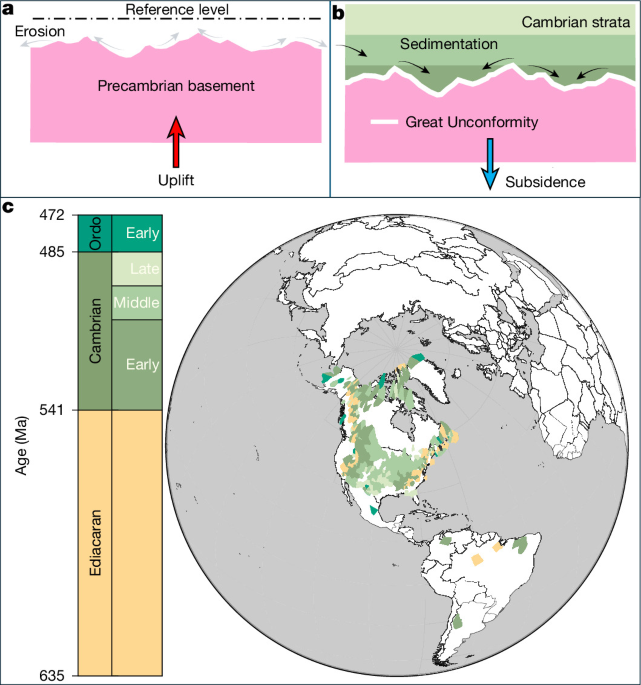
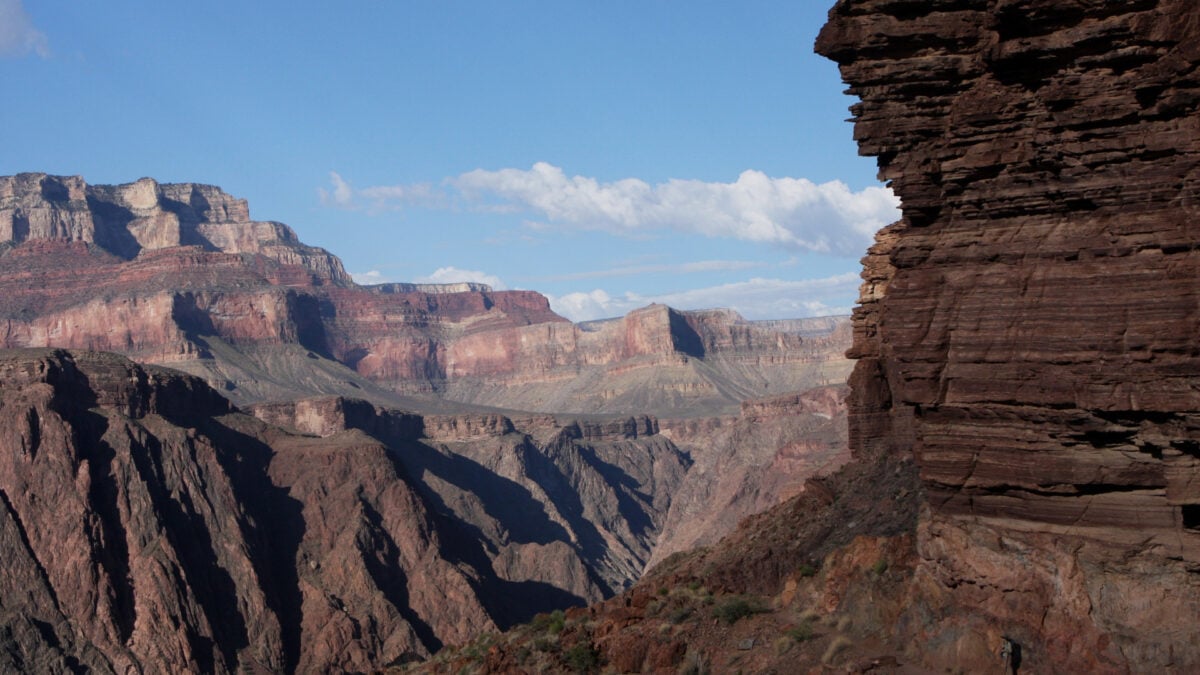
Earth’s geological chronicle contains missing chapters stretching across hundreds of millions to billions of years, a planet-wide mystery known as the Great Unconformity that geologists first identified at the Grand Canyon in the 1870s in research published in Nature. For a century and a half, the forces that erased this massive chunk of the planet’s history remained unexplained.
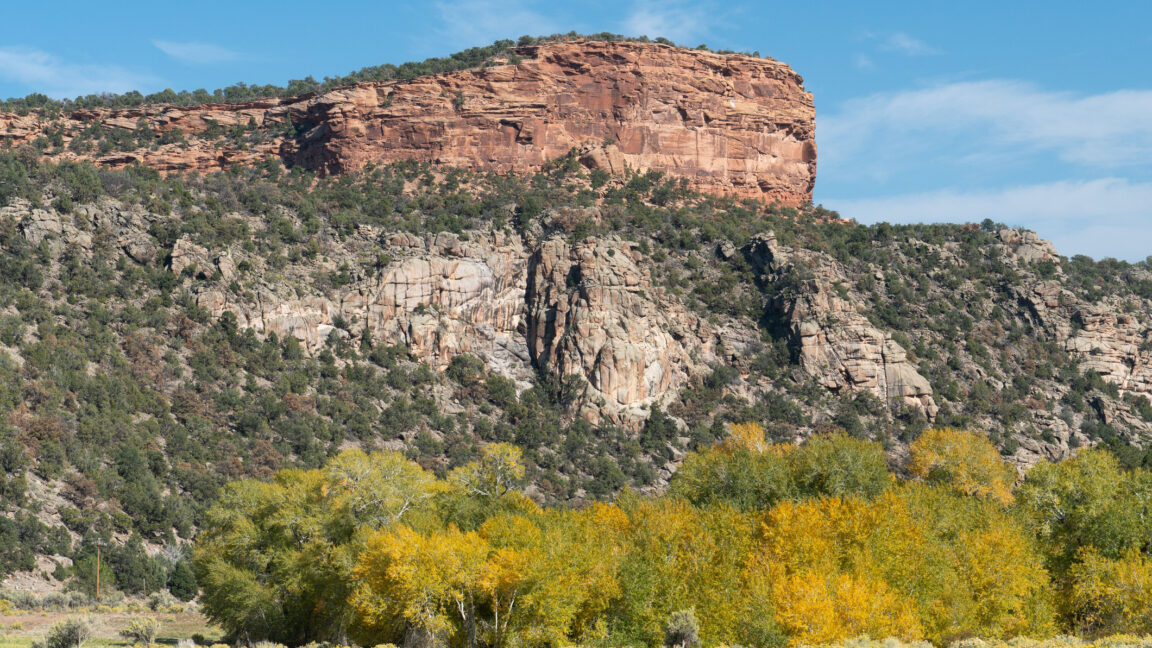
Geologists have found evidence of the Great Unconformity throughout North America and parts of northern China, as well as beneath younger rocks in northern Europe. In the Grand Canyon, researchers estimate the gap represents roughly 1.2 billion years of missing rock record, where flat layers of sedimentary rock about 540 million years old or younger rest directly atop crystalline basement rocks dating back anywhere from 1.2 billion to 1.8 billion years.
Mantle Convection Drives Continental Uplift and Erosion
The Earth’s mantle, a 2,900-kilometer-thick layer of hot solid rock, slowly convects over tens to hundreds of millions of years. Hot rock rises from deep beneath the surface while cold rock sinks, pulling and pushing the ground above in a process that can raise or lower the surface by hundreds of meters. “An analogy would be a lava lamp, where some stuff comes up and some stuff comes down,” explained Nicolas Flament, an associate professor and ARC Future Fellow at the University of Wollongong.
Other explanations previously considered included rifting, stretching of Earth’s crust, and global sea-level drops, alongside theories pointing to mountain-building or volcanic activity. However, researchers said that rifting primarily affects continental edges, while sea-level changes should have impacted all continents uniformly. Another proposed idea suggested that the mantle moved continents up and down through dynamic topography, though Flament noted this had been proposed previously without being quantitatively tested.
To test how these deep processes influenced the planet’s crust, researchers used the Australian supercomputer Gadi to run six simulations of mantle convection going back one billion years. The models were driven by reconstructions of how tectonic plates moved over that timeframe.
The results showed that mantle movement caused ancient continental blocks—specifically Laurentia, which forms much of North America, Baltica in northern Europe, and North China—to be lifted upward between roughly one billion and 540 million years ago.
Glacial Erosion Shaped Landmasses During Snowball Earth
When these continental blocks rose, their crystalline underlayers reached the surface and experienced massive erosion. Researchers note that this uplift coincided with the Snowball Earth period between 720 million and 635 million years ago, during which massive ice sheets slowly slid downhill across the elevated landmasses, eroding away everything in their path.
According to the team, sometimes what is missing can tell us more about the story of Earth than what we can see, as forces deep beneath our feet have left planet-scale marks in the geological record.
Over the past 540 million years, these same continental blocks have subsided and pulled downward. As the land sank, new layers of sediment buried the worn rock surface. This single, long period of uplift followed by a long period of sinking created the ideal scenario for forming and preserving the Great Unconformity.
Dhungana and Flament grouped regions where the ground rose and fell in similar ways to determine where the unconformity should have formed and survived, though they said that the starting configuration of these simulations remains uncertain.
Models Match Unconformity Patterns Across Global Formations
The study used data from formations in Baltica and North China to investigate the phenomenon globally, discovering that its model predictions matched where the best-preserved unconformities are found.
In contrast to Laurentia, Baltica, and North China, models showed that Australia and South America experienced only two cycles of uplift and subsidence from 900 million years ago, a scenario not conducive to forming the unconformity—matching the sparse evidence found on those continents.
The cutoff layer of around 540 million years marks the start of the Cambrian era, when complex life on Earth experienced unprecedented growth known as the Cambrian explosion. Scientists suggest that the massive erosion of entire continents altered seawater chemistry, shaping the environment in which complex life first evolved.