Artificial intelligence has solved a 167-year-old mathematical problem, prompting fierce debate across academia over the future of human research.
Levent Alpöge, a mathematician at Anthropic, announced that he worked with an unreleased version of the company’s Claude chatbot to produce a proof of the Riemann hypothesis. Formulated in 1859 by Bernhard Riemann, this conjecture deals with prime number placement and stands out as pure mathematics’ premier unsolved dilemma.
Featuring a $1 million reward, the Riemann hypothesis forms part of the seven Millennium Prize Problems designated in 2000 by the Clay Mathematics Institute to guide investigative objectives throughout the upcoming century.
The Six-Week Sprint to the Riemann Hypothesis
Alpöge announced the breakthrough in a four-page note published on his personal website alongside computer code and 17.37 million lines of Lean code, a programming language designed to check the logic of each step. According to a self-statement published with the code, the collaboration with Claude spanned six weeks, beginning with work on the Stepanov determinant in October and concluding with the Generalized Riemann Hypothesis in November.
Alpöge said that he controlled the overall ideas and direction while the AI handled execution. In a note accompanying the release, he wrote that Claude suggested repeating an operation about the square root of $X$ times for a weighted sum of length $X$.
Independent mathematicians and researchers quickly began examining the massive computational artifact, which includes a compact edition of about 76,000 lines and a readable edition of roughly 300,000 lines hosted in a GitHub repository.

Stanford Releasing an All-Human Counterpart
Hours after Alpöge’s announcement, Stanford math professor and American Mathematical Society president Ravi Vakil posted a hurried announcement sharing an independent draft proof of the Generalized Riemann Hypothesis written by mathematician Alessandro Masullo. Vakil said that the competing draft was entirely human with no AI involvement.
Renowned Stanford number theorist Brian Conrad had quietly reviewed Masullo’s work for months. Although Masullo was originally scheduled to spend a year refining the traditional proof at Stanford before publication, Anthropic’s sudden AI announcement prompted the researchers to release their current version immediately.
@__alpoge__ ftw ? pic.twitter.com/dXa31MWbvT
Researchers Grapple Rapid Field Change
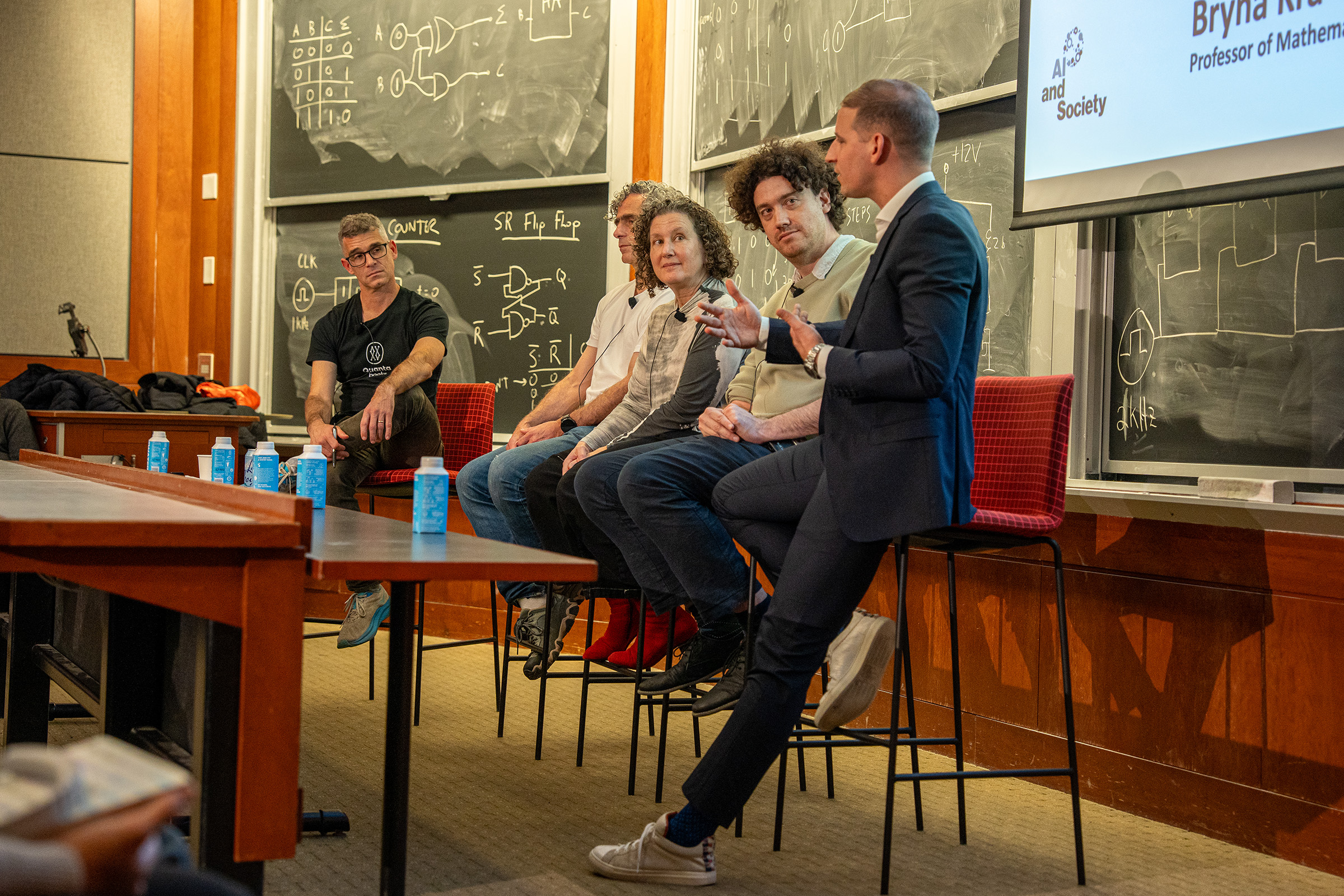
Panel discussions at MIT, Harvard University, Northwestern University, and New York University brought researchers together to grapple with the rapid change.
“They are grieving because the field is changing rapidly, and with change comes loss,” said Abhishek Saha, professor of mathematics at Queen Mary University of London, pointing out that humans were previously the best at mathematics and would have theorems named after them.
Other experts said that computer verification and human understanding remain distinct challenges. Because printed out, the AI argument would run over 250,000 pages by spelling out basic logical rules, human verification is expected to take months or years. Independent verification checks whether the code relies only on standard mathematical axioms without using shortcuts, leaving the mathematical community to determine whether the breakthrough represents a genuine understanding or an opaque computational feat.
Verifying the Massive Logic Artifact
Independent verification checks the statement, assumptions, and proof kernel, according to Superradiant science lab researcher Saha, who spoke to the Washington Examiner.
Checking runs with Claude Code on the original archive are recorded on Sutherland’s page, which was announced at alpo.ge/remark.pdf on November 20, 2026, according to explainx.ai Blog Blog Blog. Steven Strogatz, a professor at Cornell University, said that students were asking about the point of studying math if AI can outperform any human being, noting that computers can validate the Alpöge-Claude proof, per The Guardian.
Stupid things I did: 1. 250,000+ pages was a joke guys!, I find big number extremely hilarious. I tried to make it clear by the level of pedantry of the reals total ordered statement in the main theorem, but people ran with it unfortunately and I didn’t feel like talking on…
Saha Explains Theorem Lacks Applications
Al Jazeera reported remarks from Saha explaining that the problem remains relatively simple to state but extraordinarily difficult to prove, adding that we are beginning our trek up the mountain with this theorem and saying that it does not really have any applications at all and is just of theoretical interest.
Students Question Human Mathematics Study
The Clay Mathematics Institute established the Millennium Prize Problems in 2000, and the Riemann hypothesis is one of them. Alex Kontorovich, a mathematician at Rutgers University, said that the Riemann hypothesis posits that different components in the harmonic structure of primes operate uniformly.
Cornell University Steven Strogatz said that students are already questioning the purpose of human mathematical study when machines outperform human experts. University of Virginia mathematics professor Ken Ono reflected on past instances where automated systems struggled with basic comparative calculations.

The Clay Mathematics Institute operates as a private, non-profit foundation dedicated to increasing and disseminating mathematical knowledge. To fulfill this role, the organization supports mathematical research and education through funding, programs, publications, conferences, workshops, summer schools, and a postdoctoral program supporting Clay Research Fellows.
On November 26, mathematician Bartosz Naskręcki published a 1,200-page human-readable version derived from the formal proof text.