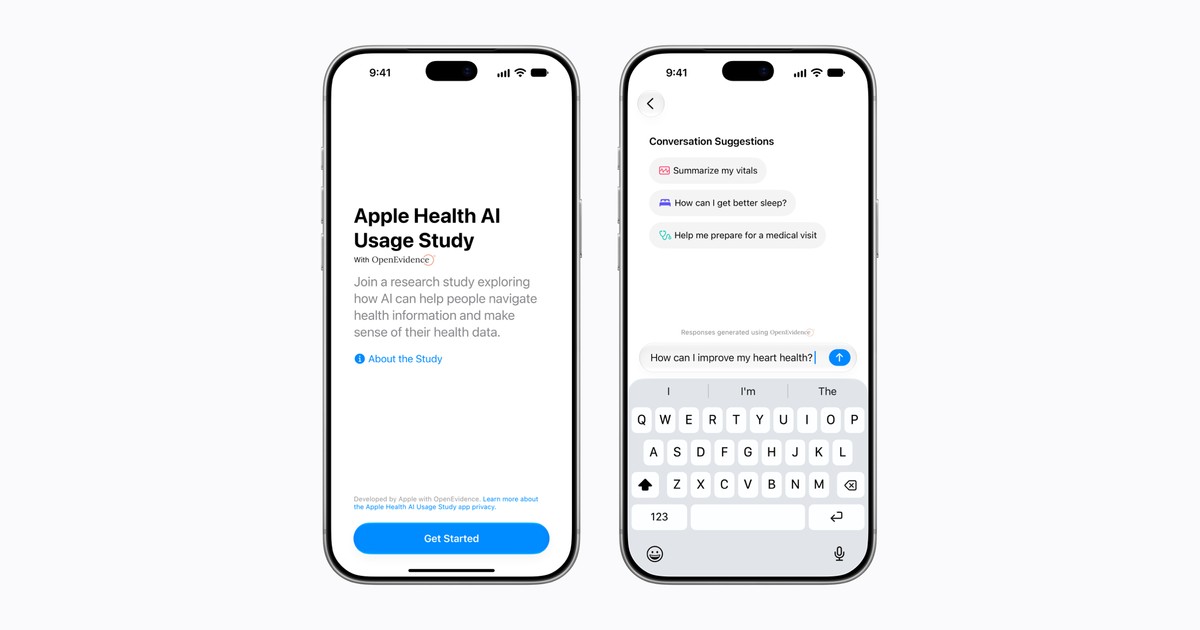
Apple launched the Apple Health AI Usage Study app in the United States on Sunday to examine how users interact with conversational health artificial intelligence.
The company is partnering with OpenEvidence to provide medically grounded AI technology for the virtual project. OpenEvidence operates a clinical platform. Healthcare professionals use it. The platform generates responses from established medical literature. This includes The New England Journal of Medicine, the Journal of the American Medical Association, and Nature.
The study aims to recruit up to 200,000 participants. Eligibility is limited to US residents aged 21 and older. They must own an Apple Intelligence-enabled iPhone. This is an iPhone 15 Pro or a newer model running iOS 26 or later.
Participants use a dedicated app to ask everyday health questions. They read complex medical information translated into approachable language. Users review linked peer-reviewed clinical citations. They rate the responses and complete monthly surveys about their experiences.

Study participants can choose to share HealthKit data. This includes resting heart rate, physical activity, sleep records, and laboratory results. Sharing this gives the system more personalized context when answering inquiries.
Apple said user queries are first processed on the iPhone. Privacy protections are designed to remove identifying information before reaching OpenEvidence. OpenEvidence deletes question-and-response data within 24 hours. The collected information will not be used to train AI models.
OpenEvidence CEO Daniel Nadler said this during an announcement at the HLTH conference in Las Vegas.
OpenEvidence is the most trusted and loved brand product among doctors. Apple is the most trusted and loved brand and product among consumers
Daniel Nadler, OpenEvidence CEO
“Insights from this study will help advance the broader scientific conversation and ensure that as technology evolves, we continue building trusted tools that genuinely support people wherever they are on their health journey,” said Sumbul Desai, Apple's vice president of Health and Fitness.

At Apple, we believe responsible innovation starts with scientific rigor and clinical grounding. Health is deeply personal, and conducting a dedicated research study is the most thoughtful way to understand how people engage with, comprehend, and evaluate health AI in everyday life
Sumbul Desai, Apple’s vice president of Health and Fitness
Robert M. Wachter, professor and chair of the Department of Medicine at UCSF, said this about the tools.
Patients and clinicians are both turning to AI, but the tools they use are being built and tested in separate worlds. When patients and doctors draw on versions of the same trustworthy tools, patients arrive prepared, conversations improve, and next steps happen seamlessly. Connecting these tools, and rigorously studying what works, is how we’ll get there
Robert M. Wachter, UCSF’s professor and chair of the Department of Medicine