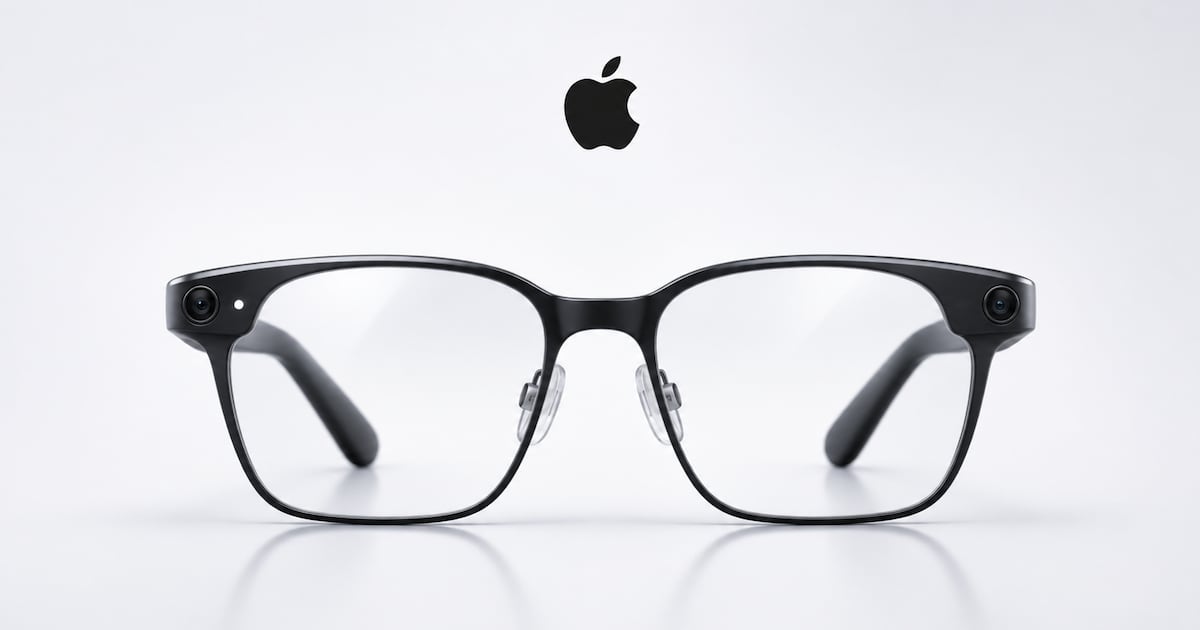
Apple is pushing forward with plans to unveil its first artificial intelligence glasses at the Worldwide Developers Conference in June 2027, according to Bloomberg’s Mark Gurman, setting the stage for a three-way battle in the wearable technology market against Meta and Samsung.
The prototypes, carrying the internal code name “N50,” are designed to be slightly thinner than Meta’s second-generation Ray-Ban AI glasses. Rather than incorporating a bulky augmented-reality display, the initial hardware relies on built-in cameras, microphones, and an upgraded Siri AI assistant to process the wearer’s surroundings through voice commands.
Apple Tests N50 Frame Prototypes and visionOS Hardware
Apple has largely finalized the physical layout of the N50 frames, testing multiple colors and materials. Some tested prototypes integrate cameras directly into the frame without protruding housings, accompanied by front-facing status indicator lights.
Under the hood, the wearable runs a streamlined version of visionOS 28 powered by a processor derived from older Apple Watch chips, while dedicated custom components handle wireless networking and image processing. The device includes Wi-Fi connectivity, allowing certain functions to operate independently when a paired iPhone is out of range, though the glasses will not function as standalone devices.
Engineers have also experimented with a distinct power source. As The Verge reported, the prototypes feature a MagSafe-like charging accessory that Gurman described as “flat, rectangular” and “roughly the size of a Tic Tac.” The three-pin magnetic connector attaches near the tip of the left temple arm, designed so wearers can recharge the device while keeping it on their face, though its inclusion in the final retail product remains unconfirmed.
Apple is also working on camera-equipped AirPods slated for late 2027 that will similarly provide Siri with surrounding information. Apple previously explored an automotive venture, confirming talks with Hyundai in 2021 before backing away due to a lack of secrecy. Apple is reportedly planning to unveil its first smart glasses at the Worldwide Developers Conference in June 2027 and ship them before the end of the year.
Siri Uses iPhone to Execute App Tasks via Voice
Rather than running standalone applications, Apple expects wearers to interact with familiar software through voice commands routed to a nearby, compatible iPhone. The strategy mirrors the early architecture of the Apple Watch, which initially relied on host devices to execute code.
Developers are instructed to build App Intents for their existing iOS applications, allowing Siri to execute tasks such as booking restaurant tables, calling vehicles, or ordering food without requiring a dedicated screen on the frames. Apple introduced developer previews for these expanded Siri controls in the iOS 27.3 betas, planning to roll out native app support in December before opening submission channels to third-party developers in the spring of 2027.
Basic operations handled directly by Apple's system software include identifying buildings, translating signs and conversations, providing directions, reading refrigerator contents to suggest meals, and managing calls, messages, and smart-home controls.

However, an obstacle persists in the European Union. Apple does not sell the product there “as Siri AI is currently unavailable in iOS in the EU,” noting that it is “working constructively with the EU in an attempt to find a path forward.” Glasses whose entire app ecosystem relies on Siri AI face this regional gap unless resolution is achieved prior to the late 2027 window.
Market Rivalry With Meta and Samsung
Apple’s planned arrival in late 2027 places it in direct competition with entrenched rivals. According to market research firm Omdia data cited by Chosun Ilbo, Meta commanded 81.3% of global AI glasses shipments in the first half of 2026, while other market estimates place Meta’s category share at roughly 94%. Meta expanded its lineup by releasing the third-generation Ray-Ban Meta in September.
The category has seen massive expansion, with global shipments of AI glasses jumping 263% year over year in the first half of 2026, and displayless models accounting for 96% of those units. Domestically, Samsung’s competing product, developed in collaboration with Gentle Monster, sells for 650,000 to 700,000 Korean won, utilizing a camera and voice commands without a display and running Google’s AI model Gemini.
While rival manufacturers have partnered directly with fashion brands, Apple is utilizing in-house styles and designs to help bring costs down and ensure the glasses fit aesthetically with its other products.

A financial filing from Chinese equipment manufacturer Quick Intelligent Equipment disclosed participation in Apple’s AI glasses and smart earphone projects, noting that the work would drive demand for precision welding and machine-vision inspection tools.
Despite settled hardware plans, software development and AI performance remain complex challenges. Gurman reported that ongoing software delays could still shift the proposed release timeline past late 2027.
“would begin before the end of the year,” as quoted by The Verge in the newsletter, regarding shipments.