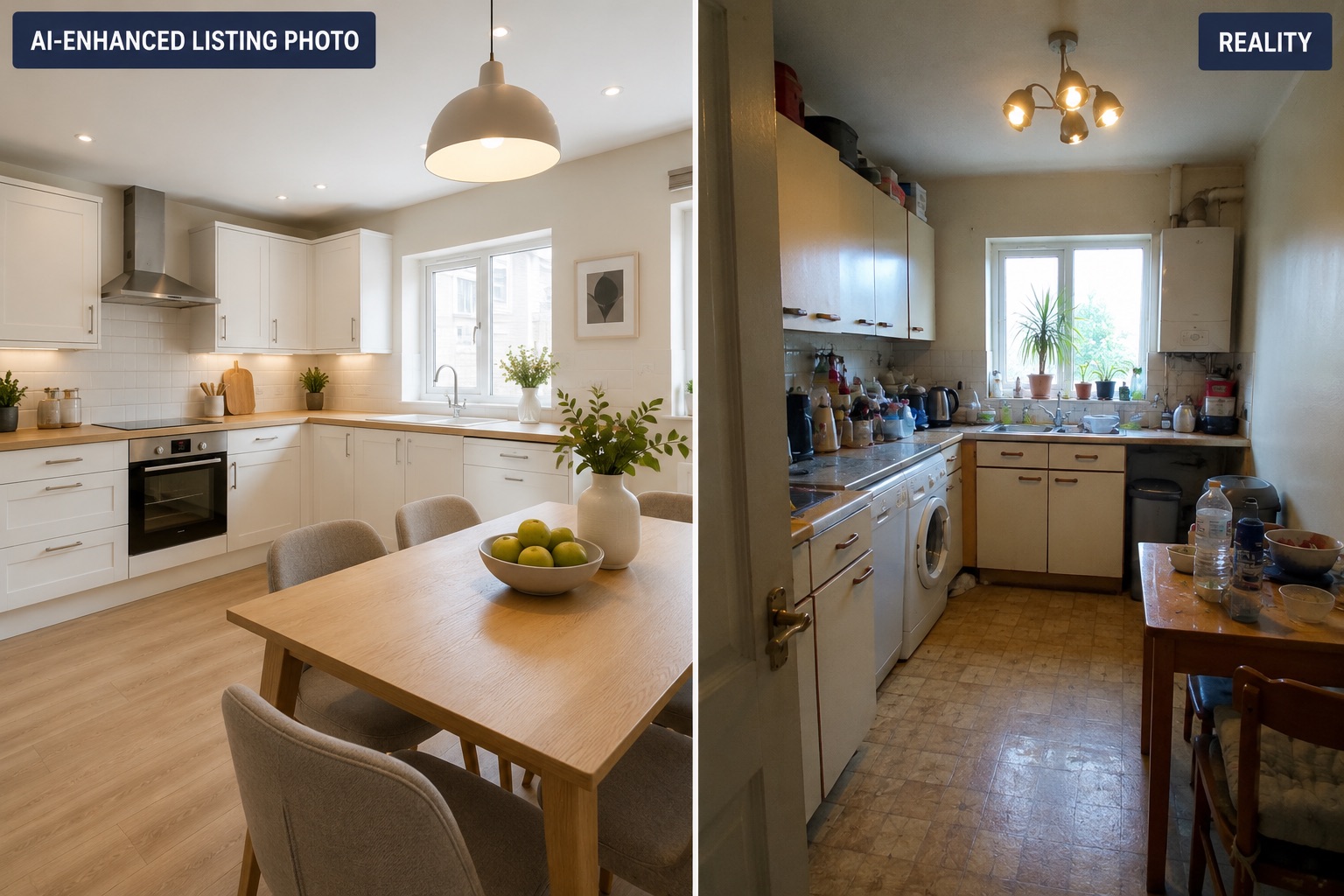
Estate agents are increasingly using AI to digitally enhance property photos, a practice known as “housefishing” that can mislead buyers by misrepresenting room sizes, decor, or structural details. While the industry argues the technology helps visualize potential, regulators warn that hiding features or altering reality can break the law.
Earlier this year, Olivia Nicole, 29, encountered a listing on Rightmove for a five-bedroom property in south-west London. Upon arriving for her viewing, she discovered the home bore little resemblance to the online images. “The rooms were much smaller than they were in the pictures and the decor was totally different,” she told the BBC. “Some structural features were also different.”
Nicole said that the windows in the property were noticeably smaller than those depicted, and a raised wall section visible in the listing was absent in person. She later learned the images on the Rightmove, Zoopla, and Winkworth websites had been enhanced with AI. Because the listing lacked clear labeling, she felt the experience wasted her time and forced her to take unnecessary leave from work.

Defining Acceptable AI Use
The Guild of Property Professionals, a trade group for independent estate agents, acknowledges that while it is difficult to quantify how common AI-enhanced listings have become, the practice is seeing a rise. According to a survey of 906 UK homebuyers, one in five who purchased a home in the past year viewed properties where photos had been digitally altered to appear better than they were.
Jack Bushrod, who reviews property listings on his social media channel, Housing Horrors, has observed a “surge” of such images over the last six months. He suggests that using AI to declutter a room or add virtual furniture to an empty space is acceptable to help buyers visualize potential. However, he draws a firm line at deceptive edits.
I’ve seen one house where they had removed a pillar and added a window. Others might use AI to remove stains on the carpet or cracks in tiles. It’s little details you would only notice in person.
Jack Bushrod, Housing Horrors reviewer
Estate Agents Must Disclose AI Photo Enhancements to Consumers
Trading Standards has informed the BBC that estate agents may use AI for basic photo enhancements or virtual furnishing, provided they disclose the use of technology to consumers. However, the agency warns that structurally altering a room—such as adding a window or concealing existing features—could mislead buyers and potentially violate the law.
A spokeswoman for Howards, an estate agency, said that the company has introduced a policy to label all AI-enhanced photos. She emphasized that the firm does not use AI “to misrepresent the fundamental features of a property” but rather to help clients imagine possibilities.