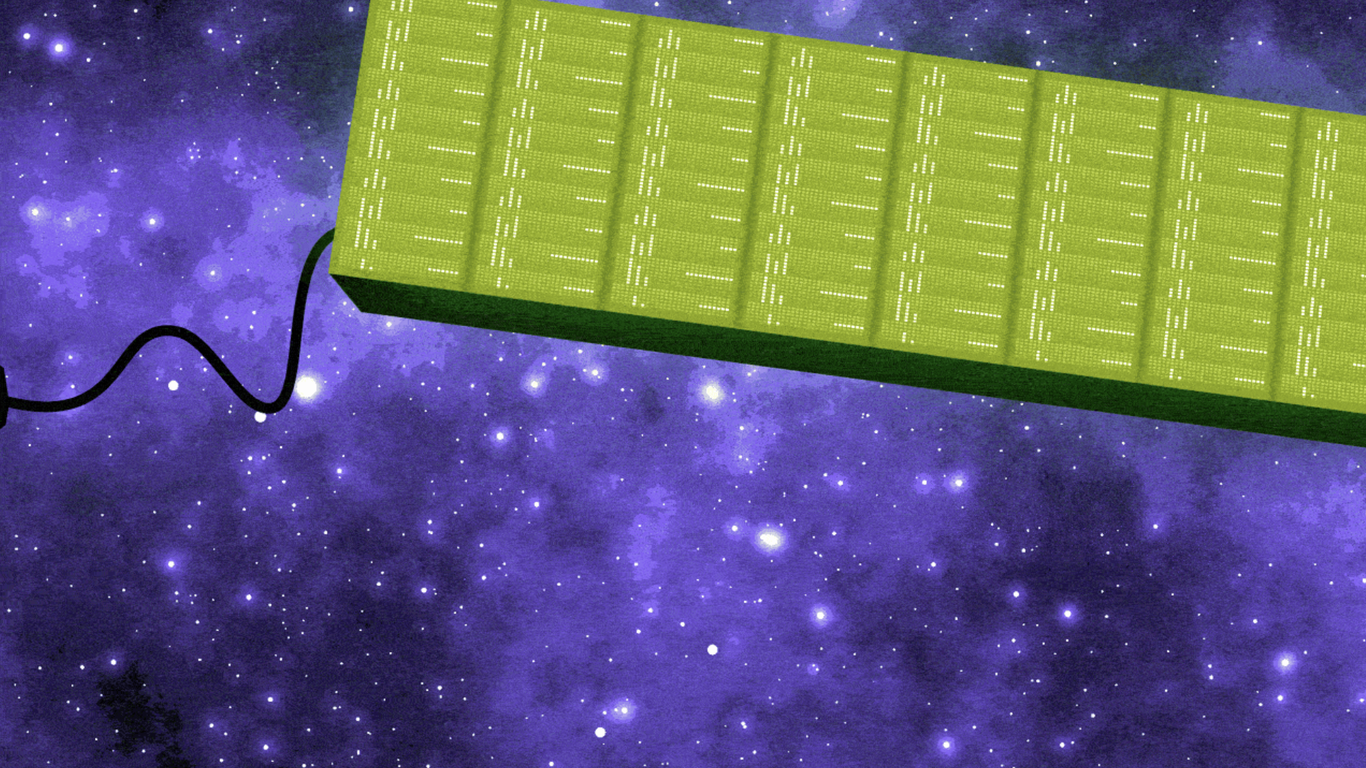
Sprawling orbital data centers could soon outnumber visible stars across the night sky while generating hundreds of large rocket launches annually, according to a report by the Innovation for Cool Earth Forum.
Companies File for Tens of Thousands of AI Satellites
Major technology companies have submitted regulatory filings for tens of thousands of satellites designed to deliver unprecedented computing capacity for artificial intelligence models. According to the Secure World Foundation, SpaceX submitted a request to the Federal Communications Commission in January 2026 for authorization to run as many as one million data-center satellites, with four additional firms subsequently submitting paperwork for several hundred thousand more units.
Starcloud and Blue Origin’s Project Sunrise have proposed constellations of 88,000 and 51,600 satellites, respectively. Additional filings include Cowboy Space’s Stampede project with up to 20,000 satellites, and a separate application from a company called Orbital for up to 100,000 satellites. Roughly 19,000 satellites orbit Earth today, and full implementation of these proposed data-center plans would raise the number in low Earth orbit more than 50-fold.
SpaceX asserted in its regulatory filings that by directly harnessing near-constant solar power with little operating or maintenance costs, these satellites would achieve transformative cost and energy efficiency while reducing environmental impacts. The company contended that the system would push humanity toward becoming a Kardashev II-level civilization capable of harnessing the entire sun to support AI-driven applications for billions of people.
According to its application, Blue Origin said that the initiative would safeguard local communities and natural ecosystems by relocating compute operations requiring high amounts of energy and water away from ground-based facilities, thereby lessening the strain placed on land resources, water supplies, and electrical grids.
Investment in orbital data centers has swelled to $1.11 billion so far this year, per market research firm Quilty Space. However, Caleb Henry, Quilty Space’s director of research, noted in an interview that operators may be requesting licenses for more satellites than they plan to launch to avoid raising their numbers later.
Henry cautioned that observers are tallying paper filings as substantive deployments before the technology is proven, stating that people are treating paper filings as real when that status remains unknown.
David Sandalow Warns About Environmental Impacts and Risks
The report titled “Space-Based Data Centers Roadmap: The Case for Caution” was led by David Sandalow, an inaugural fellow at Columbia’s Center on Global Energy Policy. Sandalow told Axios that unknown variables remain regarding environmental impacts, warning that deployment could occur well before risks are fully understood or governed.
Companies and policymakers should proceed with great caution.
David Sandalow, lead author
Sandalow added that development should advance slowly and with care rather than launching large quantities to observe outcomes.

Not just launching lots and lots of these things and, kind of, seeing what happens. … There’s big risks.
David Sandalow, lead author
The study lists potential policy measures including brightness limitations, assessments of impacts before launch, mandated mitigation protocols, limits on satellite quantities, and global benchmarks. Independent Alberta Senator Paula Simons opened a Senate Inquiry on the emerging problem of satellite debris falls in March, which forms part of the broader public policy puzzle surrounding orbital crowding.
John Barentine, president of the Center for Space Environmentalism in the United States, described the proposed changes compared to the status quo as a remarkable sea change.
Protecting Orbital Data Centers from Radiation and Heat
Engineering hurdles include thermal regulation and radiation protection outside Earth’s atmosphere. “Much brighter than the satellites that we see in the sky right now.” Lawler said that electronics are subject to solar storms outside the Earth's atmosphere, and while companies have improved, protecting an entire orbital data center remains a difficult challenge.
Alexis Abramson, dean of the Columbia Climate School and a principal co-author of the roadmap, co-wrote the chapters covering cooling, night sky, and astronomy alongside Sandalow. The report questions economics and weight claims, noting that while SpaceX suggested in regulatory filings that a 100-kW data-center satellite could weigh one tonne, the authors’ estimate for the power system alone is about 2.2 tonnes.
Heavier satellites require more launches. Maintaining an orbital fleet covering 10% of projected 2030 artificial intelligence data center demand would require more than 700 large rocket launches annually, equating to roughly two per day in perpetuity. While space-based data centers rely on solar energy, putting them into orbit necessitates a massive volume of rocket flights that results in the release of greenhouse gases and black carbon.
The report concludes that high initial costs are unlikely to block deployment because companies may accept financial losses to establish market position, though authors warn governments and companies must wait until risks and impacts are better understood and well managed.
Earlier coverage: Study Says Single Nuclear Blast Could Disable 99% of Satellites