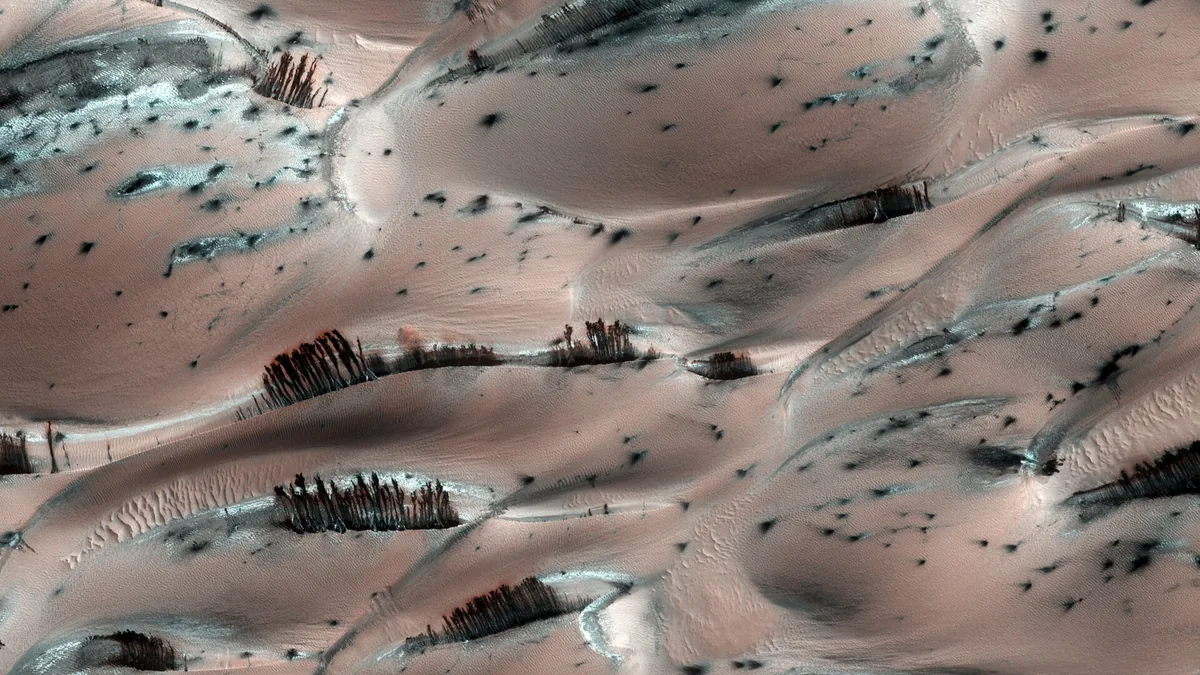
NASA’s Mars Reconnaissance Orbiter photographed what looked like a forest of dark trees rising from frozen dunes near the Martian north pole in 2008.
The image, captured by the orbiter’s HiRISE camera, shows long, shadowy streaks that resemble trunks and branches when viewed from above. Flip the picture upside down and the illusion breaks: the streaks are dark sand cascading down dune slopes as seasonal carbon dioxide ice sublimates directly into gas each spring.
Seasonal Ice Drives Dark Streaks
Mars is tilted like Earth and cycles through seasons. Its winter atmosphere freezes carbon dioxide into a blanket of dry ice rather than water snow. When spring sunlight returns, it penetrates the translucent ice and warms the dune surface from below. Gas pressure builds until it bursts outward, carrying sand down the steep slopes. The avalanches leave dark streaks that mimic tree limbs against the pale frost.
HiRISE caught a small dust cloud in the 2008 frame — direct visual evidence of an active slide rather than a static landform. By summer the ice and streaks vanish completely. Martian winds redistribute the sand and smooth the slopes until the next winter freeze restarts the cycle.
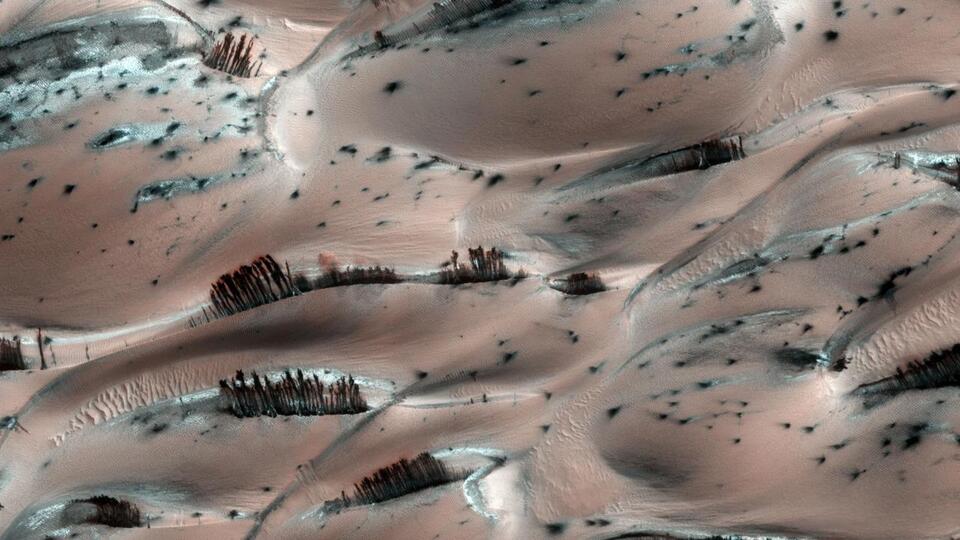
According to ScienceAlert, no rover or orbiter has ever detected a single alga, cactus, or tumbleweed on the red planet. As far as we know, nothing grows on Mars, so the photograph is startling at first glance.
ScienceAlert said flipping the image upside down makes the streaks easier to read: they look less like trees and more like what they really are — dark sand from inside a dune, knocked loose and sent tumbling down its side by the seasonal sublimation of carbon dioxide ice.
Dune Edges Move Meters Each Year
A 2011 study led by Candice Hansen-Koharcheck of the Planetary Science Institute compared HiRISE images taken over successive Martian years and found the dune field is anything but static. In five dunes the team measured, the lower edges of the slopes advanced between 2.2 and 4.7 meters in a single Martian year. Some dunes developed new gullies and alcoves; others accumulated fresh sand deposits at their bases.
The research, published in Science on February 4, 2011, involved collaborators from the University of Arizona’s Lunar and Planetary Laboratory, the Johns Hopkins Applied Physics Laboratory, and the University of Oxford. It confirmed that seasonal carbon dioxide frost drives active sand transport across the northern polar dunes each year.
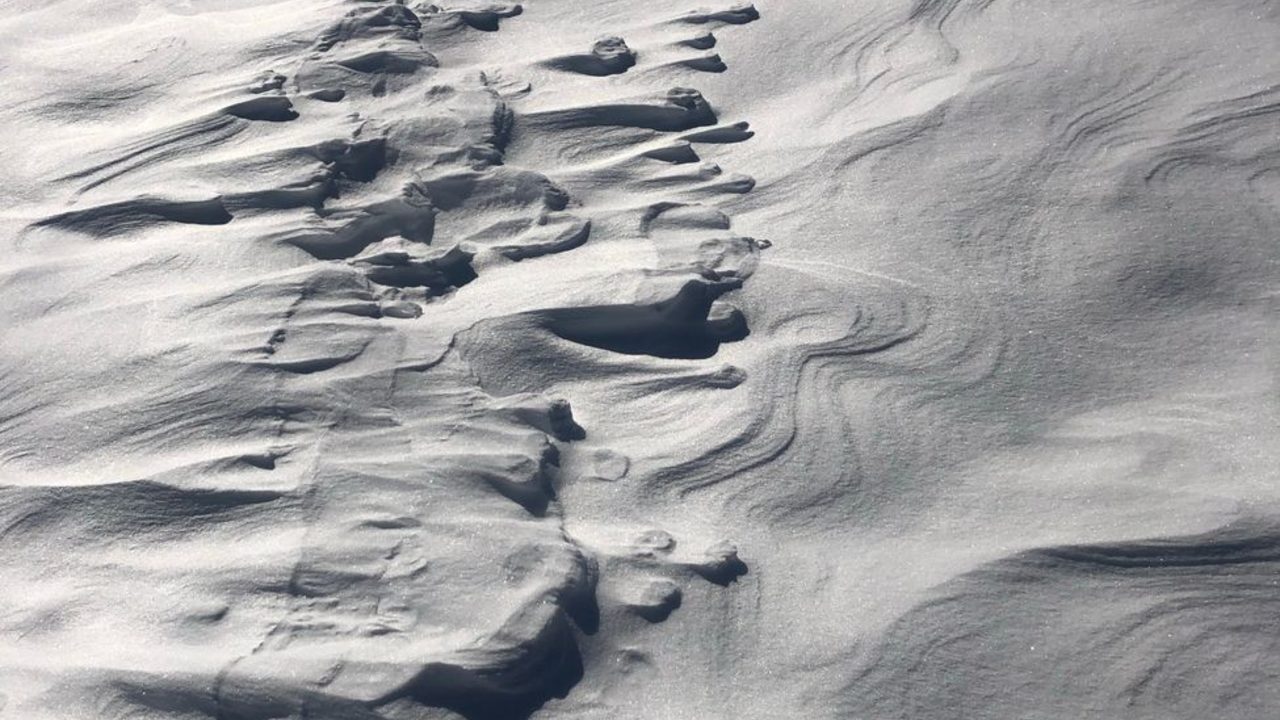
Stay frosty. ❄️ LOOK: NASA shares a photo taken by the Mars Reconnaissance Orbiter, showing the planet's frosty sand dunes. The stripes and other features are the result of sublimated ice that comes with the "seasonal thaw." Photo from NASA's Instagram pic.twitter.com/in7pZcHvJk
The study, titled “Seasonal Erosion and Restoration of Mars' Northern Polar Dunes,” included 12 authors: C. J. Hansen, M. Bourke, N. T. Bridges, and others.
Their institutions were the Planetary Science Institute in Tucson, Arizona; the School of Geography and the Environment at the University of Oxford in the UK; the Applied Physics Lab at Johns Hopkins University in Laurel, Maryland; and the Lunar and Planetary Laboratory at the University of Arizona in Tucson, Arizona. High-resolution images of Mars showed active sand transport on northern polar dunes.
False-Color Mosaic Maps Temperature
NASA released a separate false-color mosaic in April 2021 to mark the 20th anniversary of the Mars Odyssey orbiter. That image, assembled from infrared pictures taken between 2002 and 2004, shows the northern polar dune field. Blue tones mark cooler surfaces; yellow and orange mark warmer ones, mapping temperature differences across the dunes.
Physics, Not Biology, Explains the Patterns
No rover or orbiter has ever detected algae, cactus, or tumbleweed on Mars. The tree-like patterns are a seasonal geologic process: carbon dioxide ice sublimation destabilizes sand, creates gullies, and paints fleeting forests that disappear with the spring thaw — only to return when winter ice forms again.
The Martian winds redistribute the sand, gradually smoothing the slopes of the dunes. But when winter returns, the dunes freeze over once more — setting the stage for another spring of strange, fleeting forests, like trees without shadows presiding over an alien land.
ScienceAlert presents this conclusion as current understanding rather than as a new measurement tied to the 2008 photograph. The dark streaks arise from seasonal frost and sand movement instead of living organisms. They return when winter ice forms again.
This article was fact-checked by Peter Dockrill and edited by Peter Dockrill.