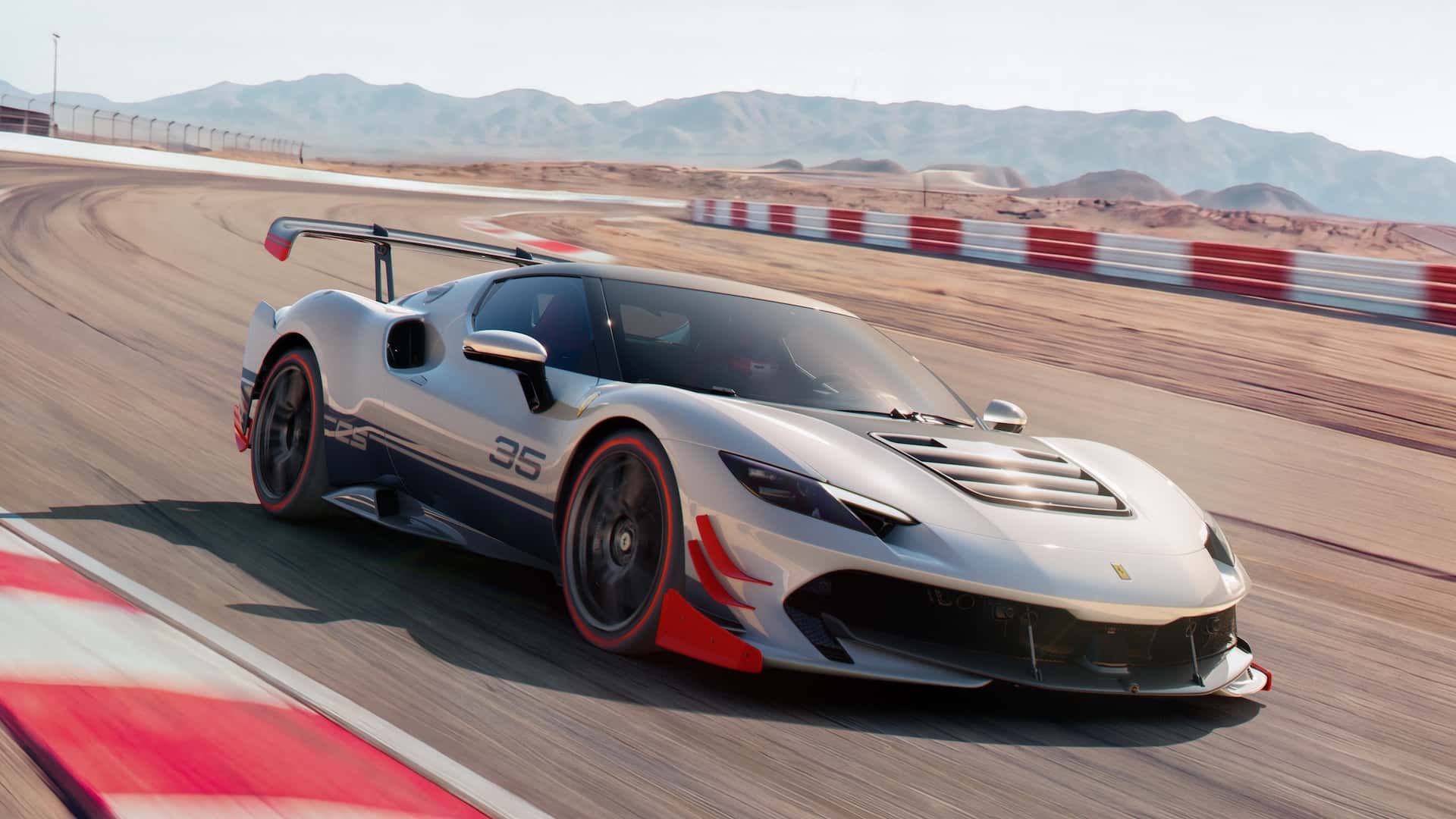
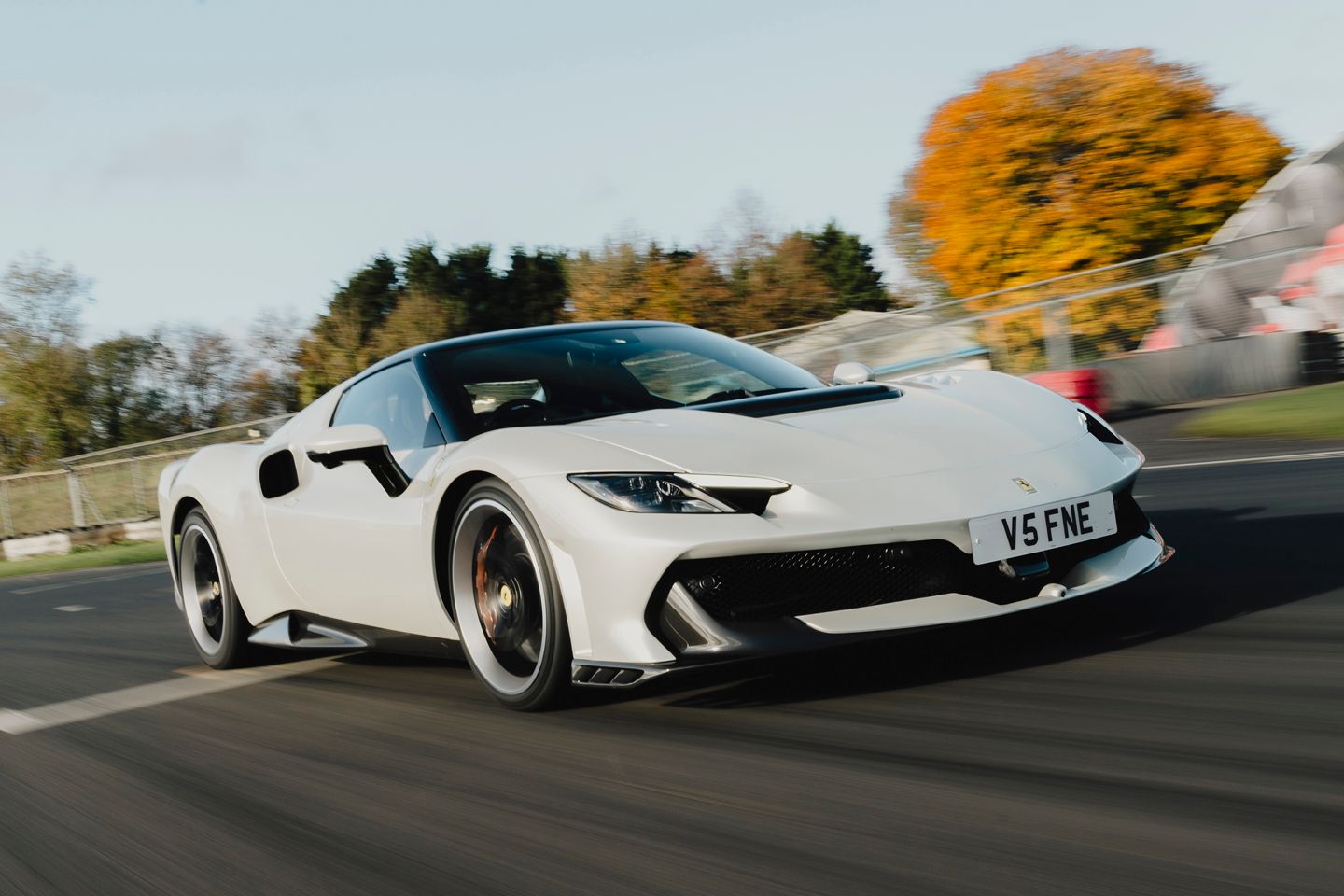
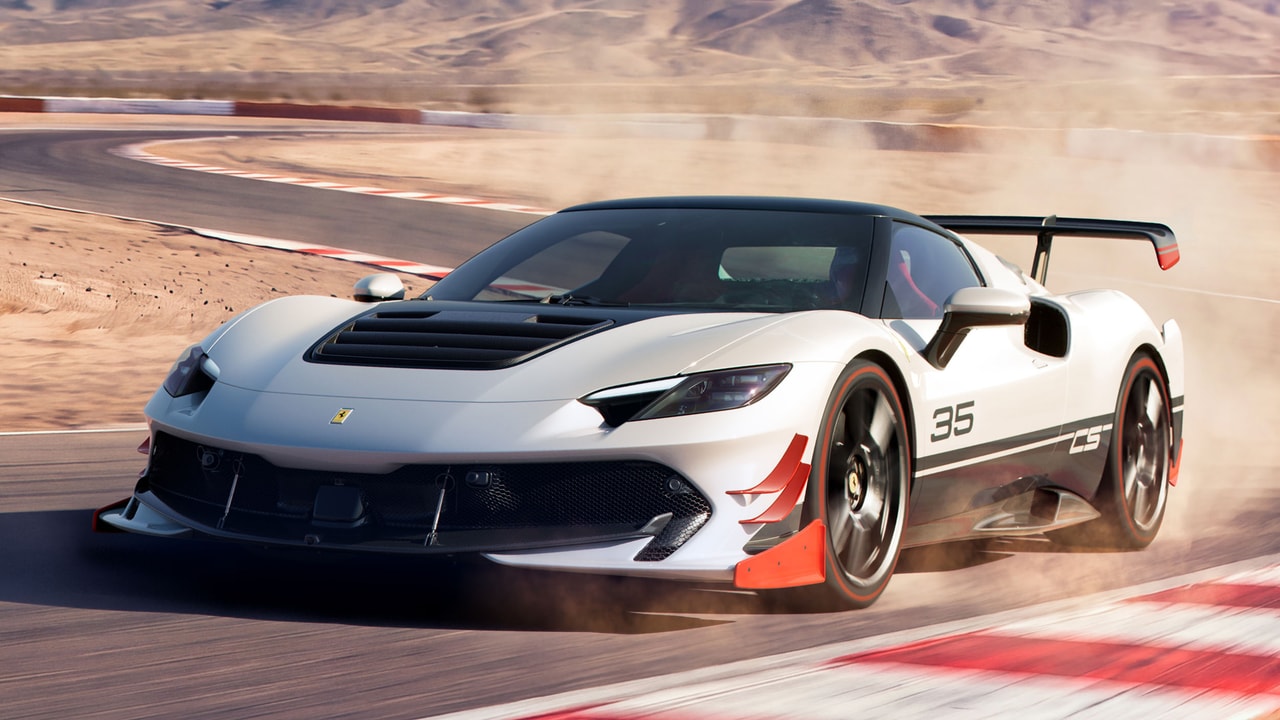
Ferrari unveiled the 296 Challenge Stradale at the Circuit de Barcelona-Catalunya during the 2026 Ferrari Finali Mondiali, stripping out the hybrid system to build a pure-combustion track car for the road.
Removing the Hybrid System to Save Weight
Dropping the battery pack and rear-mounted axial-flux electric motor allows the car to shed 140kg compared to standard models. Gianmaria Fulgenzi, Ferrari’s chief product development officer, said the engineering team wanted to avoid simply chasing higher horsepower figures, according to Motor Sport Magazine.
“We did not want to follow the pattern of having more horsepower like in the past,” said Gianmaria Fulgenzi, Ferrari’s chief product development officer. “We wanted a new paradigm. We worked on eliminating everything hybrid – erasing anything that wasn’t essential or useful.”
Gianmaria Fulgenzi, Ferrari’s chief product development officer
Without electric assist, the twin-turbocharged 3.0-litre V6 engine produces 670 horsepower at 8,000 rpm. The powertrain borrows internals from the Ferrari 296 Speciale, including titanium connecting rods and a nitrided steel crankshaft, while boost pressure and variable valve timing adjustments increase dynamic torque by more than 32 percent over the base 296 GTB.
Both models are equipped with a 2,992 cc, 120-degree V6 twin-turbo engine. Omitting the battery pack and electric motors allows this variant to shed 140kg while reducing output by roughly 200bhp.
Ferrari will offer the Challenge Stradale as a full-production model, rather than a limited edition. It is the second derivative of the standard 296 GTB, following the 868bhp Speciale.
Parallel development of this road variant took place alongside the upgraded 296 Challenge Evo designed for single-model motorsport. Adapting motorsport engineering for public streets defines the 296 Challenge Stradale, whereas the 296 Challenge Evo serves strictly as a competition machine entering the Ferrari Challenge single-make championship in 2027.
Competition for the Evo spans European and North American circuits beginning in 2027, coinciding with the Ferrari Challenge’s introduction of 40-minute endurance contests featuring two-driver lineups and mandatory pit stops.
Next year marks the initial debut of the 296 Challenge Evo within European and North American Ferrari Challenge rounds, with regional championships set to follow starting in 2028.
Ferrari’s deep-rooted history binds its street vehicles directly to its competitive motorsport endeavours. Enzo Ferrari was driven by a passion for racing, using commercial vehicle production primarily as a financial mechanism to support his track ambitions.
The Ferrari Challenge customer motorsport category, active since 1993, keeps that traditional link alive today. It started with the 348, followed by the F355, 360, and every generation since.
By bridging competition engineering and street usability, the 296 Challenge Stradale gets closer to a pure racer than any previous series Ferrari. Ferrari even calls it “the production car with the closest connection to a competition vehicle.”
No hybrid system.
670 horsepower.
Just 2,932 pounds. And 1,360 pounds of downforce at 155 miles per hour.
Created in tandem with the track-only 296 Challenge Evo, this vehicle is slated for entry into Ferrari’s single-make competition category beginning in 2027. The price? Around $307,000.
A fixed rear wing, dedicated front splitter, and fully enclosed underbody generate 617 kg of downforce at 250 km/h, representing a 72 per cent increase over the 296 GTB.

The car completes a lap of Ferrari’s Fiorano test track in 1 minute and 18.5 seconds, making it half a second quicker around the circuit than the more powerful SF90 supercar and half a second faster than the 296 Speciale.
Strikingly similar aerodynamic hardware on the racing variant is mirrored by the prominent rear spoiler, front dive planes, and assertive rear underbody diffuser.
Together, these aerodynamic devices generate an impressive 1,360 pounds of downforce at 155 miles per hour, over the 296 GTB crowned Road & Track Performance Car of the Year in 2024.
Chief development driver Raffaele de Simone said that “this is not a car for everyone. If you want to slide, you don’t want this car. This is like going back 30 years, it’s more precise, more challenging, with less assistance. It’s more difficult to drive. The brake pedal is firmer and has less travel, the throttle spring is stiffer and the steering is heavier”, according to Top Gear.
“We want the purest and the most direct relationship with the car,” said chief development driver Raffaele de Simone.
Emphasizing that hybrid technology remains vital for ultimate capability, engineers were careful to clarify that Ferrari is not abandoning electrified powertrains.
Circuit Comparisons and Production Availability
While the lighter Challenge Stradale holds an advantage on tighter courses, senior product manager Matteo Turconi outlined where different variants excel.
“At Fiorano and other twistier tracks the Challenge Stradale is faster,” Turconi said, “at high speed circuits like Monza, the Speciale is faster.”
“At high speed circuits like Monza, the Speciale is faster.” Aerodynamic downforce generated by the rear wing amounts to 270kg, which pushes the chassis firmly toward the tarmac.
Total downforce reaches 617kg at 155mph. Ferrari quotes a dry weight of 1,330kg.
The front luggage compartment remains, although it has been reduced to 67 liters. Unlike limited-run specialty models that require an established garage history, Ferrari intends to build the Challenge Stradale as part of its standard production lineup.
European pricing is set at 291,000 euros, translating to roughly $320,000, with United States deliveries expected to begin in the third quarter of 2027.
Ferrari traces its motorsport roots to 1929, when Enzo Ferrari founded Scuderia Ferrari as a racing team before building road cars under his own name in 1947. The company’s first road car, the 125 S, debuted that year, and its Formula One team, Scuderia Ferrari, remains the championship’s oldest and most successful entrant.
The Ferrari Challenge single-make series, which the new 296 Challenge Evo will join in 2027, has run since 1993, continuing the direct link between competition and production models that defines the brand.
According to Turconi, “this is not a car for everyone. Or the others come to think of it. Ferrari can be trusted to make it a blistering driver’s car.