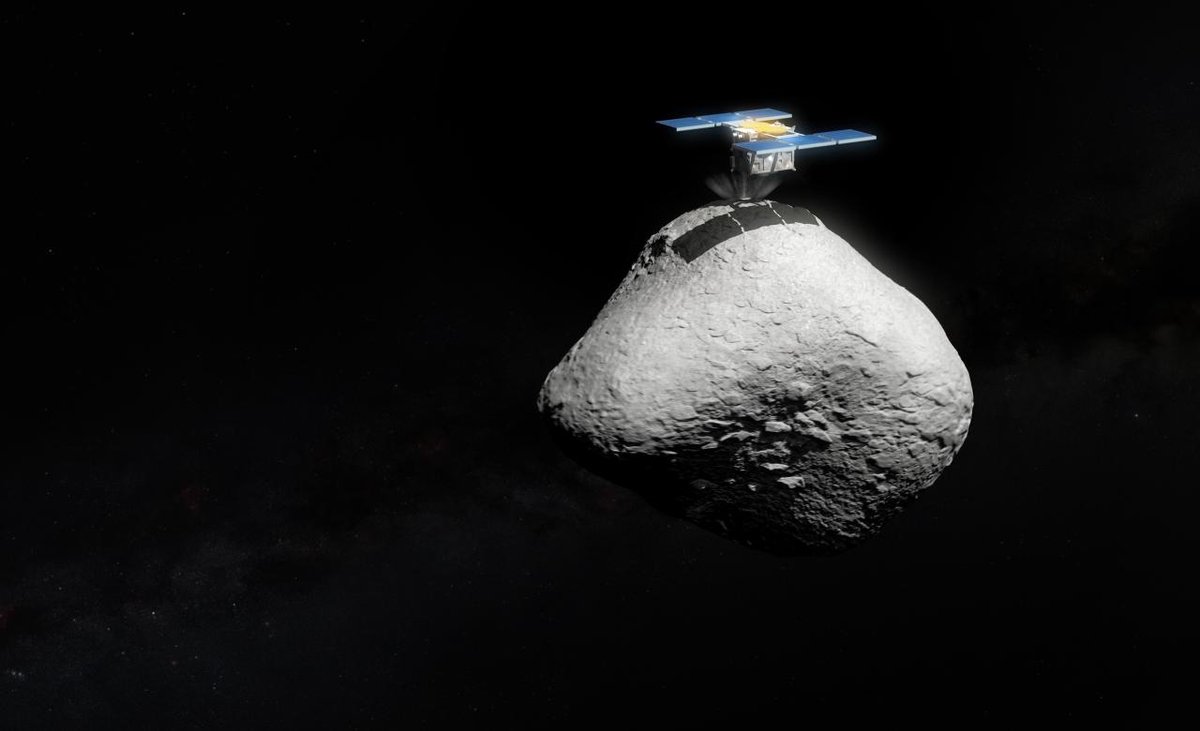
“extended mission,” officials from the Japan Aerospace Exploration Agency announced on November 16, regarding their Hayabusa2 spacecraft.
Operating past its lifetime, the probe can no longer reach 1998 KY26 for a rendezvous in 2031 due to engine problems. Instead, Hayabusa2 will now visit a different target, the near-Earth asteroid 2015 BM510, in 2028.
Hayabusa2 Targets a New Asteroid
Discovered in 1998 by astronomer Tom Gehrels of the University of Arizona, 1998 KY26 is about 36 feet across. It rotates about once every five minutes. The object orbits the sun between Earth and Mars, reflecting about 50 percent of the sunlight it receives. Its movements baffle people because it accelerates around the sun in ways gravity cannot explain.
A nongravitational acceleration on a minor body points toward cometary activity. However, 1998 KY26 lacks a visible tail. Researchers identified dark comets that experience similar accelerations without visible tails. Recent research demonstrates that 1998 KY26 is too warm to sustain ice.
Published in Icarus on October 28, 2026, a study by Korbin Hansen and Masatoshi Hirabayashi at the Georgia Institute of Technology found that the object has a temperature of minus 53 degrees Fahrenheit.
“If something has ice, then it’s a comet. But no ice means no comet,” Darryl Z. Seligman at Michigan State University told The New York Times, as reported by EarthSky.
Scientists Probe Radiation Pressure Theories
Davide Farnocchia, an engineer at NASA’s Jet Propulsion Laboratory in Pasadena, California, suggested that photons of light might push the small body through radiation pressure.
David Jewitt, director of the Institute for Planets and Exoplanets at the University of California, Los Angeles, said that the momentum per photon is very small. There are a lot of photons pushing objects around if they are not too big.
Another potential driver is the Yarkovsky effect. Combined with radiation pressure, these forces might account for the observed accelerations of 1998 KY26, an interpretation that NASA favors.
Harvard University astrophysicist Avi Loeb proposed that the object could be the Soviet Phobos 1 probe launched toward Mars in 1988.
Japan Aerospace Exploration Agency, formed in 2003 by merging three predecessor bodies, operates the Hayabusa missions from which the current spacecraft descends. Its first asteroid sampler, Hayabusa, returned material in 2010, and Hayabusa2 later deployed rovers on an asteroid surface. JAXA also runs the H3 and Epsilon S launch vehicles and contributes the Kibō module and resupply flights to the International Space Station.
NASA Administrator Jared Isaacman said that there is no evidence the object is “anything but an asteroid,” and Bryce T. Bolin of Eureka Scientific Inc. said that the object is way too heavy, way too dense to be space junk.