The Welsh Government ruled out a mass badger cull in its new eradication strategy on Tuesday, confirming it will not follow England’s path of widespread, non-selective killing.
Cabinet Minister for Rural Resilience and Sustainability Llŷr Gruffydd MS announced the decision in a Senedd statement responding to the Bovine TB Eradication Programme Board. The government committed to evidence-based action across “cattle, people and wildlife” but explicitly rejected a mass cull — the policy in place across England since 2013.
The published response allows “targeted and proportionate interventions” in wildlife. That includes trapping badgers, testing them for TB, vaccinating and releasing them — or removing them from the population. Killing badgers remains a possibility, just not on a mass, non-selective scale.
Ethical principles make it clear that lethal intervention should be the last option and only in exceptional circumstances, with clear, time-bound objectives as part of a systematic plan.
RSPCA Cymru
The RSPCA pointed to its own polling showing 46% of people in Wales categorically oppose badger culling, compared to 27% who support it, while 98% consider protecting Welsh wildlife important. Thomas urged ministers to prioritise cattle-based measures, which she said are “more cost-effective and have been proven to work.”

Rob Pownall, founder of Protect the Wild, called the ruling “an enormous relief and a testament to the tens of thousands of people who refused to stay silent.”
“Today’s confirmation that the Welsh Government will not pursue a mass badger cull is an enormous relief and a testament to the tens of thousands of people who refused to stay silent. It means Wales will avoid the widespread slaughter that has devastated badger populations across England,” Pownall said.
Pownall warned against declaring victory. “Calling it 'targeted removal' doesn't change what happens to the animal being killed,” he wrote.
The group argues that badgers are being made scapegoats for disease spread within a human-created cattle farming system, citing government figures showing new cattle herd TB incidents fell by 22.6%, while the number of cattle slaughtered following testing also fell by 22.6% in the year to June 2026, with 95.7% of herds TB-free — all without a mass cull.
Pressure built after the Plaid Cymru administration published its Programme for Government 2026–2030 in September, promising a “holistic approach to eradication that is evidence-based and science-led, incorporating the three pillars of cattle, people and wildlife.” The government did not rule out a return to badger culling at that stage, prompting RSPCA Cymru to launch a supporter action urging Members of the Senedd to demand a public consultation before any decision.
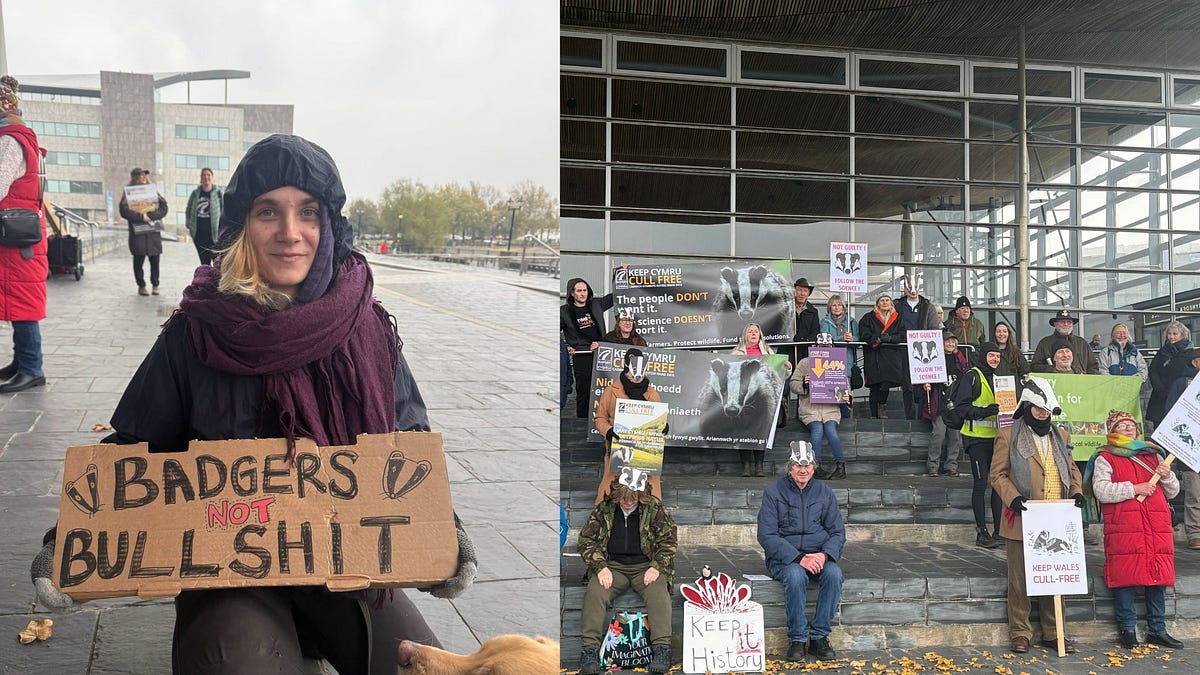
That campaign culminated in a demonstration outside the Senedd earlier this month, where more than 100 people gathered in poor weather to oppose a cull. Tuesday’s statement is the government’s formal response to the Eradication Programme Board’s recommendations.
Cabinet Minister for Rural Resilience and Sustainability Llŷr Gruffydd MS, who has held the Plaid Cymru environment and rural affairs portfolio since October 2018 and previously served as Shadow Minister for rural affairs, announced on Tuesday that Wales will reject a mass badger cull in its new bovine TB eradication strategy.
The government says further decisions will depend on evidence, research — including population surveys and fieldwork — and potentially public consultation. No new targeted cull has been announced. For now, Wales has avoided the mass culling that has killed hundreds of thousands of badgers in England since 2013, but the framework for lethal wildlife control remains in place.