Nearly 100,000 residents have been moved inland as Cyclone Arnab batters India’s eastern coast with sustained winds topping 125 kilometers per hour.
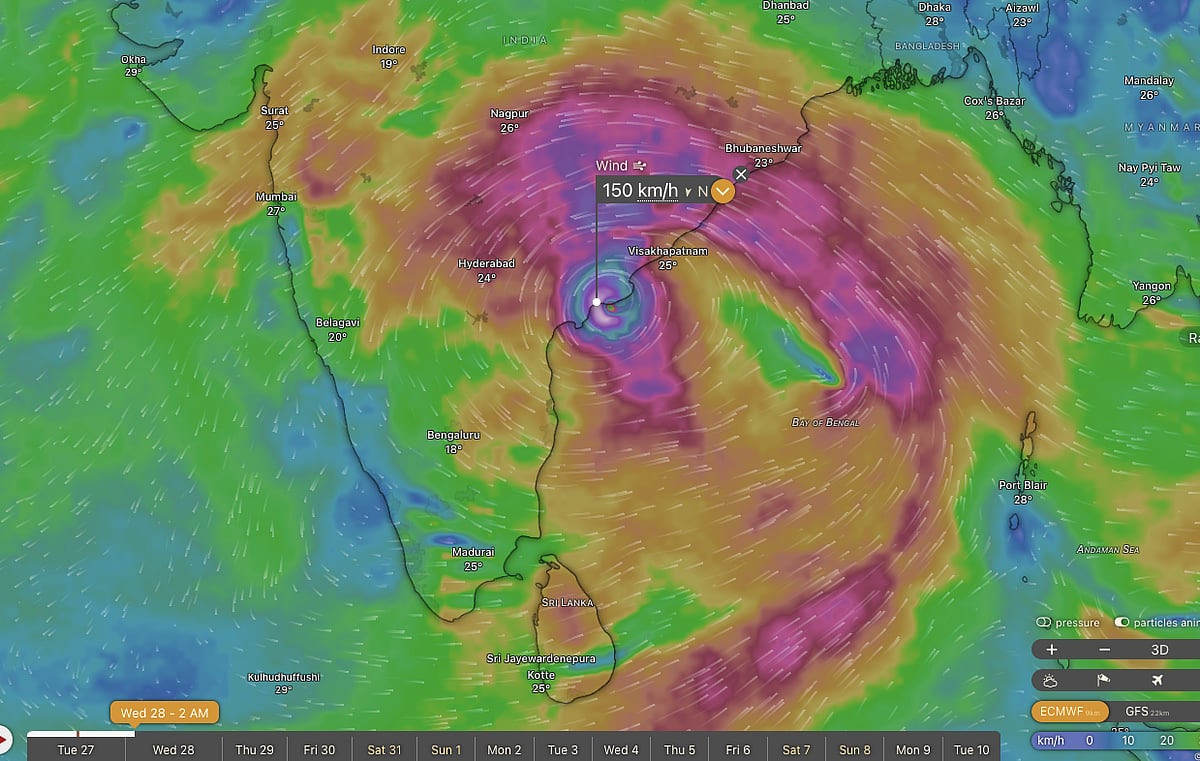
The storm made its drawn-out landfall over Andhra Pradesh on October 28, 2026, bringing gales that tore down trees, wrecked power lines, and triggered torrential rainfall across the region. According to the India Meteorological Department (IMD), the system packed wind gusts reaching 150 kilometers per hour, ranking it in the third-highest category on a five-tier storm scale. The destructive weather has severely disrupted transportation networks, halting both train and flight operations across Andhra Pradesh and neighboring Odisha.
The severe cyclonic storm “Arnab” over Coastal Andhra Pradesh & Yanam and adjoining Westcentral Bay of Bengal, moved very slowly north-northwestwards with the speed of 7 kmph during past 6 hours and lay centered at 1430 hrs IST of today, the 28th October, over the same region… pic.twitter.com/OAr8wtop6W
Heavy Rainfall Floods Northern Districts
The heaviest rainfall concentrated across north coastal Andhra Pradesh, where meteorological stations recorded staggering accumulation totals within a single day. Garividi and Srungavarapukota in Vizianagaram district recorded 26 cm and 25 cm of rain respectively, while Anakapalli logged 25 cm and Visakhapatnam recorded 22 cm. The resulting waterlogging prompted authorities to shut educational institutions on October 29. These closures represent district-level administrative decisions rather than a blanket statewide mandate, with further extensions depending entirely on fresh assessments from individual District Collectors.
For elderly residents and families in low-lying coastal zones, the storm brought terrifying memories of prior weather events. Rajeshwari, a 65-year-old resident sheltered in a government facility near Kakinada, described the reality of rising water levels. Our homes get flooded, and we have to stay in the water,
she told AFP, explaining why she accepted transportation on a government-provided bus to safety.
Relief Operations and the Threat of a Second System
In response to the mounting crisis, Andhra Pradesh Chief Minister N Chandrababu Naidu credited advance evacuations and precautionary planning with preventing casualties so far. Across the border in Odisha, Chief Minister Mohan Charan Majhi convened a high-level review meeting at the Office of the Special Relief Commissioner, directing the Odisha Disaster Rapid Action Force (ODRAF), National Disaster Response Force (NDRF), and Fire Services to maintain high alert status while prioritizing the restoration of drinking water, electricity, and communication infrastructure.
Even as Cyclone Arnab weakens, forecasters warn that weather risks are far from over. The IMD is tracking the storm using Doppler weather radar in Visakhapatnam while monitoring compounding meteorological factors. Weather forecasting models, including projections from the European Centre for Medium-Range Weather Forecasts (ECMWF) and the Global Forecast System, point to the possibility of a fresh low-pressure area forming over the southeast Bay of Bengal. Weather blog Vagaries of Weather noted that this new system could approach the Odisha coast around November 1 or 2, though meteorologists emphasize that these long-range projections remain uncertain and a secondary cyclone formation is not yet confirmed.
I spoke with Union Home Minister Shri @AmitShah Ji and briefed him on the impact of #CycloneArnab across Andhra Pradesh.I explained the extensive damage caused by the cyclone, particularly to agricultural and horticultural crops, power infrastructure, roads and other public…
More on Cyclone Arnab
NDRF personnel remove a fallen tree in Seethammadhara, Visakhapatnam, amid Cyclone Arnab on Wednesday, October 28, 2026. 📹 @krdeepu18 pic.twitter.com/CGUeSHcFT2
VIDEO | Bhubaneswar: On Cyclone Arnab, IMD Director Manorama Mohanty says, “The landfall process has now been completed. It began at around 2 AM and continued until 8 AM today, taking approximately six hours to complete. As of now, the very severe cyclonic storm has weakened into… pic.twitter.com/vWfRcUzDIO”
✈️ Vijayawada International Airport – Flights Update for 28.10.2026Due to Cyclone ARNAAD, 18 flights are cancelled and 4 flights scheduled, as per the latest information. Passengers are advised to check with airlines for updates.@AAI_Official @AAIRHQSR @DGCAIndia @MoCA_GoI pic.twitter.com/mEYaQvETNc
#WATCH | A cargo vessel carrying sulphur appears to have drifted and run aground in the sea near Antarvedi in Andhra Pradesh, amid cyclone ArnabAccording to port officials, the vessel departed from Visakhapatnam but drifted off course after its engine reportedly failed. The… pic.twitter.com/lV6x5EQqWT
The severe cyclonic storm “#Arnab” over Coastal #Andhra_Pradesh & #Yanam and adjoining Westcentral Bay of Bengal, moved very slowly northwestwards with the speed of 5 kmph during past 6 hours and lay centered at 1130 hrs IST of today, the 28th October, over the same region near… pic.twitter.com/dKCbxGqowp
Andhra Pradesh Chief Minister N. Chandrababu Naidu writes to Union Home Minister Amit Shah seeking a Central team to assess Cyclone Arnab damage. pic.twitter.com/B5Km8dGA4E
Waves surge along the Visakhapatnam coast on Wednesday, hours after Cyclone Arnab crossed the coast near Narsapur. The city’s beaches remain closed.Video: @krdeepu18 pic.twitter.com/rOghvaq7MH
Our government stands firmly with the people of Andhra Pradesh as we face the challenges posed by #CycloneArnab. We are making every possible effort to minimise the impact of the cyclone, protect lives and restore normalcy at the earliest.I have been continuously monitoring the… pic.twitter.com/amishohZPy
Reviewed the ground situation with senior officials today in the wake of Cyclone Arnab.Minor disruptions like tree falls reported across 10 locations, were promptly attended to. Situation is being closely monitored to maintain safe and smooth train operations.
Travel AdvisoryDue to bad weather conditions arising from Tropical Cyclone Arnab, flights to and from Rajahmundry, Vijayawada and Visakhapatnam will remain impacted today as well.Customers are advised to check their flight status before proceeding to the airport.The safety…
People make their way past trees that fell across a road at Samanasa village in Konaseema district after Cyclone Arnab crossed the coast on Wednesday.Video: @Vudimudiraju pic.twitter.com/d2qhAhDKnK
The true test of leadership comes in the toughest of times. As Cyclone Arnab strikes our coast, Andhra Pradesh is fortunate to have a leader of deep experience and immense calibre at the helm, standing with every family.@ncbn #CycloneArnab#AndhraPradesh… pic.twitter.com/51xHePVrAW
National Bulletin No. 28 based on 1730 hrs IST of 28th October, 2026: Cyclonic Storm “Arnab” [Pronunciation: Ornab] over Coastal Andhra Pradesh & Yanam and adjoining Westcentral Bay of Bengal—Red Message]The severe cyclonic storm “Arnab” over Coastal Andhra Pradesh & Yanam and… pic.twitter.com/SkQNbZABDw