At 3:54 p.m. ET on Friday, November 13, the Federal Aviation Administration grounded every departing flight in America, marking only the third nationwide ground stop ever ordered.
The restriction paralyzed commercial aviation as “a communication issue” struck all 22 regional centers guiding air traffic across the country, according to transportation officials. The emergency measure came in the wake of old equipment buckling under a surge of data, forcing transport authorities to halt all departures for more than five hours.
Federal Aviation Administration Grounds U.S. Departures
The nationwide halt began at 3:36 p.m. New York time when the agency ordered its 22 traffic management centers to suspend flights “due to extraordinary circumstances and for reasons of safety.” Only two prior nationwide ground stops had ever been ordered before this incident, with the first occurring on September 11, 2001, and the second on January 11, 2023.
During the five-hour blockade, no aircraft departed, while planes already airborne were handled individually through emergency procedures. The agency lifted the prohibition at 8:15 p.m. New York time, but the operational disruption rippled across the global network.
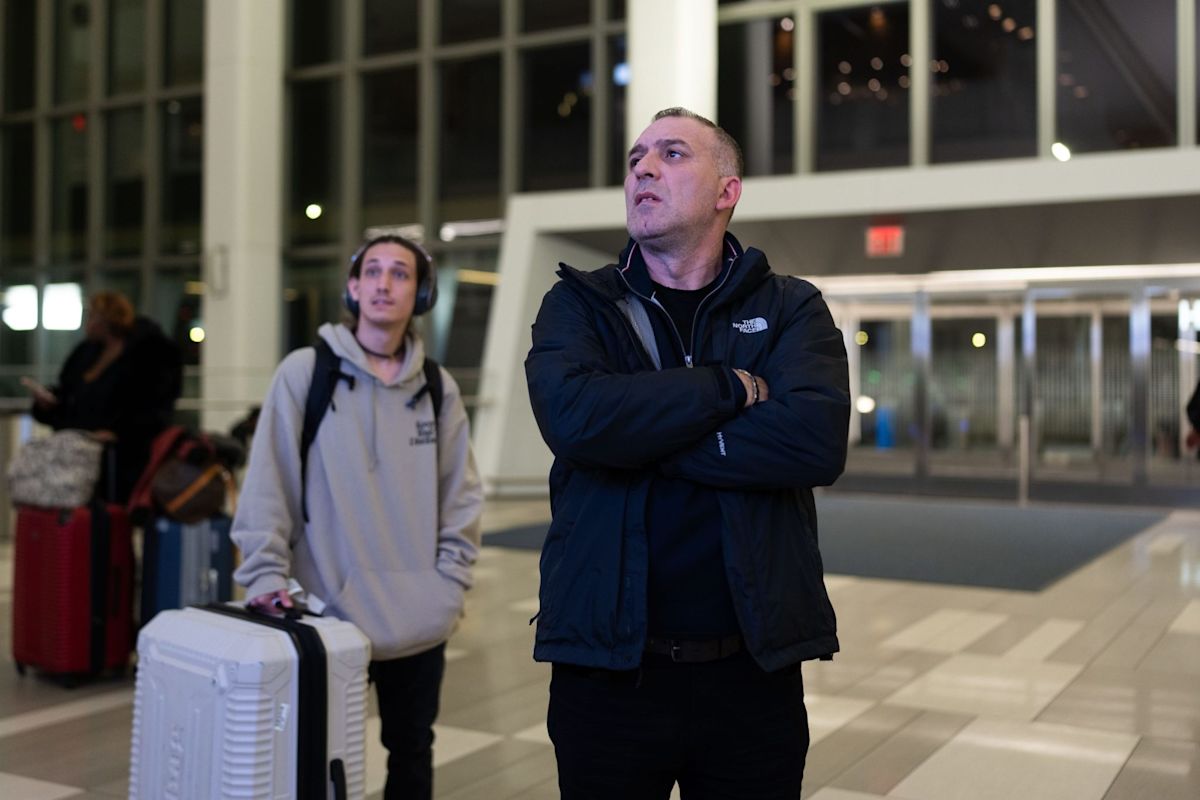
FlightAware data showed that the Friday ground stop resulted in more than 9,000 canceled flights. By early Saturday morning, cancellations had climbed past an additional 3,700 flights, leaving hundreds of thousands of passengers stranded in long queues at airport rental counters and ticket desks.
Our absolute priority is your safety, as well as that of your family when you fly. It will take us time to return to normal operations.
Sean Duffy
Sean Duffy Demands 50 Billion Dollars
Sean Duffy explained that radar and communication systems operated only in an intermittent manner across multiple facilities, leaving air traffic controllers unable to track aircraft positions in real time. Officials quickly ruled out any cyberattack or connection to a major Microsoft outage that had disrupted services globally a day earlier.
Investigating the underlying mechanism, Duffy pointed to antiquated infrastructure within the aviation network. We use copper lines from the 1980s, he told reporters at the White House, describing a fragile system overwhelmed by data volume. Some equipment dated back even further, operating on hardware from the 1960s alongside floppy disks.

While the administration had previously asked Congress for $30.1 billion to upgrade air traffic control systems, Duffy pressed lawmakers for a larger package. I want 50 billion dollars, Duffy stated, arguing that a completely modernized network is required to prevent future systemic failures.
Markwayne Mullin Rules Out Cyberattacks
Sean Duffy addressed the public in a subsequent press briefing, confirming that there is no cyberattack and no link to the Microsoft failure.
The aviation blackout highlighted ongoing strains within the American air traffic system, which employs more than 14,000 controllers managing upwards of 44,000 daily flights. Chronic staffing shortages, amplified by the COVID-19 pandemic, have compounded infrastructure vulnerabilities.
Prior communication breakdowns had already tested the network, including twin telecommunications failures at the Philadelphia control center that disrupted arrivals at Newark Liberty International Airport in the spring of 2025, and an accidental severed telecom line that grounded flights along the East Coast in September 2026.
Earlier coverage: Federal Aviation Administration Halts All Departures Nationwide