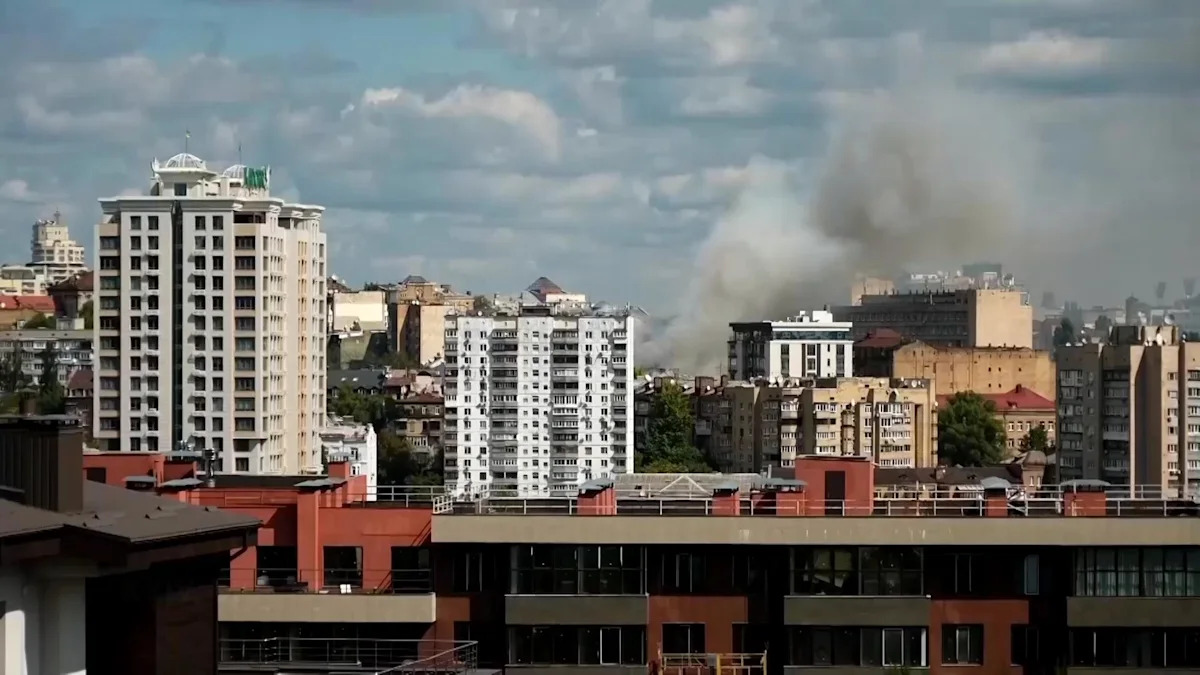
Day and night air raid alerts have become a permanent fixture for Kyiv residents as relentless drone and missile strikes disrupt daily life and target the capital’s energy infrastructure and bridges ahead of the winter season.
Air raid sirens now sound around the clock in Ukraine’s capital, disrupting commutes and draining public resilience. Beginning in late August 2026 and accelerating sharply through September, Moscow abandoned its earlier pattern of mostly nighttime bombardments, deploying fast-flying, jet-powered drones that cross the capital in a matter of minutes according to regional reporting. Where residents once relied on daylight hours for safety, the baseline of wartime life has fundamentally altered.
The toll of the campaign has seen dozens of civilians killed in the capital over recent months, and hundreds have been injured.
Jet-Powered Drones Strain Kyiv Air Defenses
The technical nature of the air war has evolved past the slower propeller-driven drones that volunteer defense teams spent the last few years successfully picking off.
Ukraine is experiencing chronic shortages of U.S.-made Patriot air defense systems and PAC-3 interceptors, which remain among the few weapons in the country’s arsenal capable of intercepting fast-moving Russian ballistic missiles as noted by field production teams. That defense effort faces severe logistical bottlenecks. With interception rates dropping against faster targets, alarms frequently sound after or even during explosions, leaving citizens with seconds to find shelter.
Putin wants to destroy us. He doesn't respect us, our sovereignty and territorial integrity. He really thinks that we are not a country, not a nation. Do you really believe that just the eastern part of our country will be enough for him? Then why did he go for Kyiv when the… pic.twitter.com/nxF5n5t0yt
The speed gap between jet-powered drones and older anti-aircraft setups has driven down interception rates. Ukrainian authorities had anticipated assaults of this nature since the year started, while the monthly output of standard Russian ballistic missiles simultaneously climbed above previous production levels of roughly 60 units.
Families Face Constant Psychological Toll and Disruption
Nikita Horskyi and Alona Horska shelter with their two children in a hallway because their 16-story apartment building lacks a proper basement shelter following an early morning attack that triggered multiple explosions. The air-raid alarm sounded at 3:11 a.m., and within three minutes nearly 10 explosions struck, waking the family and prompting Horskyi to carry the children while Horska prepared makeshift beds. The pair positioned the kids in the corridor because they figured a dual-wall setup offered superior protection compared to an outer wall by itself, as reported by The New York Times.
Of course, it affects my mental state and my nerves
Mark, 10
I have to come up with things to calm myself down
Mark, 10
The New York Times noted that Mark also talked about having to keep his anxiety under control following every blast. Despite the nighttime attacks, the children nonetheless got up for school. When attacks happen every day, residents note it is hard to describe the experience without swearing.
Strikes Target Critical Infrastructure Before Winter
Recent strikes have hit a data center in Shuliavka in an office building, an office of Ukrtelecom sharing a building with the private clinic Dobrobut, and another Ukrtelecom office located in a building next to the National Academy of Sciences according to frontline journalistic accounts.
We believe this war will be over as soon as possible. But Putin plans to stick around much longer. He is building a Russia that looks like North Korea – where children are raised from an early age for war and to die for their leader. So Russia will not stop being dangerous.And… pic.twitter.com/v0fWIsD7mn
Police officers inspected damages following a Russian drone strike on the Northern Bridge on October 4, 2026, during the Russian invasion of Ukraine, as transportation arteries absorbed direct impacts. Shortly after the German chancellor flew in on an unannounced trip on October 4 to demonstrate European backing during escalating strikes, Moscow targeted another principal bridge in Kyiv.
Residents face the prospect of severe energy supply issues as temperatures drop. Frequent repeat attacks make it harder to repair the damage as winter approaches, echoing conditions from the previous year when certain Kyiv neighborhoods spent weeks completely devoid of heat while outside readings frequently plunged beneath minus 20 degrees Celsius (minus 4 degrees Fahrenheit).
The world’s best gamers would envy this level of play. Ukrainian interceptor drone pilots catch Russian recon and strike drones in the air and turn them into falling scrap. For warriors on the front line, each downed drone is one less threat overhead. For cities in the rear,… pic.twitter.com/aq9OLGnsFs