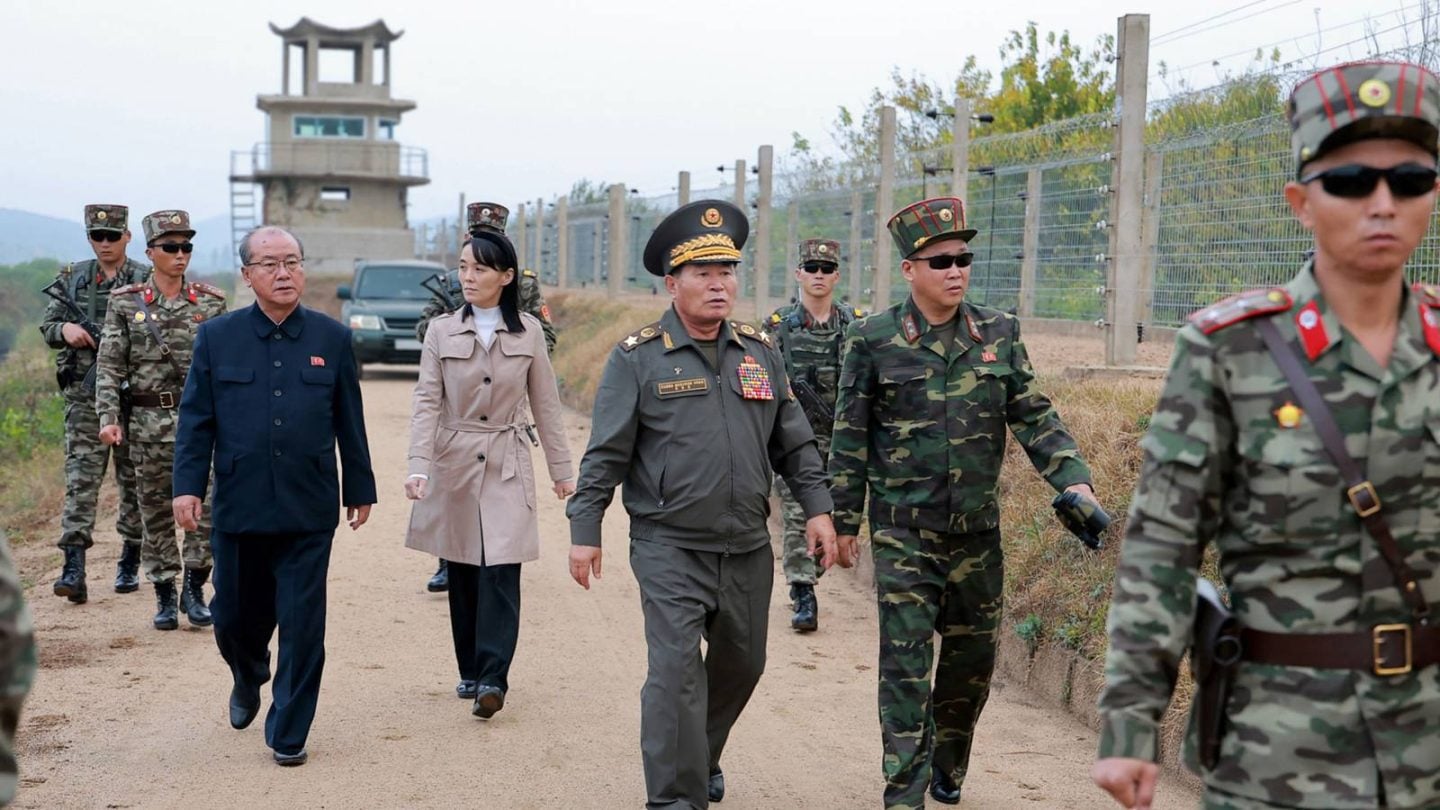
North Korea has constructed a continuous fortified barrier along its 250-kilometer border with South Korea since April 2024, laying about 960,000 landmines and escalating tensions following a September border blast that injured three South Korean soldiers.
Why is North Korea building a permanent border inside the DMZ?
The 250-kilometer frontier has long operated as a 4-kilometer-wide demilitarized buffer zone established under the 1953 armistice that halted the Korean War. Since April 2024, however, North Korea has transformed that buffer by constructing a continuous physical barrier made of wire fencing, tactical roads, anti-tank barriers, and minefields on ground stripped of vegetation. South Korea’s joint chiefs of staff report that ground-clearing is nearly finished, with construction roughly 40 to 60 percent complete and expected to conclude by the second half of 2028.
International relations experts connect this militarization to a fundamental policy shift by North Korean leader Kim Jong Un. After decades in which reunification remained a stated goal, Kim redefined South Korea in December 2023 as a separate, hostile state, leaving Pyongyang free to pursue status as a nuclear state without the ideological contradiction of threatening reunification targets. Analysts in Seoul indicate the fortification serves multiple objectives: preventing citizens from leaving, slowing any South Korean advance if warfare returns, and converting the frontier into something that works as an international border.
How a September landmine blast plunged relations to new lows
Friction along the frontier intensified sharply on September 21, when three South Korean soldiers sustained injuries from a landmine explosion while clearing a path inside the demilitarized zone. One soldier lost a foot in the blast. Following an inspection with the U.S.-led United Nations Command, South Korea’s military concluded that the devices were North Korean mines planted south of the military demarcation line, and Seoul demanded an immediate apology and clearance of remaining mines.
Pyongyang rejected all responsibility for the explosion, dismissing the accusation as a self-staged farce
. Tensions continued to mount as South Korea reported that North Korean troops crossed the border’s demarcation line 50 times during fortification work this year, prompting South Korean warning shots and broadcast responses. North Korea countered that those warning shots constituted provocations by armed rogues
that had crossed beyond the red line
.
Kim Yo Jong inspects frontline positions and threatens retaliation
Kim Yo Jong, the sister of the North Korean leader, inspected frontline border areas alongside Korean People’s Army Marshal Pak Jong Chon, praising the fortification work as a sacred and great undertaking
supporting her brother’s policy of permanent separation. She issued a series of sharp statements criticizing Seoul and warning of severe retaliation against any South Korean interference with the barrier.
Our military leadership underlined the need to make those rogues aware that our new firepower units have taken their firing positions.
Kim Yo Jong, North Korean official
Kim Yo Jong warned that if South Korean warning shots caused actual harm to our territorial security and our service persons’ safety
, North Korea will show no mercy for the armed gangsters bereft of reason
. She also announced that psychological warfare loudspeakers would resume broadcasting across the border.
Where does the disputed military demarcation line actually run?
Compounding the military friction is deep uncertainty over the precise location of the border. The 1953 armistice drew the military demarcation line on maps at a scale of 1:50,000, where a single millimeter-wide line covers roughly 50 meters of terrain. While the exact location of the border remains uncertain, North Korea has been constructing fortifications along the line.
As a result, each side relies on a different methodology to reconstruct the boundary. Seoul uses mapping aligned with the U.S. National Geospatial-Intelligence Agency, the United Nations Command applies its own decade-old survey, and North Korea connects the visible markers it can still locate. South Korea’s defense ministry found that its mapped line disagrees with the United Nations Command survey at roughly 60 percent of compared points, frequently varying by tens of meters.
Seoul demands halt to border fortification
South Korea’s defense ministry has condemned the border fortification as an armistice violation, demanding that Pyongyang halt construction. Seoul has also proposed bilateral talks to jointly verify the demarcation line, restore military communication channels cut in 2023, and establish protocols to prevent accidental clashes. Pyongyang ignored a similar offer made a year prior.
Daniel Pinkston, an international relations lecturer at Troy University in Seoul, noted that while North Korea maintains asymmetric advantages through nuclear weapons and weapons of mass destruction, command and communication hurdles would hinder its ability to win a conventional war. He added that Pyongyang’s deepening military ties with Russia, including sending personnel to support operations against Ukraine, may be emboldening Kim Jong Un to take firmer action against the South amid a total absence of interest in dialogue from Pyongyang.