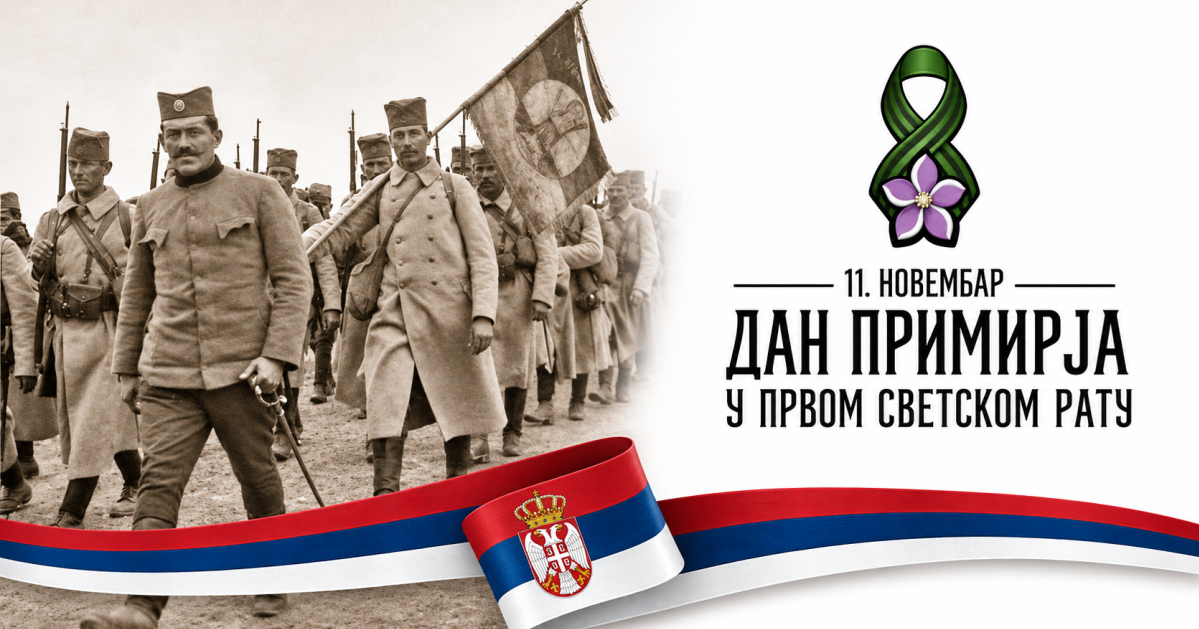
Serbia marked Armistice Day on Wednesday with state ceremonies, a 10-round artillery salute on the Kalemgdan fortress, and memorial services honoring the generation that survived the devastating front-line toll of the First World War.
Defence Minister Bratislav Gašić laid a wreath at the Monument to the Unknown Hero on Avala, accompanied by Chief of the General Staff General Milan Mojsilović and Military Cabinet Head Brigadier General Boris Stojković. Guard units performed a ceremonial drill alongside the national anthem, and Gašić inscribed a tribute in the memorial book.
Across the city, members of the Serbian Armed Forces Guard fired 10 rounds from six artillery pieces from the Sava Terrace on Kalemgdan, operating under an order issued by acting President Ana Brnabić.
The artillery firing was attended by acting Assistant Minister for Budget and Finance Goran Momčilović, Operations Department J-3 Chief Brigadier General Novica Gogić, Guard Commander Brigadier General Vladimir Vukajlović, and Republic President Military Cabinet Chief Brigadier General Boris Stojković.
The national holiday marks the armistice signed in a railway carriage in the Forest of Compiègne in France. The allied document was signed in a special carriage of Marshal Ferdinand Foch, and it remained in force until the signing of the Treaty of Versailles on June 28, 1919.
The suspension halted more than four years of conflict that killed people worldwide. While the fighting stopped that morning, the formal legal state of war continued until the signing of the Treaty of Versailles on June 28, 1919.
Armistice Day is observed as a non-working day in Serbia, while equivalent remembrances are held internationally. In Britain, New Zealand, France, Belgium, and Commonwealth nations, the date is marked as Remembrance Day or “Armistice Day,” while the United States observes it as Veterans Day.
Marković noted the significance of Great Britain, France, and Russia, which participated in the war until 1917, as reported by the public broadcaster RTS.
According to official data, Serbia’s total losses reached 1,247,435 individuals—representing roughly 28 percent of the population recorded in the 1914 census. This total comprised 402,435 military casualties and 845,000 civilian deaths resulting from the four-year conflict.

Notable military exploits from the era include the aerial victory achieved by artilleryman Raka Ljutovac, a member of the “Tanasko Rajić” artillery regiment, who successfully brought down an enemy aircraft with ground artillery in late September 1915.
The visual emblem itself was created in 2013 by then-Director of the Office for Kosovo and Metohija Marko Đurić and Ambassador to Brazil Aleksandar Ristić. The symbol serves to represent the severe losses sustained by the nation alongside its subsequent recovery.
The plant, discovered in the Jelašnica Gorge near Niš in 1882 by court physician Sava Petrović, possesses the biological capacity to rehydrate and return to green life after appearing completely dry during droughts. Officials said that the flower serves as a dual emblem representing both the profound suffering of the nation and its subsequent recovery.
Protected under Serbian law as a strictly endangered species, natural habitats of Natalija’s ramonda include the Jelašnica Gorge and Mount Kajmakčalan.