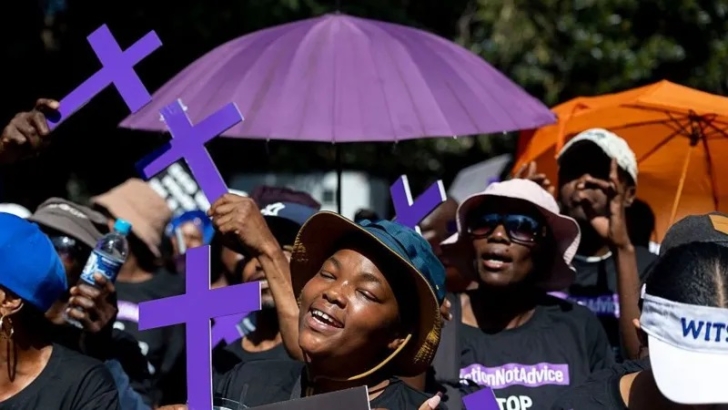
South African police recorded the deaths of 581 women between July and September this year, according to newly released national crime statistics.
The data was published on Friday. Officials said it remains unclear whether the figures represent an increase or decrease from previous periods. Police had previously suspended the reporting of separate statistics for female victims, citing “significant anomalies” in the data.
Gauteng Province Leads Female Murder Count
Gauteng province accounted for 131 of the female victims. The province encompasses Johannesburg. The figure includes 13 women discovered in public spaces around the region. They were often found partially naked and showing signs of physical trauma. These cases drew national outcry and pressure on law enforcement to secure arrests.
General Tommy Mthombeni is the police chief for Gauteng. He confirmed on Thursday that eight suspects are in custody in connection with the 13 murders. Three individuals are linked to the death of Elizabeth Moselakgomo. She was a 38-year-old runner. Her disappearance in Kempton Park triggered a high-profile search. Her body was recovered on September 12. It was badly bruised and partially clothed.
Ntimba’s was the ninth body found in the Ekurhuleni region. An arrest was also made in July regarding the death of Busisiwe Mahlangu, the first of the 13 victims identified in the Kempton Park area, whose body was found on July 15.
National Murder Rate Dips Slightly
Total murders nationwide declined slightly. Police reported 5,590 homicides during the three-month period. That is a reduction of 204 cases compared to the same time last year. The country still averages approximately 60 murders per day.
Acting Police Minister Firoz Cachalia addressed the need for “greater efforts to prevent… violence” against women and children following the release of the data.
According to police, three masked men entered the home looking for the owner. No arrests have been made in connection with the Free State shooting.
Gauteng, South Africa’s smallest province by land area at just 1.5% of the country’s total, holds more than a quarter of the national population with roughly 16.1 million residents. Formed from the former Transvaal province after the 1994 multiracial elections, it was renamed from Pretoria–Witwatersrand–Vereeniging to its current Sotho-Tswana name meaning “place of gold” in 1995. The province encompasses Johannesburg, the country’s largest city and financial hub, and Pretoria, the administrative capital.
President Cyril Ramaphosa previously declared violence against women a “national disaster” last year and has vowed that “no stone will be left unturned” in the pursuit of justice for these victims.


