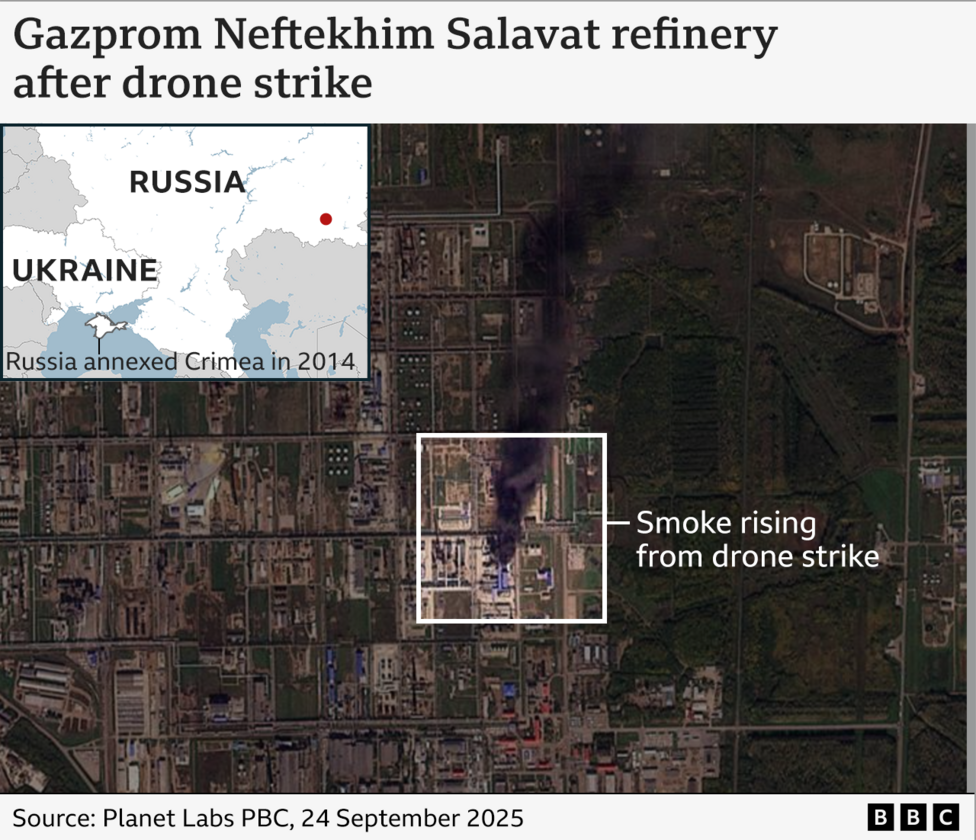
US President Donald Trump called for Ukrainian leadership changes and blamed Kyiv for high fuel costs following a Russian strike that killed 20 people in Zaporizhzhia. President Volodymyr Zelenskyy countered that Ukraine would halt refinery strikes only if Russia stops hitting the nation’s energy grid.
The political collision between Washington and Kyiv erupted as a high-stakes diplomatic push collided with surging energy costs ahead of upcoming midterm elections. The friction intensified after the White House announced an agreement with Moscow to release significant quantities of Russian diesel onto global markets. On Friday, President Donald Trump made public that Moscow will immediately provide over 300,000 tons of diesel, with another 500,000 tons arriving in November and 1 million tons coming straight after. Depending on the state of their diesel refineries, Russia will soon ship 3,000,000 tons of diesel fuel within a brief timeframe.
Donald Trump Demands Leadership Change and Blames Kyiv for Diesel Prices
Speaking to reporters before leaving the White House, Trump asserted that Volodymyr Zelenskyy had failed to end the conflict and claimed responsibility for inflating fuel prices through ongoing drone attacks on Russian energy facilities. The US president argued that the Ukrainian leader had lost thirty percent of the country and insisted the war should never have started. Trump claimed that if he had been president in 2022, Russia’s invasion of Ukraine would have never started, stating there was no reason the war started and that it began due to incompetence.
“I suggest they get a new leader who can make a deal because he could have made many deals and for some reason he never does.”
President Donald Trump, via Associated Press
Trump also issued a direct warning regarding long-range drone strikes, stating that he had instructed the Ukrainian president to spare petroleum infrastructure. According to the administration, those refinery attacks threaten American farmers and ranchers by driving up diesel expenses. Administration envoys Steve Witkoff and Jared Kushner reportedly raised the prospect during recent talks in Miami that intelligence sharing could be curtailed if Kyiv failed to halt the strikes. Outside the Mariinskyi Palace following talks in Kyiv, images from September 6, 2026, captured Ukrainian President Volodymyr Zelenskyy at a joint news conference alongside Steve Witkoff and Jared Kushner, special envoys of US President Donald Trump.
Volodymyr Zelenskyy Offers Energy Truce as Deadly Bombardment Hits Zaporizhzhia
Hours after the diesel agreement was made public, Russian aerial bombs struck residential buildings in the southeastern city of Zaporizhzhia, killing 20 people, including three children, according to Ukraine’s state rescue service. Ukrainian officials denounced the timing of the bombardment.
“Today, Russia expressed its thanks for the lifting of sanctions on diesel exports by dropping five glide bombs on residential buildings in Zaporizhzhia.”
President Volodymyr Zelenskyy, via Agence France-Presse
Amid the fallout from the White House announcement, Zelenskyy announced that Ukraine would halt refinery strikes on the condition that Moscow reciprocated by ending its assault on Ukrainian power grids. He maintained that any de-escalation steps must be backed by real guarantees, adding that Putin remains unwilling to halt energy attacks. Ukrainian forces have engaged in reciprocal campaigns, including a drone attack that shut down a data center run by Russian technology giant Yandex in Vladimir, marking the third strike on the company’s facilities in four days.

International Reaction and Sanctions Fallout Across Europe
European and domestic allies reacted with sharp divisions.
Germany and other European capitals reaffirmed their commitment to existing restrictions. German foreign policy representatives and government spokespersons stated that Berlin remains fully supportive of Zelenskyy’s administration and will maintain sanctions on Russia. Foreign ministers are preparing to evaluate the largest package of sanctions listings yet, targeting 1,600 individuals and entities linked to Russia’s military-industrial complex.
Ukrainian Foreign Minister Defends President Amid Ongoing Occupation and Diplomatic Friction
Ukrainian Foreign Minister Andrii Sybiha defended his country’s leader, emphasizing that Zelenskyy retains the support of the Ukrainian public and has the democratic mandate to lead the nation through its fight for independence.
Energy analysts note that domestic political pressures in Washington have created a convenient scapegoat if fuel prices remain elevated through November. While independent estimates indicate that roughly twenty percent of Ukrainian territory remains under Russian occupation, long-range aerial exchanges continue unabated alongside ongoing diplomatic friction. Statutory rules such as the Ending Importation of Russian Oil Act 2022 stipulate that Russian diesel imports to the United States are prohibited unless the president formally notifies Congress that Russia has pulled out of Ukraine, recognized Ukrainian sovereignty, and no longer presents a danger to NATO.