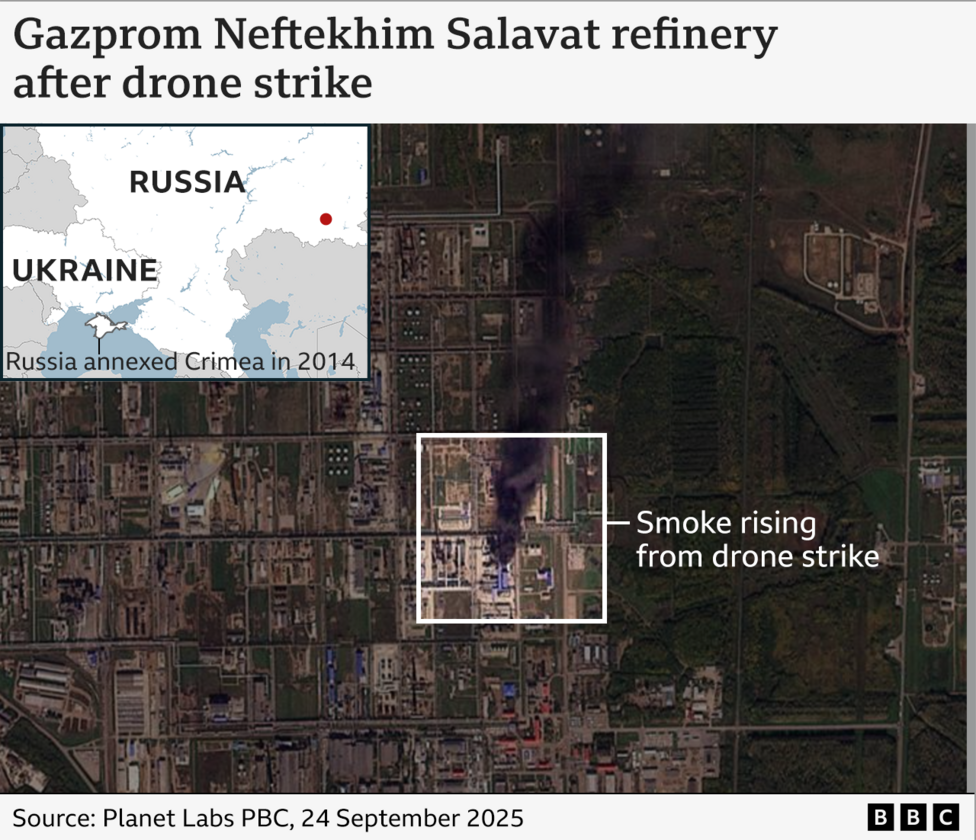
Long-range Ukrainian drone strikes have taken out more than half of Russia’s oil refining capacity, prompting President Donald Trump to announce a diesel supply arrangement with Vladimir Putin. Despite Washington’s pressure to halt the energy campaign, Kyiv responded with new strikes on Russian oil infrastructure.
Ukrainian Drone Strikes Cripple Russian Petroleum Processing
Ukrainian forces have stepped up long-range drone operations targeting critical components at Russian oil facilities. Ukrainian defense authorities report that these attacks have eliminated over fifty percent of Russia’s petroleum processing capability, thereby restricting Moscow’s capacity to provision frontline troops. The campaign, which intensified significantly over the summer months, focuses on hard-to-repair equipment such as desalting and distillation units.
Industry analysts note that modern military operations rely heavily on refined transportation fuels rather than raw crude oil. By targeting conversion infrastructure, Ukraine has disrupted fuel supplies across Russia, leading to localized shortages and long queues at petrol stations.
Data compiled by the independent Ukrainian open-source research group Tochnyi indicates that mass drone attacks began in earnest in August of last year. According to market analysis firm S&P Global Energy, at least two-thirds of the 36 major Russian refineries they track were hit between April 1 and August. Refined petroleum products form part of a tightly connected global market where spare refining capacity is limited, meaning any disruption in a major producing nation can spill over to affect supplies and prices internationally. In a rare acknowledgment of the economic cost, Vladimir Putin told a meeting of the Valdai Club forum that these attacks had cost Russia roughly 1 percent of its gross domestic product.
Attacks Target Samara Oil Storage and Dispatch Facilities
Beyond individual refineries, Ukrainian operations have hit major regional energy hubs. The Samara linear production and dispatch station in the Samara region has faced recurring drone attacks. The facility plays a central role in receiving, storing, and blending crude oil from Western Siberia and Tatarstan to produce Russia’s primary Urals export grade.
Ukrainian military authorities confirmed that previous strikes on the Samara hub destroyed four massive oil storage tanks, each designed to hold approximately 50,000 cubic meters of oil, alongside pipeline sections and automated loading stations. Additional strikes targeted the Astrakhan Gas Processing Plant, damaging secondary distillation and gas treatment units that supply elemental sulfur essential for explosives and propellants.
According to updates from Ukraine’s General Staff, operations during the night of October 9 to 10 targeted the Samara installation near the settlement of Prosvet. Ukrainian Special Operations Forces describe the Samara hub as a critical junction where four major oil pipelines converge, supported by 71 storage tanks holding a combined capacity exceeding 1.6 million cubic metres. At the same hub, a previous raid on October 2 inflicted damage on an automated petroleum-products loading station, a segment of pipeline infrastructure, three RVS-PK-50,000 tanks, and 11 RVS-20,000 storage tanks. Ukrainian officials confirmed that an October 4 strike on the Astrakhan plant damaged components of two gas treatment units—specifically designated as U-172 and U-272—as well as the U-1731 secondary distillation unit. The Astrakhan facility possesses a designed capacity to process up to 12 billion cubic meters of raw gas annually and produces up to 3.5 million tonnes of technical sulfur per year, accounting for about half of Russia’s total production of the material.
Trump Announces Diesel Agreement and Kyiv Responds
The energy campaign has drawn sharp opposition from Washington. President Donald Trump blamed the Ukrainian drone strikes for driving up global fuel prices. Following reports that Kyiv ignored multiple requests to halt the energy attacks, the White House announced a commercial agreement with Moscow.
Under the arrangement, Russia agreed to immediately supply more than 300,000 tons of diesel fuel to international and American markets. To facilitate the transactions, the U.S. Treasury Department issued a temporary general license authorizing related deals through April 7, 2027.

Hours after the announcement, a large fire broke out at an oil-loading terminal operated by the Novoshakhtinsk refinery in Rostov-on-Don following reported drone strikes. Ukrainian leadership defended the continued military campaign. Volodymyr Zelenskyy argued that funds earned from energy exports would be redirected toward weapons manufacturing and military recruitment.
“Every additional billion dollars they can earn from exports will be spent on nothing but sourcing and importing critical components and equipment to manufacture weapons, upgrading Shaheds, producing missiles and recruiting even more mercenaries to fight at the front.”
Volodymyr Zelenskyy
The U.S. Treasury waiver for Russian diesel shipments was granted shortly before statutory penalties were scheduled to take effect under the Lindsey O. Graham Sanctioning Russia and Iran Act of 2026, which places obligatory trade restrictions and punitive measures on purchasers of Russian crude and refined products. Local authorities in Russia’s Rostov region reported that more than 100 drones were intercepted during the overnight assault on the Novoshakhtinsk oil-loading terminal. In response to the diplomatic pressure from Washington, a senior Ukrainian official told the Financial Times that Kyiv would maintain its long-range drone strikes on Russian energy facilities regardless of the arrangement.
Western Allies Divide over Moscow Diesel Supply Agreements
The diesel agreement has exposed deeper rifts among Western allies and trading partners. Keith Kellogg noted in media interviews that Moscow’s willingness to supply diesel serves primarily to relieve economic pressure on its battered energy sector. Meanwhile, British officials expressed solidarity with Kyiv, pledging to strengthen sanctions against Moscow.
As multilateral talks proceeded in Miami involving diplomatic envoys, Kyiv maintained its proposal for a mutual energy armistice—offering to pause refinery strikes only if Russia ceases attacks against Ukraine’s civilian electricity grid and heating plants.
During the Miami consultations, U.S. envoys Steve Witkoff and Jared Kushner met with Ukrainian and European negotiators. Concurrently, EU foreign policy chief Kaja Kallas warned in Brussels that Russia was placing lives across Europe at risk through hybrid operations.