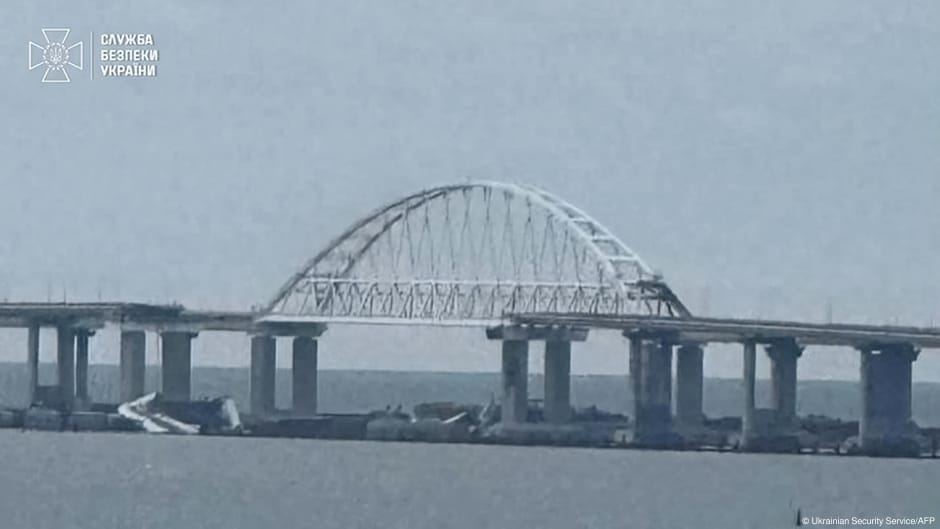
Ukraine’s military struck the strategic Kerch Bridge during the night of November 17, 2026, causing a 225-meter section of its highway to collapse into the sea and block shipping channels between the Black Sea and the Sea of Azov.
Ukrainian Forces Neutralize Defenses to Strike the Crimean Bridge
President Volodymyr Zelensky said the operation “was the result of a seven-stage operation” by the military and security services. Ukrainian forces systematically neutralized air defense systems, radars, and electronic warfare equipment along the path to the objective.
According to the Security Service of Ukraine, the operation involved deploying “Palyanytsia kamikaze drones to target the roadway section” of the Crimean Bridge, resulting in its collapse. Subsequent missile strikes on November 18 and 19 targeted the parallel railway span using Neptune cruise missiles, according to Al Jazeera reporting.
Satellite imagery obtained by TWZ confirmed damage to the rail span alongside the collapsed road deck. The Ukrainian Defence Ministry described the bridge as “a war machine” used to supply fuel, ammunition, equipment, and personnel to Russian forces in southern Ukraine.
Zelensky announced that the military strike also employed the Flamingo system alongside various drones and Neptune missiles, while British daily The Times cited sources indicating the operation proceeded without assistance from SpaceX’s Starlink satellite network.
Blocked Waterways and Navigational Bottlenecks
The destruction of the central span dropped heavy steel and asphalt debris directly into the sole deep-water shipping channel connecting the Black Sea and the Sea of Azov. According to Ukrainian Navy Spokesperson Dmytro Pletenchuk, Russian shipping cannot pass through the strait because wreckage now occupies much of the water column. Pletenchuk noted that bad weather will delay any wreck clearance operations in the combat zone.
The closure also prevents the Russian Navy from moving warships in and out of the Sea of Azov. “The number of possible options for how things could develop [for the Black Sea Fleet] has decreased, precisely because of the closure of the Kerch Strait,” Pletenchuk said, as transcribed by Ukrinform.
"This train terminates here." On the night of November 19, Ukrainian Neptune missiles struck the railway section of the Crimean Bridge, with hits recorded near the arch and on the tracks. The extent of the damage is still being assessed, but train traffic has stopped. Now a… pic.twitter.com/ytZOeQCzvG
Oleg Kryuchkov, an adviser to the Russian-installed head of Crimea, announced that local authorities would initiate free passenger boat services across the Kerch Strait between Port Krym and Port Kavkaz.
Putin Dismisses the Attack on the Symbolic Crossing
The 19-kilometer crossing was built starting around 2015 and opened in 2018 as a personal symbol of Russian President Vladimir Putin’s territorial ambitions in Crimea. Russian President Vladimir Putin dismissed the operation during public remarks, characterizing the targeted span as a purely civilian facility.
Putin: Our response will be much more painful than what Kyiv did to the Crimean Bridge. I want everybody to know that. pic.twitter.com/zWu73VI13R
We haven’t even transported oil or petroleum products across the bridge.
Vladimir Putin, Russian President
Independent analysts emphasize the psychological blow of the attack. Tomas Jermalavicius, Head of Studies at the International Centre for Defense and Security, noted that the loss “will reverberate through the regime’s image of control”, power, and potency.
Kremlin spokesperson Dmitry Peskov vowed that the bridge would be rebuilt even better than before. Olga Kurlayeva, described as the deputy president of the Republic of Crimea, similarly maintained that the crossing remained purely civilian infrastructure.

Military Logistics Face Strain as Road Repairs Take Time
With the road bridge destroyed and rail traffic disrupted, Russian military logistics in southern Ukraine face increased strain. Military expert David Gendelman noted that commanders will be forced to rely heavily on the coastal M-14 highway, an overland route that remains exposed to Ukrainian air attacks.
Infrastructure engineers consulted by Radio Free Europe/Radio Liberty estimated that repairing the road span will take approximately a year. Ukrainian aviation engineer Konstantin Kryvolap explained that substantial engineering work will be required because the road bridge sits inside the railway structure, complicating the transport of complete replacement spans from the Black Sea.
⚡️ Russia’s Transport Ministry quietly removed the collapsed road arch from its official image of the Crimean Bridge. The updated graphics used in the ministry's communications now show only the railroad section following Ukrainian strikes earlier this month. pic.twitter.com/VLsXcCFRHr
David MacKenzie, a senior technical director with British engineering consultancy COWI, noted that any new span must be assembled on the shore of the Sea of Azov before being floated to the site and lifted into position.
Consequences for Regional Security and Shipping
Mike Petersen, who serves as a specialist on the Russian military and a former senior US naval adviser at the Center for Naval Analyses, indicated that Ukrainian forces might actively challenge any clearance efforts, potentially prolonging the strait’s closure indefinitely.
"So far, I have not seen such commitments on paper." President Zelenskyy. My weekly update features the Kerch bridge attack, Operation Bear Claw, Ukraine diplomacy, the Shenzhen trilat – and my Big 5 recommended readings. https://t.co/U62j4Spqfo pic.twitter.com/KTQAyGkKfe
Oleg Kalashnikov warned that the situation presents a direct threat of losing the Tauric Peninsula, according to statements shared on social media by Anton Gerashchenko. Ukrainian human rights activist Arsen Bariiev noted that the effects of the bridge destruction would show up very soon and people should simply wait.
Peter Dickinson observed in an interview that Putin made the seizure of Crimea his personal victory and used Kremlin propaganda to associate it with himself.
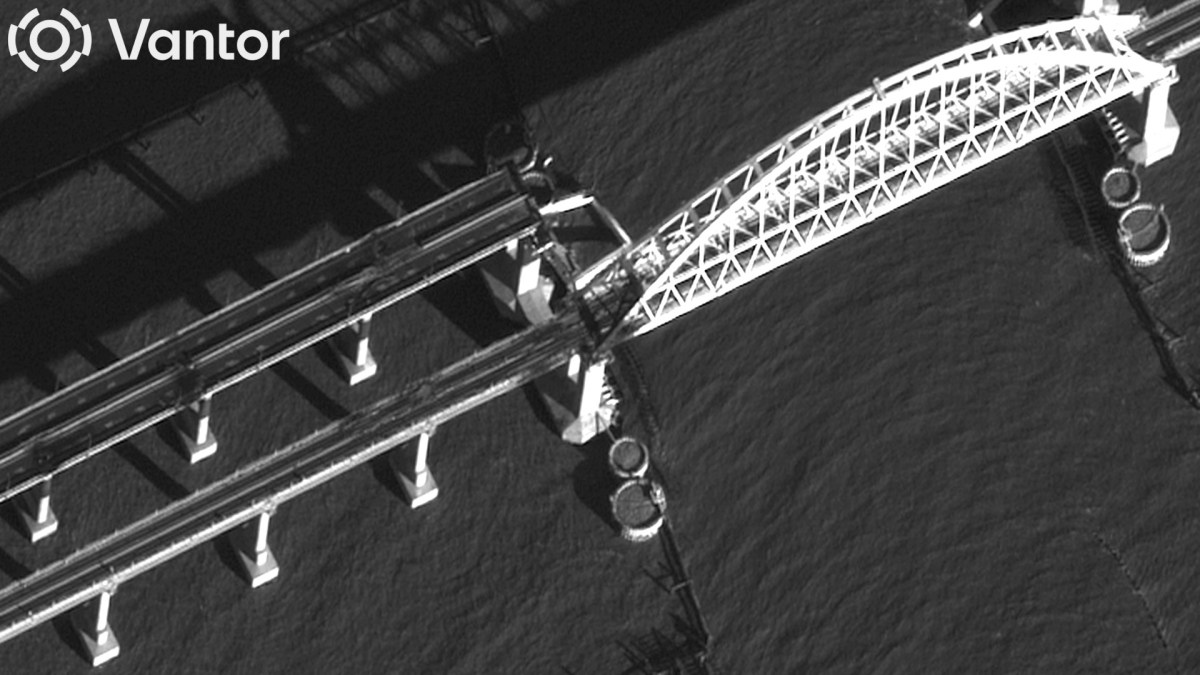
Dickinson noted that Putin confidently claimed credit for the project after its completion, making it a personal symbol of his imperial ambitions to reestablish the Russian Empire. The Security Service of Ukraine confirmed that one of the metal arches and the automobile span under it were completely destroyed during the operation.
Logistical Pressures and Repair Challenges
RUSI Senior Associate Fellow for International Security Justin Bronk assessed that although the destruction has embarrassed Moscow, Russia’s adapted southern supply chains mean the military impact will probably stay localised.
Russian Z-blogger Kalashnikov said the fate of the entire war hinges on the Kerch Bridge. Strikes on the bridge and the closure of the land corridor could cut off supplies to the Russian army and seriously undermine its positions, according to him. "This is actually a threat of… pic.twitter.com/QmoXrkOMX0
Naval News reported that the Crimean Peninsula is effectively becoming an island following the interdiction of its critical supply routes. Meduza noted that Russia’s Transport Ministry published travel instructions on its Telegram channel using an updated image depicting the bridge with only one arch.
DW reported warnings from Ukrainian military experts concerning the systematic disruption of Russian logistics, while the pro-Kremlin Rybar Telegram channel wrote that even installing a pre-assembled arch under active fire conditions would constitute a challenging task.
DW also highlighted Ukrainian statements noting that the armed forces are now able to strike floating cranes and repair teams directly. The Maritime Executive observed that cleanup contractors may face multiple damaged spans once weather conditions permit work to begin inside the combat zone.
Wider Regional Implications and International Statements
Polish Foreign Minister Radoslaw Sikorski posted on social media platform X that the development showed Ukraine held significant cards. Meanwhile, Brian Clark, a senior naval operations expert at the Hudson Institute, observed that the structural integrity of the crossing appeared severely compromised by the successive waves of strikes.
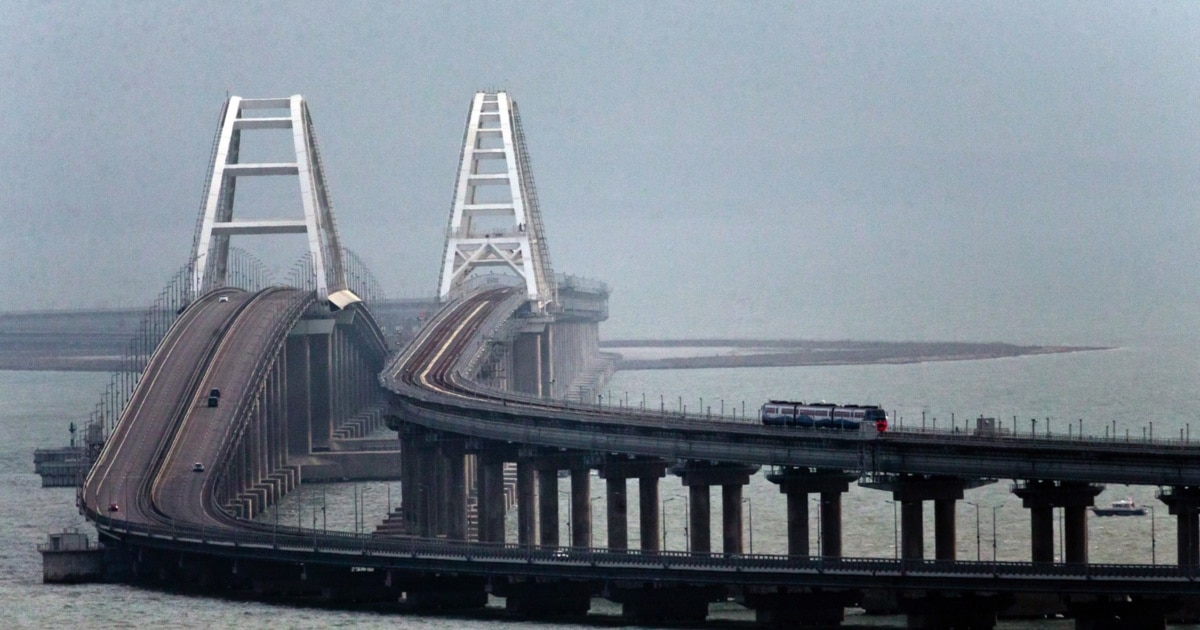
The inland shelf Sea of Azov connects directly to the Black Sea through the narrow 4 km Strait of Kerch, serving as an important access route for Central Asia from the Caspian Sea via the Volga–Don Canal according to Wikipedia geographical data. This vital waterway maintains a constant outflow of water toward the Black Sea.
Russian transportation authorities published revised travel guidance via official messaging channels, quietly removing depictions of the second arch from informational graphics. Deputy Prime Minister Andrei Nikitin stated that traffic had resumed on the undamaged rail tracks, while regional officials attempted to reassure travelers that alternative transit routes remained viable across the peninsula.
The Defence Forces hit the Crimean Bridge: span down, road traffic to occupied Crimea halted During the night of 17 November, the Defence Forces of Ukraine struck the Kerch Bridge. For years, russia built the myth of a “forever russian” Crimea around this bridge, and now that… pic.twitter.com/AyfvzIwg8r