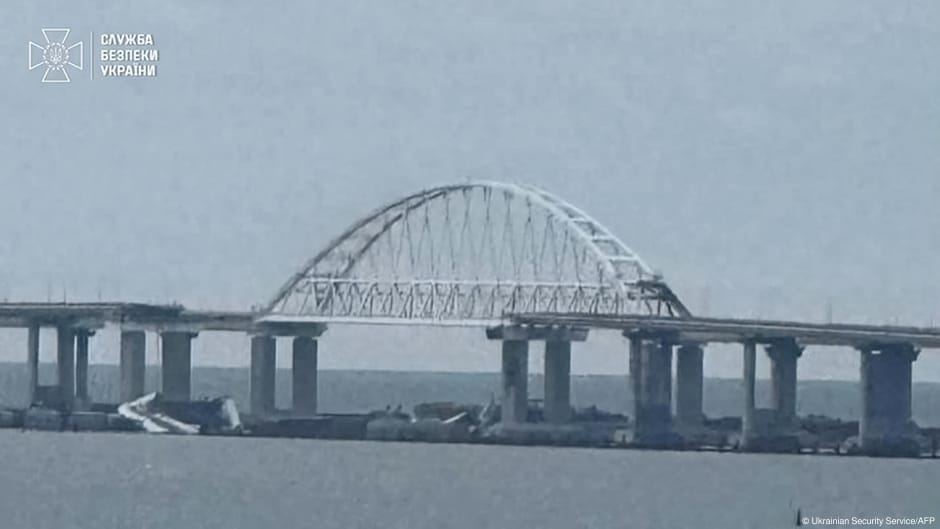
Ukraine destroyed the central road span of the Kerch Bridge on November 17, cutting the only direct land link between Russia and occupied Crimea and blocking the shipping channel beneath it.
The strike was the fourth and most complex Ukrainian operation against the 19-kilometer bridge since the full-scale invasion began. Ukraine’s Security Service (SBU) said it used Palyanytsia kamikaze drones to bring down the roadway section, collapsing more than 270 meters of steel arch into the Kerch Strait.
Satellite imagery obtained by TWZ shows the fallen span — weighing an estimated 5,500–6,000 tonnes — now rests in the only deep-water passage under the central arch, halting maritime traffic between the Black Sea and the Sea of Azov.
"This train terminates here." On the night of November 19, Ukrainian Neptune missiles struck the railway section of the Crimean Bridge, with hits recorded near the arch and on the tracks. The extent of the damage is still being assessed, but train traffic has stopped. Now a… pic.twitter.com/ytZOeQCzvG
President Volodymyr Zelenskyy described the operation as a seven-stage effort that “gradually destroy[ed] air defence systems, radars, electronic warfare equipment, and other designated targets on the way to the final objective.” The SBU confirmed it first neutralized Russian air defences along the approach before striking the bridge directly. Russia’s transport ministry announced a “temporary suspension” of road and rail traffic, though rail services later resumed on the parallel span.
“Russia is attacking our infrastructure every day, particularly bridges in Zaporizhzhia, Dnipro, Kyiv, and the Odesa region,” Zelenskyy said. “We are rebuilding our infrastructure, but we also remind Russia that the war always returns to where it began.”
Putin: Our response will be much more painful than what Kyiv did to the Crimean Bridge. I want everybody to know that. pic.twitter.com/zWu73VI13R
Shipping channel blocked, naval access cut
The collapsed span has turned the Kerch Strait into a maritime bottleneck. The fairway’s control depth was only 6.7 meters before the attack; wreckage now occupies much of the water column.
Ukrainian Navy spokesperson Dmytro Pletenchuk said Russian shipping cannot pass through the strait, and the same physical restrictions prevent the Black Sea Fleet from moving warships to and from the Sea of Azov. “Previously, there was at least some alternative for safely withdrawing the fleet from the Black Sea, but now even that option is no longer available,” Pletenchuk said.
Naval News reported that a less-publicized October strike on a rail bridge over the Don River at Rostov-on-Don compounded the isolation. With both the Kerch Strait and the Don River crossing blocked, the Sea of Azov is effectively cut off. The port of Azov has essentially ceased operations, and a drone campaign against shipping — codenamed Operation Molochka — struck around 300 vessels in the Sea of Azov starting in June.
Logistics shift to the R-280 “highway of death”
With the road bridge gone, Russia’s primary overland supply route to Crimea is the R-280 federal highway — a 630-kilometer road through occupied Mariupol and Melitopol that Ukrainian drones strike regularly. The route, still unfinished in places, crosses multiple bridges that Ukrainian missiles and drones have repeatedly damaged, forcing Russian engineers to build pontoon crossings.
🔴 Russia is reportedly trying to track down a man who filmed the collapsed Crimean Bridge road section from a train, exposing damage Moscow tried to hide. pic.twitter.com/PYrWrJSYRh
Analyst Emil Kastehelmi of the Black Bird Group told the Kyiv Independent that most heavy traffic had already shifted to the land route before this strike. “Even if regular heavier traffic goes another route, (the bridge) would have served as an emergency route if (Russia) had to transport something very quickly, but of course, that option is now gone,” Kastehelmi said.
Rail link survives but under threat
The railway span remains standing, though it was hit again by Neptune missiles on the night of November 18–19. Ukrainian officials said they recorded hits near the arch and on the tracks, but the full extent of damage was still being assessed.
While Russian attacks had previously targeted bridges in front-line areas, seeking to disrupt supply routes to Ukrainian forces, October marked the first strikes on such infrastructure in the capital. A month later, Ukraine launched a seven-stage operation that partially…
RUSI noted Russia had largely stopped relying on the Kerch Bridge for military logistics by 2024, shifting resupply to rail lines running through occupied Donetsk and Luhansk directly from Russia. That adaptation means the military impact of the road bridge’s loss will probably stay localized to southern Ukraine, though the political embarrassment for the Kremlin is significant.
Repair timeline measured in years, not months
Russian officials vowed to rebuild “even better than before,” but engineers say the earliest realistic scenario for restoring the road span is about a year — and that assumes Ukrainian strikes cease. Aviation engineer Konstantin Kryvolap told RFE/RL the bridge’s arch attachment points are its weakest structural elements. “Very substantial engineering work will be required,” Kryvolap said.
"So far, I have not seen such commitments on paper." President Zelenskyy. My weekly update features the Kerch bridge attack, Operation Bear Claw, Ukraine diplomacy, the Shenzhen trilat – and my Big 5 recommended readings. https://t.co/U62j4Spqfo pic.twitter.com/KTQAyGkKfe
The Maritime Executive said that wreck clearance must await calmer weather, and the work itself will be exposed to combat hazards. Meanwhile, a ferry crossing in the strait is vulnerable to Ukrainian strikes, and the overland route through Mariupol remains within range of “middle strike” attack drones — raising the possibility that Russian forces and civilians in Crimea could be cut off from their supply chain entirely.
Russia Weighs Repair Options, Rejects Ceasefire
Meduza reported that Russian authorities are considering two options for restoring the bridge but have not said when repairs might begin or how long they would take.
Speaking to reporters in Shenzhen during the APEC summit, President Vladimir Putin said he and the Security Council had discussed a possible partial ceasefire with Ukraine but dropped the idea after the bridge strikes, adding that retaliatory actions would be far more painful than the damage to the crossing.
DW cited the Russian-installed deputy head of Crimea, Olga Kurlayeva, who described the bridge as a purely civilian structure, while Ukrainian military experts interviewed by the outlet pointed to the systematic disruption of Russian logistics. The Atlantic Council quoted President Zelenskyy saying Ukraine’s defensive capabilities are strong and will remain so, and that Kyiv will never leave terror against its cities and people unanswered.
⚡️ Russia’s Transport Ministry quietly removed the collapsed road arch from its official image of the Crimean Bridge. The updated graphics used in the ministry's communications now show only the railroad section following Ukrainian strikes earlier this month. pic.twitter.com/VLsXcCFRHr
Experts Assess Damage and Strategic Consequences
Brian Clark, a former U.S. naval officer at the Hudson Institute, told RFE/RL that the damage is quite significant and may have compromised the bridge’s structural integrity.
Naval News reported that the Kerch Strait crossing is just one link in Russia’s supply chain and that Ukrainian forces are reducing the capabilities of the rest of Moscow’s military logistics step by step.
Analyst Anton Gerashchenko wrote on X that the situation represents a threat of losing the Tauric Peninsula, while RUSI assessed that the destruction is politically embarrassing for Moscow but logistically contained because Russia has adapted its southern supply chains.
Putin’s personal project, Ukraine’s symbolic target
The bridge opened in May 2018 after Putin personally drove a truck across it, cementing his association with the seizure of Crimea. The Atlantic Council called its partial destruction a personal humiliation that ranks alongside his worst moments of the entire war.
Russian Z-blogger Kalashnikov said the fate of the entire war hinges on the Kerch Bridge. Strikes on the bridge and the closure of the land corridor could cut off supplies to the Russian army and seriously undermine its positions, according to him. "This is actually a threat of… pic.twitter.com/QmoXrkOMX0
Tomas Jermalavicius of the International Centre for Defense and Security told the Kyiv Independent: “Given that the bridge was Putin’s crown jewel in consolidating — both physically and cognitively — the illegal control over Crimea, its loss — even if temporary — will reverberate through the regime’s image of control, power, and potency.”
Meduza documented three previous major strikes: a truck bomb in October 2022 that dropped two road spans, a naval drone attack on Pier 145 in July 2023, and an underwater drone strike on waterline buttresses in 2025.
Ukraine’s November 2026 operation on the Kerch Bridge, combining drones and Neptune missiles over successive nights, brought down the road section and may have crippled the rail section. Russian authorities have not given even a rough timeline for repairs.
Putin told reporters at the APEC summit in China that Russia dropped the idea of a partial ceasefire after the bridge strikes. “Our retaliatory actions will be far more painful than what the Kyiv regime has done to the bridge,” he said.
Earlier coverage: Kerch Bridge Partially Collapses After Ukrainian Strikes, Officials Say