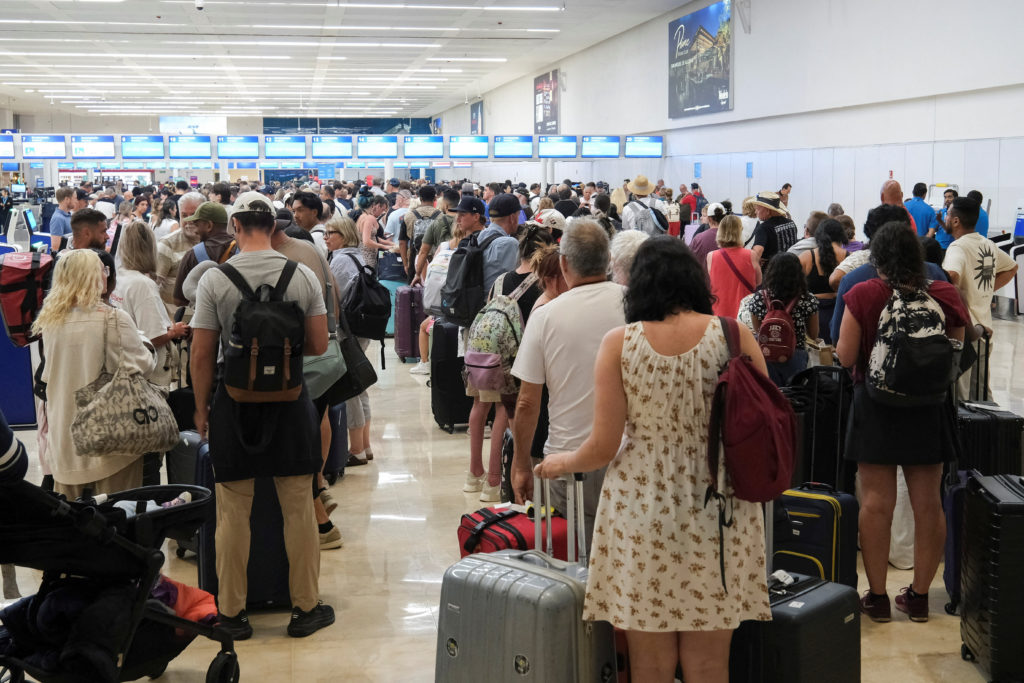
Transportation Secretary Sean Duffy is pushing for an additional $50.1 billion in new Federal Aviation Administration funding following a nationwide ground stop that stranded hundreds of thousands of passengers.
FAA Official Supervised Contractor Work in Arkansas
The nationwide ground stop lasted nearly five hours after a telecommunications outage created instability in radar data and communications. Seventeen of twenty en route air traffic control centers experienced static and potentially inaccurate information, forcing the agency to halt departures out of an abundance of caution.
The Trump Administration got to work IMMEDIATELY to get to the root cause of the communication issue impacting flights across the country ⬇️ @CBSNews https://t.co/Fg2VwTt8vn
Secretary Duffy blamed the incident on routine upgrade work by contractor L3Harris to replace aging copper wire infrastructure with fiber-optic technology. However, investigative reporting reveals that an FAA official was actively supervising the work in rural Arkansas, testing the finished product and signing off on it before the failure occurred.
According to government authorities, an information overload triggered by a broken router and the swapping of legacy copper cabling generated intense worry, prompting a complete freeze on departures. Both President Trump and Transportation Secretary Sean Duffy attributed the difficulties to the advanced age of the aviation network’s foundational hardware.
Pilots, flight attendants, air traffic controllers, airlines — 60 aviation groups that rarely agree on anything are united behind one mission: overhauling our airspace with state-of-the-art software, resilient telecom architecture, and modernized towers and runways I took that… pic.twitter.com/zYih7sflXC
Conversely, aviation specialist David Woods indicated that the root cause of the incident was actually the deployment of SMART, an artificial intelligence-driven air traffic control system that debuted in the Washington D.C. area on September 21 and rolled out nationwide on November 10.
Looking back at prior aviation crises, Sean Duffy took aim at his predecessor, then-Transportation Secretary Pete Buttigieg, over a comparable 2023 disruption—attributing the breakdown to flawed leadership and misplaced priorities—nearly four years before he would encounter a coast-to-coast FAA ground stop in his own tenure as transportation secretary. Duffy targeted Buttigieg during a Fox News America Reports segment shortly after the January 2023 ground stop, ridiculing his paternity leave and casting doubt on his capability to steer the agency through an emergency.
As secretary, I made sure to leave air travel in better condition than when we arrived. We reversed a decade of decline in air traffic controller staffing, drove down runway safety incidents, and when I left office we were experiencing the lowest flight cancellation rates in… https://t.co/68KleIhFEc
But Duffy also voted for FAA funding and reauthorization measures in 2012, 2013 and 2018. Asked on CNN’s State of the Union whether he accepted responsibility for the latest outage, Duffy acknowledged his role overseeing the FAA but pointed to the aging infrastructure he inherited, stating that he takes responsibility for what was given to him by prior administrations.
Congressional Pushback on the Funding Request
The administration’s funding demand, which was suddenly raised from an initial $30 billion proposal, met with skepticism from both parties on Capitol Hill during a contentious closed-door briefing with Senate Republicans. Lawmakers pointed out that Congress previously funded $14.4 billion across two bills for modernization, and that a prior $12.5 billion allocation from legislation championed by President Donald Trump remains partially unspent.
In an interview with National Public Radio, NATCA President Nick Daniels discussed the nationwide ground stop on Friday, Nov. 13, 2026. Listen to the full interview on National Public Radio's website. https://t.co/M3hCbDBsC5 pic.twitter.com/VEASe0PddM
“Yes, it's allowing us to build a solid foundation.” FAA Administrator Bryan Bedford said.
The funding request was submitted via a letter cosigned by FAA chief Bryan Bedford and White House budget director Russell Vought, stating the money was needed to deliver a truly world-class air traffic control network.
Following his public criticism of Congress last week regarding the breakdown, Duffy held closed-door discussions with Senate Republicans on Tuesday to present his arguments on Capitol Hill. Other Democrats are vexed by the FAA funding request, with Senator Brian Schatz stating that while he generally supports investing in air traffic control, $50 billion sounds like an awfully round number.
“But I also have to acknowledge what was delivered to me…I take responsibility for what was given to me by prior administrations.” Transportation Secretary Sean Duffy said.
ok, so if the ground stop was really caused by a single new router 1. why was the new router installed? installed for AI? 2. why was the whole system so vulnerable to a single errant router? but, also, are we getting the whole story?https://t.co/sfBr5gXTFM
“At his first press conference, all Duffy did was attack Democrats, and he asked for $50 billion when they haven’t even spent the $12 billion we’ve given to them,” said Senate Minority Leader Chuck Schumer, D-N.Y., according to NBC News.
Staffing Shortages Force Mandatory Overtime for Controllers
Beyond physical infrastructure, aviation experts and labor representatives point to profound human resource constraints within the network. Nick Daniels, president of the National Air Traffic Controllers Association, said that the system operates with about 11,000 certified professional controllers instead of the roughly 14,000 needed, forcing most to work six-day weeks with mandatory 10-hour shifts.
“Right now, we’re probably 3,000 certified professional controllers short,” Daniels told NPR.
When the FAA instituted that ground stop, air traffic personnel were tasked with directing every aircraft to a secure landing and helping untangle the resulting chaos. Union leadership emphasized that equipment inside some towers is older than the workers operating it, with controllers highlighting the immense stress placed on personnel during mandatory overtime and six-day workweeks.
Earlier coverage: Federal Aviation Administration Halts All Departures Nationwide