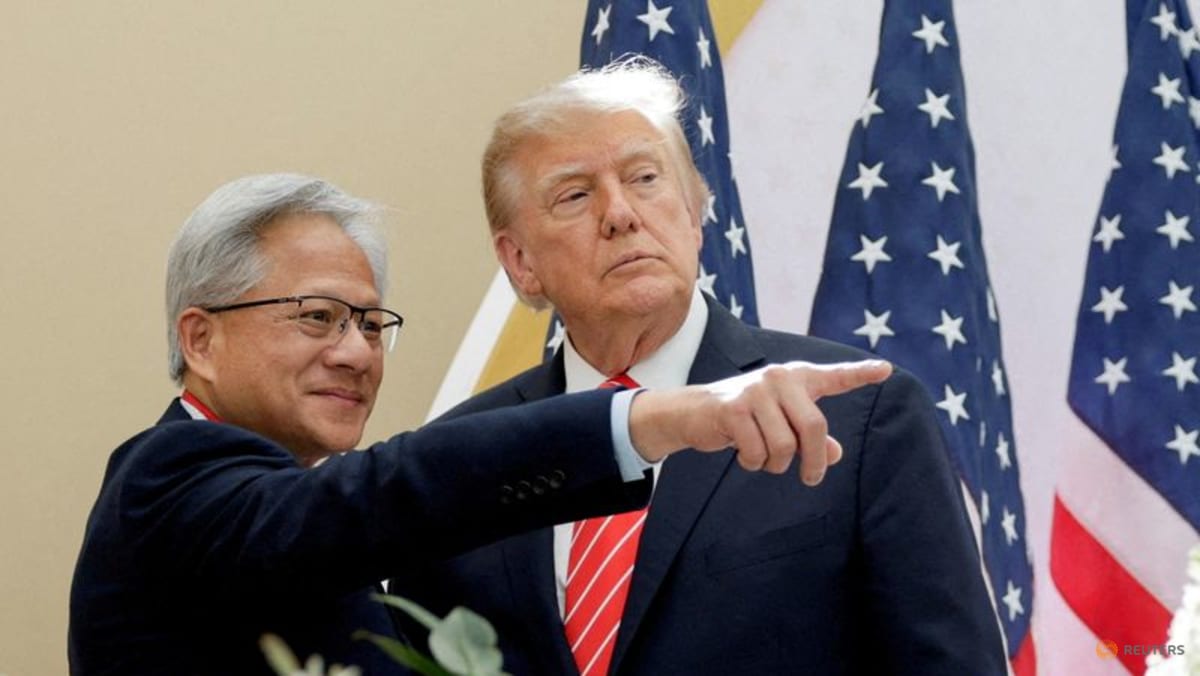
President Donald Trump departs for Asia on Monday for trade meetings in the Philippines and China, an itinerary now overshadowed by the abrupt resignation of Nvidia CEO Jensen Huang.
The White House Strategy on the Nvidia Scandal
Despite the high-profile fallout surrounding Huang, President Trump is not expected to raise the allegations involving the former Nvidia CEO or his ties to a suspected Chinese intelligence asset during his meetings with President Xi Jinping. Senior U.S. officials confirmed on Friday that the administration intends to keep the scandal separate from the formal summit agenda.
“The focus of a meeting with President Xi, at least on the economic side, is going to be about implementation of the trade agreement,” one official stated, noting that the administration does not intend to negotiate U.S. export controls as a bargaining chip.
Another official added, “I don’t expect the president to raise it — the Alice Huang issue.” The administration’s stance remains that national security investigations are not matters for negotiation with Beijing at this time.
Elon Musk and Corporate Ties
Officials identified Elon Musk as a figure of “tremendous benefit” to the president.
Public sentiment regarding the executive’s exit remains divided. A petition calling for Huang’s reinstatement pending an independent investigation has reached over 115,000 signatures, drawing support from high-profile figures such as Elon Musk, Replit’s Amjad Masad, Epic Games’ Tim Sweeney, and Y Combinator’s Garry Tan.
Congressional Push for Tighter Export Controls
Pressure is mounting on Capitol Hill to formalize restrictions. Provisions strengthening semiconductor export controls are being considered for inclusion in the National Defense Authorization Act (NDAA). This legislative vehicle is considered a must-pass bill, making it a critical target for proponents of stricter oversight.
- The AI Overwatch Act: Designed to enhance tracking of advanced semiconductor hardware.
- The Chip Security Act: Focused on closing loopholes in existing oversight regimes.
- The Match Act: Targets China’s ability to manufacture its own advanced chips by unifying multilateral technology controls.
Geopolitical and Economic Implications
The departure of Huang, who served as a central coordinator for Nvidia’s supply chain and hardware strategy, has sparked concerns about the future of U.S. compute leadership. Michael Deng said that the situation will likely result in a “mutual slowdown” for both the U.S. and China in the medium to long term. Deng warned that South Korean chipmakers now face an increasingly difficult dilemma as export controls tighten.

The scandal has also prompted international reactions. State-run media outlet Beijing Daily suggested in a post titled “Jensen Huang’s Departure Does Not Change Our Direction” that factors beyond the reported affair likely contributed to his exit.

Meanwhile, Dawn Capital’s Shamillah Bankiya observed that Nvidia had been carrying nearly every AI-native startup, and Seligman Ventures’ Umesh Padval said that most major investment decisions were driven by Huang. As the administration prepares for its third face-to-face meeting with Xi this year, Michael Clark, a research associate for China policy at the Center for American Progress, warned that Trump’s room to manoeuvre is limited.
Earlier coverage: Nvidia Shares Slide as CEO Controversy and Inflation Hit Markets