A critical memory safety flaw in the world’s third-largest programming language lets unauthenticated attackers run code remotely on enterprise servers, prompting international patches and government warnings.
Java4Shell Flaw Exposes Core Infrastructure
The flaw involves code that writes data to incorrect memory locations. This can crash a program or allow an attacker to run their own commands.
This weakness exists only on AMD and Intel x86-64 processors with AVX-512 VBMI support. California researcher Quang Luong found the bug while checking OpenJDK HotSpot with an AI coding tool.
The firm said the process took about three hours and cost less than $200 in tokens. Professor Toby Walsh said the incident is a serious flaw in a language built to protect memory. He said the bug had been “hiding in plain sight for 12 years.”
Versions and Technical Scope
The flaw affects OpenJDK 17.0.6 and later versions. This includes distributions from Oracle, Amazon Corretto, Eclipse Temurin, Microsoft Build of OpenJDK, Azul Zulu, and Red Hat.
Since the vulnerability has leaked: Calif discovered and reported Java4Shell (CVE-2026-114938). We're publishing technical details by 1 PM Pacific today, after Oracle releases a patch. Stay tuned! https://t.co/No5hJXK1Zx
Oracle Java SE builds identified as vulnerable are 8u511b33-perf, 17.0.21.0.3, 21.0.13.0.3, 25.0.5.0.3, and 27.0.1.0.3. Updated builds from Oracle are 17.0.21.1, 21.0.13.1, 25.0.5.1, and 27.0.1.1.
Amazon released updated Corretto builds on November 17, such as 17.0.21.1.2 and 21.0.13.1.2. For Oracle Java SE 8, the Enterprise Performance Pack build 8u511b33-perf is vulnerable, while 8u513-perf is the patched version.
🚨 Java4Shell: A critical CVSS 9.2 vulnerability affecting OpenJDK Here's everything you need to know: A memory corruption vulnerability (CVE-2026-114938) in the OpenJDK Base64 decoding engine allows remote unauthenticated attackers to achieve code execution. It affects…
Vendors ship OpenJDK packages on different schedules. Organizations must confirm their specific distribution’s version labels.
Calif Rates Flaw 9.2 Critical While Oracle Assigns 8.1
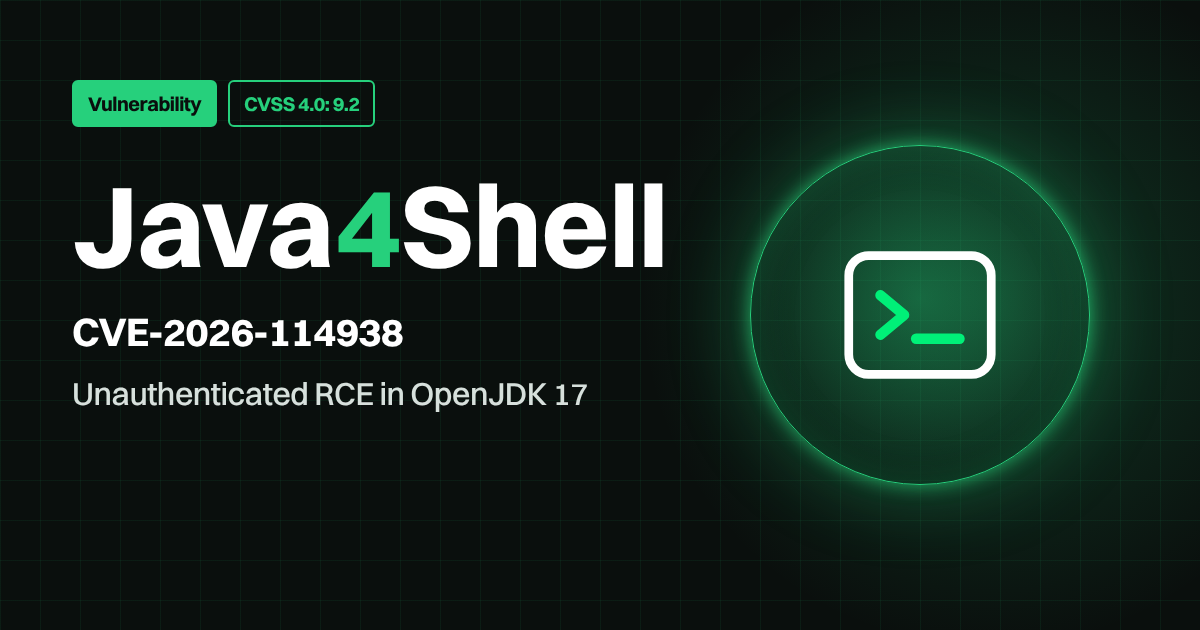
Industry groups assign different severity levels to the flaw. Calif rates Java4Shell as a 9.2 under CVSS 4.0, classifying it as “Critical.”
Oracle’s advisory is part of its November 17 Critical Security Patch Update, which addressed 11 Java SE vulnerabilities. It assigns a CVSS 3.1 score of 8.1. Oracle said the flaw is remotely exploitable without authentication, though it has high attack complexity.
Calif demonstrated that an attacker using “heap grooming” can achieve remote code execution. The U.S. Cybersecurity and Infrastructure Security Agency (CISA) urged organizations to patch immediately. No exploitation in the wild had been reported as of publication.
GPT-6 Cyber for helping further secure the internet, with a major security flaw in Java found by Calif, as part of our Patch the Planet initiative: https://t.co/DtMftfZTp7
South Korea Issues Urgent Advisory as Java Runs 90% of Fortune 500
Java runs at 90% of Fortune 500 companies. In South Korea, the government issued an urgent advisory because 89.1% of central administrative agencies’ information systems rely on the language, which is used for 53% of programming tasks there.
Calif recommends two temporary mitigations for organizations unable to patch immediately. Start the Java application with the flag -XX:-UseBASE64Intrinsics to disable the vulnerable decoder. Use -XX:UseAVX=2 to prevent the JVM from using AVX-512 instructions.
Java4Shell is a critical memory-corruption vulnerability in OpenJDK's Base64 decoder, rated as a 9.2 under CVSS v4.0. Through this vulnerability, an attacker with no credentials could corrupt Java heap memory, read secrets from it, and reach remote code execution. As of… pic.twitter.com/fr03m88f37
Administrators should audit their environment for internet-exposed services. They must verify if their CPU hardware supports the vulnerable AVX-512 VBMI feature set before prioritizing remediation efforts.
Java4Shell (CVE-2026-114938) is a memory-corruption flaw in OpenJDK's Base64 decoder. @calif_io demonstrated pre-auth RCE in Jenkins, Confluence, Jira, Kafka and more. Patch, or start x86-64 JVMs with -XX:UseAVX=2. How we defend against what comes next 👇 https://t.co/vSboILI03K