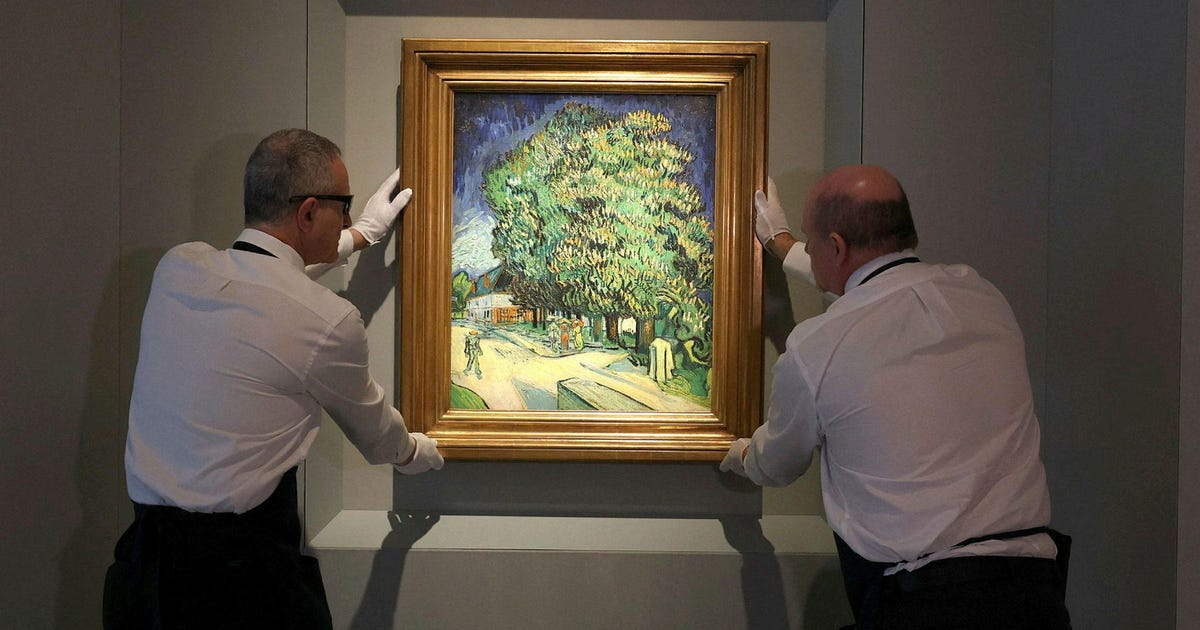
Heirs of a Jewish publisher have urged Sotheby’s to withdraw Vincent van Gogh’s “Châtaigniers en fleurs (Blossoming Chestnut Trees)” from a Manhattan auction ahead of its marquee evening sale in New York, contending that the $180 million canvas was sold under Nazi coercion in 1936.
The dispute centers on a rare 1890 masterpiece painted in Auvers-sur-Oise, near Paris, following the artist’s two years in the south of France. Estimated at $180 million, the painting is the highest-value lot in Sotheby’s fall auctions and carries a financial guarantee from the auction house.
The painting originally belonged to Gottfried Bermann Fischer, who inherited the work and the Berlin publishing house S. Fischer Verlag from his father-in-law, Samuel Fischer.
According to Sotheby’s, the canvas had been deposited with Paul Cassirer in Amsterdam in 1932 or 1933.
Just three months before the 1936 transaction, Fischer fled Berlin for Vienna to escape Nazi persecution, subjecting his family to the punitive “Reich flight tax” imposed on Jewish emigrants.
The heirs, now living in the United States, assert the sale in Amsterdam occurred as a direct result of financial losses sustained by the family publishing company under Nazi rule.

While Fischer successfully reclaimed ownership of S. Fischer Verlag after World War II, he never pursued restitution for the artworks sold during his exile, as legal avenues for recovering art sold in neutral jurisdictions like the Netherlands were virtually nonexistent at the time.
Sotheby’s said that its provenance research has not established that the work was sold under duress, though the auction house is engaged in discussions with the family.
“Sotheby’s takes provenance and restitution matters extremely seriously and has undertaken extensive research into the ownership history of Châtaigniers en fleurs,” the auction house told the BBC, noting that it had been in dialogue with the representatives regarding the painting’s history.
We recognize the importance of engaging thoughtfully and constructively with the family and are committed to working toward a mutually satisfactory resolution.
Sotheby’s spokesperson, via BBC News
In correspondence sent to Marco Toracca, the head of Sotheby’s restitution department, Schnabel demanded that the auction house either suspend the sale or prove the transaction occurred at fair market value and “would have wanted to carry out the sale even without Nazi rule.”
The attorney said that his client is prepared to work toward a fair solution in the spirit of the 1998 Washington Principles.
The painting is being offered as part of the Blaquier-Arrieta Collection, assembled by Carlos Pedro Blaquier and Nelly Arrieta de Blaquier of Buenos Aires, who began collecting Impressionist and modern art in the 1960s.
Philip Hook, a former Sotheby’s executive, described the private collection as “the stuff of legend: whispered about, kept from public view.”
Sotheby’s has titled its auction Legendary because the collection from which these canvases come is regarded as so tasteful and high class.
According to Sotheby’s ownership records, Samuel Fischer acquired the canvas in 1909 before it passed to his family following his death in 1934.
The artwork was deposited with Paul Cassirer in Amsterdam in 1932 or 1933, transferred to Henriette and Marcel Kapferer in Paris in 1936, and subsequently passed through four other owners before entering the current auction consignment.