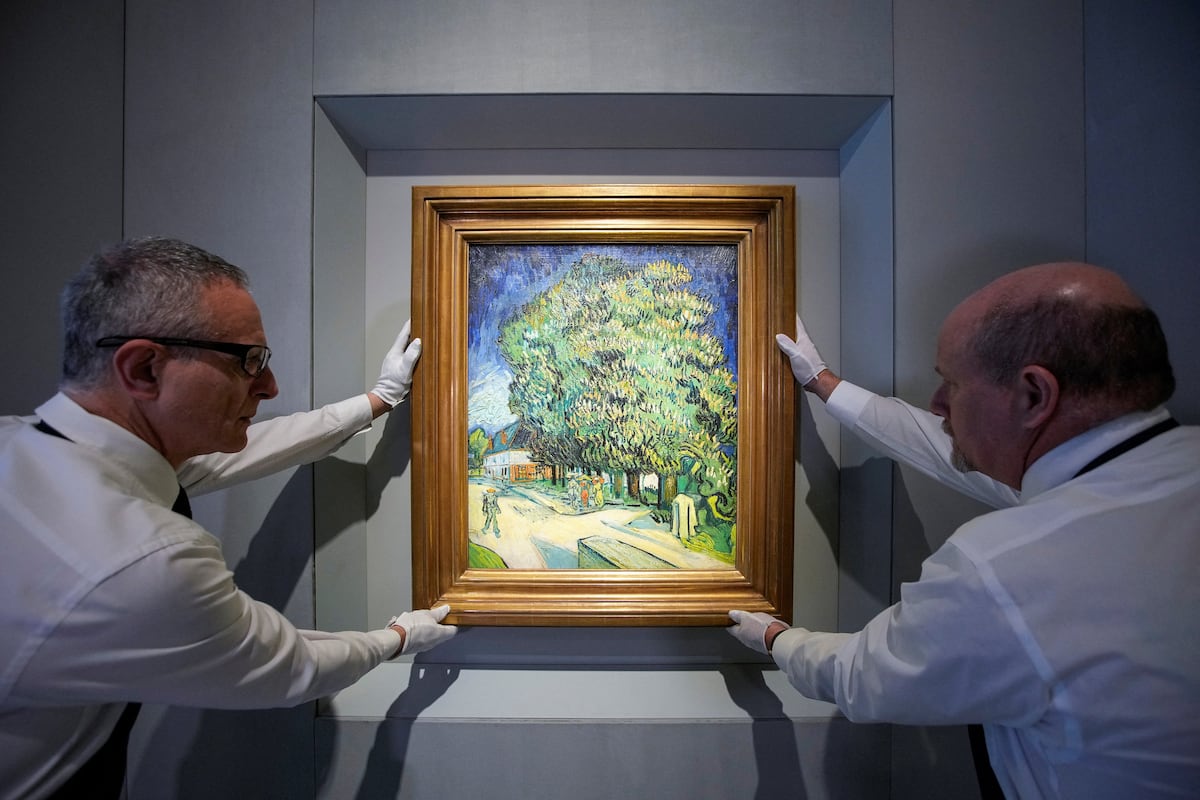
Heirs of a Jewish family are demanding that Sotheby’s withdraw a Vincent van Gogh masterpiece from its upcoming New York auction, alleging the 1890 painting was sold under Nazi-era duress.
The painting, “Châtaigniers en Fleurs” (Blossoming Chestnut Trees), carries an estimate of $180 million, which would shatter the artist’s previous auction record. The challenge comes just days before the work is scheduled to appear in the Blaquier-Arrieta Collection sale on Wednesday, November 18.
Otherwise, no auction may take place, wrote Gunnar Schnabel, the Berlin-based lawyer representing the U.S.-based heirs, in a November 12 email to Sotheby’s. Schnabel urged the auction house to prove that the family “would have wanted to carry out the sale even without Nazi rule” and that the transaction occurred at a true market price.
Bermann Fischer fled Berlin after the 1936 sale
The dispute centers on a 1936 transaction in Amsterdam. The painting was originally acquired in 1909 by Samuel Fischer, the founder of the German publishing house S. Fischer Verlag. After Fischer died in 1934, his son-in-law, Gottfried Bermann Fischer, took over the business.
As the Nazis rose to power, many of the publishing house’s authors faced bans, and Bermann Fischer eventually fled Berlin for Vienna. According to research by the descendants’ lawyer, the family was forced to pay the “Reich flight tax”, a levy imposed on citizens emigrating from Germany, which added to their financial burden.

The heirs argue that this intense financial and political pressure influenced the decision to sell the canvas. While the Netherlands was not under Nazi occupation in 1936, the descendants contend the sale was a direct consequence of the persecution faced by their family in Germany.
Sotheby’s defense of the 1936 transaction
Sotheby’s has maintained that its investigation into the painting’s ownership history does not support the claim of forced sale. Luke Nikas, a lawyer representing Sotheby’s, said that the work was sold to an independent buyer at fair market value.
The auction house provided specific details regarding the historical price to counter the allegation of a distressed sale. Records from the art dealer Paul Cassirer indicate the painting sold in June 1936 for 68,000 Swiss francs, which was approximately $22,000 at the time.
While our research to date has not established that the painting was sold under duress, we recognize the importance of engaging thoughtfully and constructively with the family and are committed to working toward a mutually satisfactory resolution.
The New York Times
Nikas also said that the Fischer family retained other paintings after the 1936 sale, works which the Nazis eventually confiscated. He argued that the family had successfully pursued and recovered those later Nazi-era losses, but never the Van Gogh sold in 1936.
Comparing Van Gogh auction benchmarks
The contested sale represents a significant moment for the art market, as the $180 million estimate places the work at the top of the current auction season.
| Work Title | Auction Year | Price Achieved |
|---|---|---|
| Verger avec cyprès | 2022 | $117 million |
| Châtaigniers en fleurs (Estimated) | 2026 | $180 million |
The painting is part of the Blaquier-Arrieta collection, which has been described by former Sotheby’s executive Philip Hook as “the stuff of legend: whispered about, kept from public view”.
Heirs seek resolution through Washington Principles and HEAR Act
The heirs are seeking a resolution based on the 1998 Washington Principles, a set of international guidelines for handling artwork confiscated or sold under duress during the Holocaust. Although these principles are non-binding, they have shaped how institutions approach restitution.

The legal environment for such claims has shifted following the passage of the Holocaust Expropriated Art Recovery (HEAR) Act.
As of November 16, Sotheby’s official auction listing continued to include the Van Gogh in the November 18 sale.
>