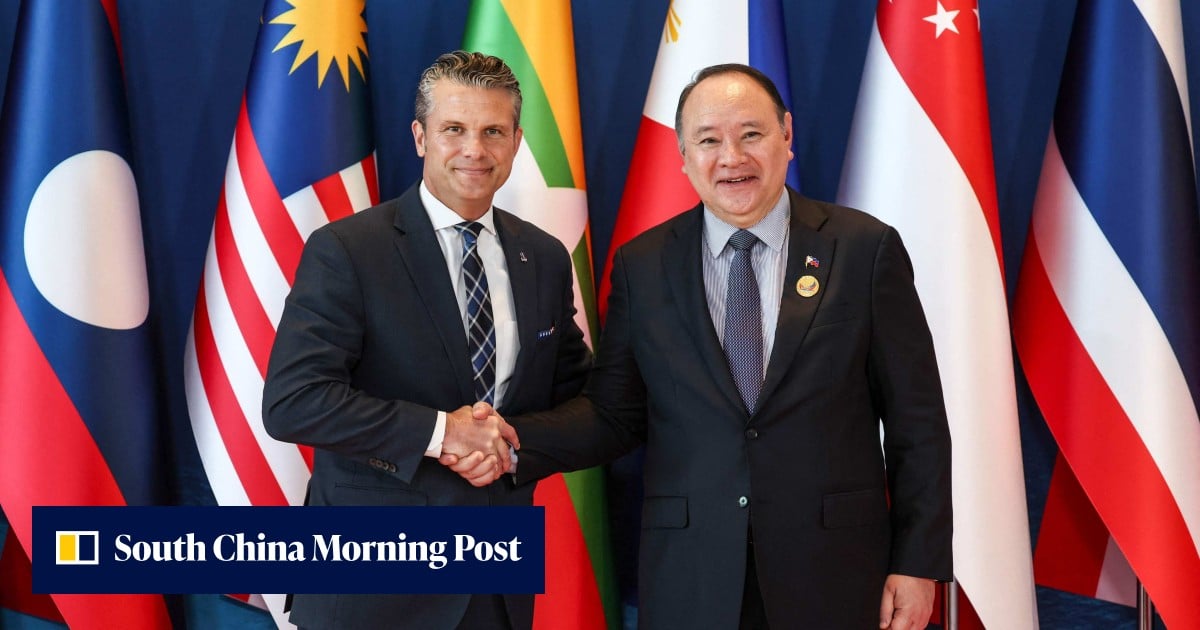
U.S. Defense Secretary Pete Hegseth has pledged increased military funding and a “modernization sprint” for command and control systems with the Philippines to bolster the “first island chain” defense posture. While the announcement signals a tightening of the U.S.-Philippine security bond, the Pentagon has withheld the specific dollar amount of the funding increase, the systems being upgraded, and the timeline for implementation, the South China Morning Post reported.
This strategic pivot aims to create a “denial defense”—a military arrangement designed to make any attempt by China to achieve its objectives in the region prohibitively costly.
The Blueprint for a ‘Denial Defense’
During meetings in Cebu on the sidelines of the Asean Defence Ministers’ Meeting Plus (ADMM-Plus), Hegseth met with Philippine Defence Secretary Gilberto Teodoro Jnr to finalize an “alliance command and control modernisation sprint.” According to a Pentagon press release, this initiative is intended to enhance “real-time bilateral coordination” and overall alliance resilience.
The “first island chain” is the geographic linchpin of this strategy. Stretching from Japan through Taiwan to the Philippines, this string of islands serves as a natural barrier. By positioning forces along this line, Washington intends to prevent China from dominating the region. This approach was formalized in the national defense strategy published in January, which explicitly instructed the U.S. to establish a “strong denial defence” along this chain while urging allies to increase their own contributions to collective security.
Hegseth characterized the current U.S. posture as “strong, quiet and clear.” He stated that the strategy is “strong enough to deter coercion and aggression, quiet enough to avoid needless escalation or public theatrics.”
Accelerating Agile Operations in Japan
The strategy extends beyond Manila. In separate talks with Japanese Defence Minister Shinjiro Koizumi, Hegseth agreed to “accelerate actions” to enable more resilient operations. This includes the flexible use of facilities and rehearsals for “distributed operations,” which involve spreading forces across multiple locations rather than concentrating them in large, vulnerable bases.
The two ministers emphasized the need for increased defense investment and “realistic training” across Japan, including live-fire exercises. However, the Pentagon has not specified which facilities will be used or when these new access agreements will take effect.
The operational reality of this strategy is already visible. Both Japan and the Philippines have seen an increase in U.S. precision-fire capabilities, including the deployment of the Typhon missile system and High Mobility Artillery Rocket System (Himars) during recent exercises. The scale of the U.S. footprint is substantial: approximately 55,000 service members are stationed under United States Forces Japan, while the Enhanced Defence Cooperation Agreement (EDCA) allows for rotational U.S. access to designated Philippine military bases.
Hegseth Coordinates with Pacific Allies to Counter Beijing
Hegseth also coordinated with the “Squad”—a security grouping comprising the U.S., Japan, Australia, and the Philippines. In a meeting with Australian Deputy Prime Minister and Defence Minister Richard Marles, Hegseth focused on preserving a “favourable balance of power in the Pacific.”
This tightening of the alliance comes as relations between Beijing and its neighbors deteriorate. Chinese Coast Guard ships have frequently collided with Philippine vessels and used water cannons in the South China Sea. Tensions with Tokyo have similarly spiked, particularly after Japanese Prime Minister Sanae Takaichi suggested Japan could take military action if Taiwan were attacked.
Beijing views Taiwan as part of its territory and has indicated it may use force to achieve reunification. While the U.S. does not recognize Taiwan as an independent state, it remains committed to providing defensive weapons to ensure the status quo is not changed by force.
Pentagon Remains Silent on Funding for Philippine Military
The Pentagon has remained silent on the actual financial commitment being made to the Philippine military.
In a departure from previous practice, China did not send its defense minister to the event, sending its defense attaché in the Philippines instead.
The primary question remaining is one of transparency: exactly how much funding is being committed to the “modernization sprint” with the Philippines, and what specific facilities or access will be implemented in Japan and the Philippines to make this “denial defence” a reality?


