A head-to-head clinical trial has found that the biologic drug omalizumab outperformed multi-food oral immunotherapy in both success and safety for patients with food allergies, according to results published in JAMA Pediatrics in July 2026.
The study, which enrolled 117 participants with a median age of 7, showed that 36 percent of those treated with omalizumab successfully tolerated at least 2,000 mg of each of three different food proteins. In contrast, some participants in the multi-allergen oral immunotherapy (OIT) group achieved the same threshold, according to study results comparing it with omalizumab.
Safety profiles were a primary driver of the difference between the two treatments. Among the immunotherapy participants, 22 percent discontinued treatment due to adverse events, while none of the patients on omalizumab stopped for the same reason. Reactions requiring epinephrine occurred in 37.3 percent of the immunotherapy group, compared with 6.9 percent for those receiving omalizumab.
Dr. Robert Wood, a lead investigator, said that adding omalizumab to oral immunotherapy may improve the safety of the treatment, even if it does not necessarily enhance its effectiveness. The trial, funded by the National Institute of Allergy and Infectious Diseases (NIAID), provides a new perspective for patients who previously relied on strict avoidance and emergency preparedness.

The landscape for food allergy care has shifted significantly since 2007, when the first proof-of-concept study for egg allergy was published. While avoidance remains a standard recommendation, clinicians now have access to sublingual immunotherapy (SLIT), oral immunotherapy, and biologics like omalizumab, which was first approved for asthma in 2003 and later for food allergies in 2024.
As of November 2026, the treatment landscape continues to adjust. The peanut-based oral immunotherapy product Palforzia was discontinued on July 31, 2026, a move not linked to safety or efficacy concerns. For patients like Erin Fenton, who has managed a severe peanut allergy since childhood, these developments have provided new options for navigating daily life.
I [was like I] don’t really care about eating a Reese’s peanut butter cup. I do care about my children being able to do those things.
Erin Fenton, patient
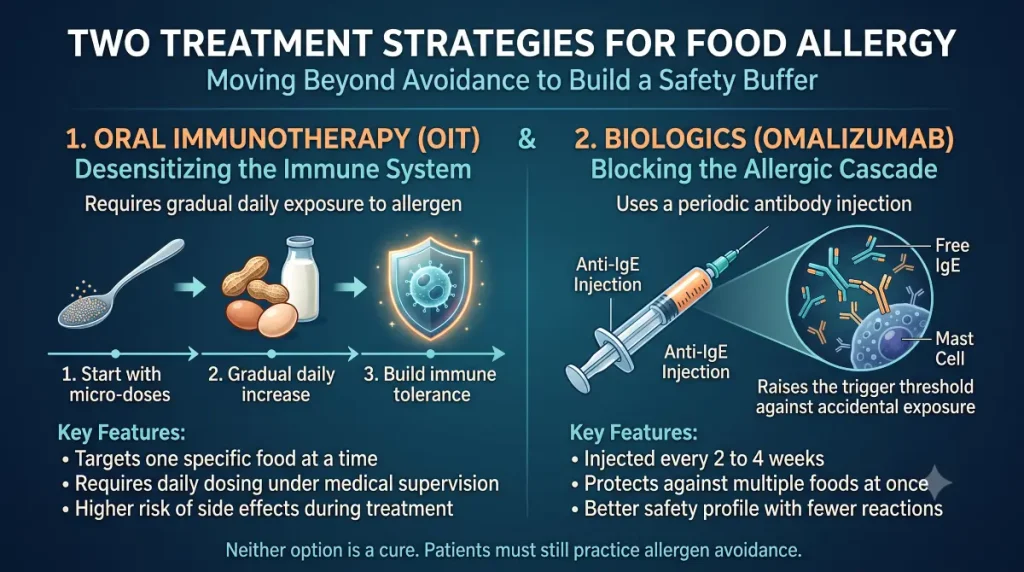
Medical experts emphasize that there is no “one-size-fits-all” approach to food allergy treatment. Kaoru Harada, a board-certified allergist at Yale Health, describes biologics as a “very exciting new development” because they block IgE antibodies, potentially addressing multiple food allergies simultaneously.
“With omalizumab for food allergy, at least the way it's approved right now, if patients stop the omalizumab, that protection is probably going to go away, but there's a lot of research going into whether there are certain patients where maybe it leads to remission,” Kaoru Harada, a board-certified allergist at Yale Health, said.
The current clinical focus is on shared decision-making, where allergists and families determine the right protocol based on individual goals—whether that means achieving protection against accidental exposure or reaching a state of higher tolerance. As Douglas H. Jones, MD, stated in his clinical column, the goal is to “find the size that fits the one.”
- Is omalizumab a cure for food allergies? No. It is designed to reduce the severity of reactions following accidental exposure, and patients must continue to avoid their known allergens.
- How does omalizumab differ from oral immunotherapy? Omalizumab is an injectable biologic that blocks IgE antibodies, whereas oral immunotherapy involves the daily consumption of small, increasing amounts of the allergen to build tolerance.
- What happens if a patient stops taking omalizumab? Protection is likely to diminish once the medication is discontinued, though research is ongoing to determine if specific patients might experience sustained remission after treatment.