The cancer-driving mutations for acute myeloid leukaemia often emerge decades before symptoms appear, according to an observational study published in Nature.
Reconstructing Leukaemia Evolution From Stored Blood Samples
Researchers at the University of Cambridge and University College London investigated the evolutionary trajectory of acute myeloid leukaemia, an aggressive blood malignancy that affects about 2,700 individuals in the United Kingdom each year. Only about one in six patients survives five years after diagnosis.
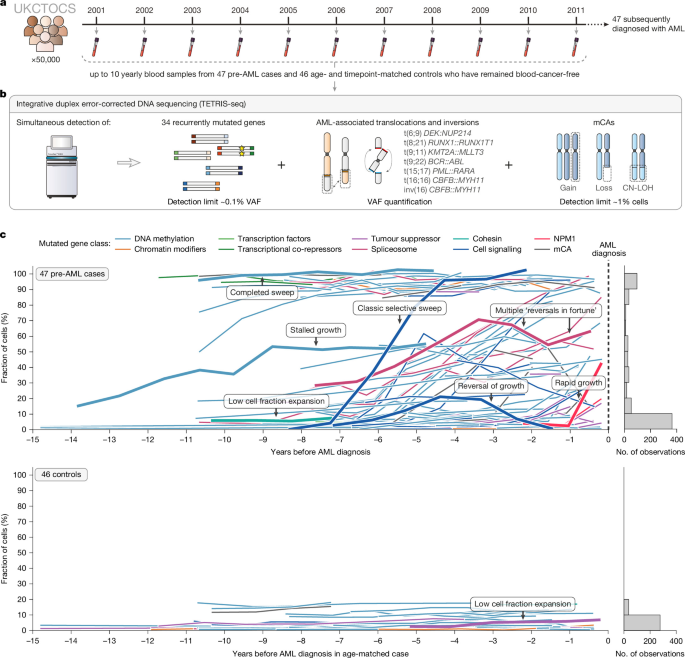
To map the disease’s origins, the research team treated longitudinal blood specimens collected before diagnosis as a molecular fossil record. They combined ultra-sensitive DNA sequencing with mathematical modelling to reconstruct when individual mutations arose, quantify cell multiplication rates, and monitor how mutant cell lines competed with normal blood cells over several decades.
The investigation analysed archived blood samples gathered through the UK Collaborative Trial of Ovarian Cancer Screening. The trial recruited 202,638 post-menopausal women aged 50 to 74 years from England, Wales, and Northern Ireland between 2001 and 2005.
At enrolment, 50,640 participants were randomised to a multimodal screening arm, providing annual blood serum samples for up to 11 years until December 31, 2011. The study examined 47 women who subsequently developed acute myeloid leukaemia at a median age of 72, alongside timepoint-matched serial samples from 46 women who remained free of blood cancer.
Genetic Alterations Before Age 20
According to the findings, the primary genetic shift occurred prior to the age of 20 in 66 percent of evaluated instances, taking place upwards of half a century before any clinical detection. Following this initial mutation, mutant blood cells underwent decades of remarkably slow proliferation, taking years to double in cell number.
In at least one-third of the leukaemia cases, researchers observed a somatic sweep, where a single clone expanded to dominate circulating blood years prior to diagnosis. No somatic sweeps were detected among the control cohort of women who remained cancer-free.
The association between somatic sweeps and heightened disease risk was validated through UK Biobank records, highlighting clonal dominance as a critical warning sign that standard genetic sequencing frequently misses by classifying variants as inherited germline traits. While many healthy older adults carry blood cells with leukaemia-associated mutations—a state identified as clonal haematopoiesis—only a small fraction eventually develop acute leukaemia.
Clinical Implications for Leukaemia Prevention
Dr Caroline Watson, lead author of the study, brought perspective from both laboratory investigation and active clinical care. Alongside her work at the Early Cancer Institute, she functions as an honorary consultant haematologist at Addenbrooke’s Hospital’s Cambridge Clonal Haematopoiesis Clinic, which stands as Europe’s inaugural clinical center focused exclusively on preventing leukaemia.
Watson drew attention to the sharp contrast between the disease’s typically sudden clinical onset and the decades-long evolutionary progression revealed by the research.
Because an established clone carrying a cancer-driving alteration expands at a steady pace, slowing only when biological space runs out or another clone overtakes it, measuring its present growth kinetics from contemporary blood specimens allows researchers to estimate how large that clone will become years or decades into the future.
Professor Blundell said that because clone multiplication grows exponentially, even a small reduction in high-risk clone activity during the ten years or more before diagnosis could lower the chances of leukemia developing.
Professor Usha Menon, who headed the UKCTOCS initiative at the UCL Institute of Clinical Trials and Methodology, said that although the project’s original purpose was assessing ovarian cancer screening, a major secondary benefit was the creation of an exclusive biobank featuring sequential serum and blood samples.
Menon underlined that this continuous archive created exceptional avenues for studying how cancer evolves over time and for confirming dependable biomarkers aimed at early identification.