
“Driving requires continuous attention, decisions and readiness to react. The body may be sitting, but the mind is working — and the heart reflects those demands,” said Ioannis Pavlidis, computer science professor at the University of Houston and senior author of the study published November 18 in npj Digital Public Health.
The research, conducted with the Texas A&M Transportation Institute, tracked 57 Texas drivers for a week using Apple Watches, iPhones and a vehicle data logger, producing more than 177,000 minute-by-minute heart-rate observations. It found that hearts stayed above each person’s resting baseline for about 94% of driving time, compared with about 81% during other sitting time.
Participants, 30 men and 27 women averaging 26 years old, were monitored continuously for one week as part of an IRB-approved naturalistic study. Driving accounted for about 10% of monitored time, with a typical trip lasting 15 minutes. In all, the data covered roughly 2,955 hours of monitoring.
Sustained elevation without the fitness payoff
Unlike aerobic exercise, which conditions the cardiovascular system, the elevation seen during driving offers no fitness benefit. The average increase above baseline was similar between driving and other sitting, but the pattern differed: driving kept heart rates in a narrower band above baseline and cut the frequency of returns to baseline roughly in half.
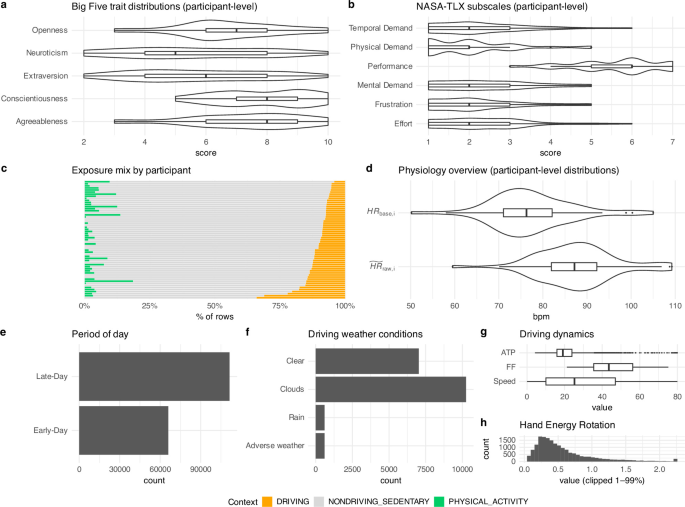
Participant-level median raw heart rate values were generally higher than participant-level baseline heart rate values, indicating that observed daily life often involved sustained elevations above baseline.
“When the heart works harder during exercise, that is generally a good thing,” Pavlidis said.
Anxiety adds up over a year of commutes
Questionnaires captured personality traits and perceived workload using the NASA Task Load Index, a six-dimension subjective measure of mental demand, physical demand, time pressure, effort, performance and frustration. Comparing participants at the low and high ends of the anxiety scale, the team’s model predicted roughly one extra heartbeat per minute for the higher-anxiety driver.
For someone driving eight hours daily — a schedule common among rideshare and delivery drivers — that gap translates to approximately 173,000 additional heartbeats per year. Everything else about the driving conditions was held equal.
What the study design captures — and what it doesn’t
The dataset, called NUBI II, covered 393 participant-days across 225 calendar days. Driving accounted for about 10% of monitored time, with a typical trip lasting 15 minutes. Participants, 30 men and 27 women averaging 26 years old, followed their normal routines.
Heart-rate data were missing more often during driving (13.6% of minutes) than during other sitting (3.5%), though the researchers found no evidence the gaps were tied to more demanding conditions such as speed or traffic. Baseline heart rate missingness was modest at the participant-day level (7.9% overall). The dataset was strongly dominated by NONDRIVING_SEDENTARY periods, making context-aware modeling essential.
Because the study is observational, it shows an association, not causation. Yearly projections assume one week of patterns holds over longer stretches and should be read as illustrative, not as forecasts for any individual’s heart health. For Figure 1e, Early-Day is defined as midnight to noon and Late-Day as noon to midnight.
Next steps: autonomous vehicles and longer horizons
Supported by TTI through 2027, the ACDC Lab plans to study larger, more diverse populations over longer periods, including long-distance commuters and full-time drivers.
As director of the University of Houston’s Affective and Data Computing Laboratory — formerly the Computational Physiology Lab — Ioannis Pavlidis pioneered contactless physiological measurement methods from 2000 to 2012, developing thermal imaging techniques to capture heart rate, breathing, and electrodermal activity without body sensors. This work established a foundation for continuous, unobtrusive monitoring in natural settings, a capability conventional tethered sensors could not provide during activities such as driving.
Pavlidis then applied these methods to influential naturalistic studies of driving distractions and deceptive behaviors, designing research that revealed real-world “fight or flight” responses in unwired participants.
Authors: Yasmine Bouzid, MD Tanim Hasan, Michael Manser, Ioannis Pavlidis.