Washington and Beijing Clash Over Pacific Subsea Cables
The security of trans-Pacific undersea infrastructure has turned into a major geopolitical flashpoint, forcing a collision between military threat assessments and the harsh operational realities of global subsea engineering. A comprehensive report commissioned by the U.S.–China Economic and Security Review Commission, titled China’s Gray Zone Threats to Trans-Pacific Undersea Cables, outlines deep vulnerabilities in the fiber-optic networks that carry 95% of international data. Yet, industry experts point out that the acute hardware shortages and vessel bottlenecks disabling the ecosystem stem as much from Western regulatory policy as they do from foreign aggression.
Command of the Deep Sea and Gray Zone Risks
According to the USCC report, Chinese defense planners increasingly treat the seabed as a critical “sixth operational dimension.” Stung by historical maritime vulnerabilities, military strategists in Beijing are pursuing “Command of the Deep Sea.” The People’s Liberation Army views undersea cables through a dual lens. They represent a strategic surveillance vulnerability against Western naval fleets, but they also serve as an asymmetric offensive tool where physical severance can degrade adversary command-and-control networks below the threshold of open warfare.
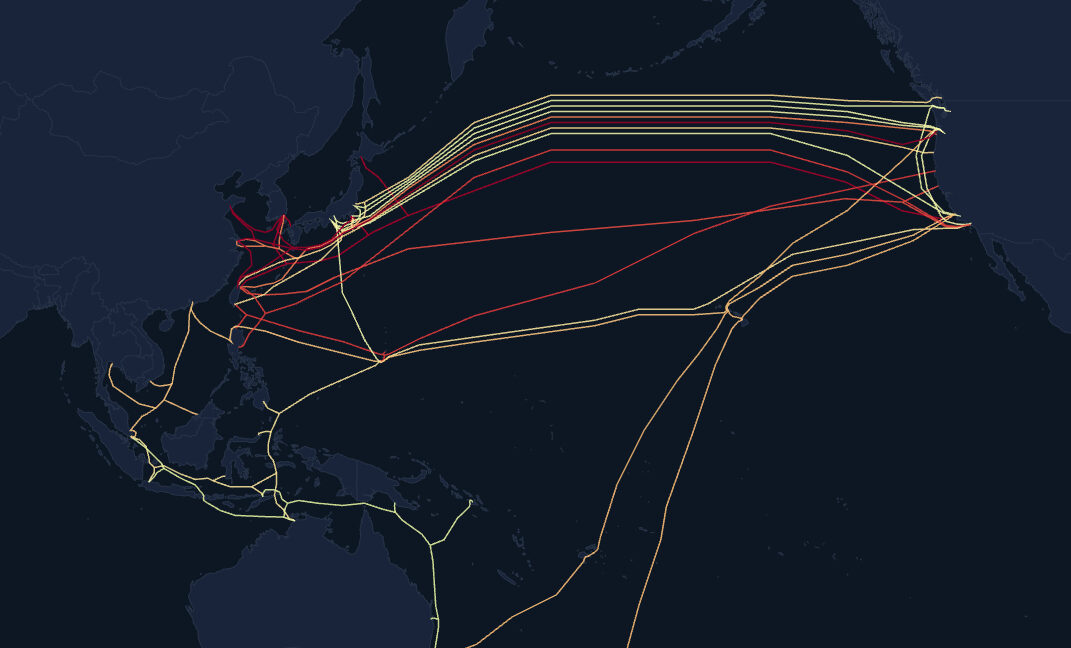
To quantify these risks, the report features a Gray Zone Vulnerability Index ranking 34 trans-Pacific cables. It highlights the First Island Chain—spanning Taiwan, Japan, and the Philippines—as the most precarious zone globally. Newer U.S. hyperscaler-backed routes like TPU, ORCA, and E2A face the highest priority targets because Beijing would suffer minimal domestic economic harm if those lines went dark.
Simulations in the document model severe disruptions. While single cable cuts are standard operational hurdles easily bypassed, simultaneous multi-cable severances would overwhelm active trans-Pacific bandwidth. Cutting the four direct U.S.–Taiwan cables—TPE, PLCN, NCP, and FASTER—would leave less than 2% active lit headroom. Rerouting traffic via the Indian Ocean and Europe would spike round-trip latency by 700 to 900 milliseconds, paralyzing high-frequency trading in the $1.37 trillion daily USD-JPY foreign exchange market and bringing distributed AI architectures to a standstill.
Subsea Engineering Veterans Challenge USCC Report on Network Failures
While the USCC report models catastrophic network failures and highlights Chinese patents for deep-sea cutting shears, electric cutters, and autonomous vehicles, subsea engineering veterans offer a starkly different counter-narrative. They argue that the systemic fragilities hobbling Western networks are largely self-inflicted.
For decades, international subsea cables operated as open, multilateral utilities. Operators across the U.S., Europe, Japan, and China pooled capital, shared fiber pairs, and distributed landing rights cooperatively. That framework broke down under sustained U.S. regulatory scrutiny.
Aggressive oversight by the FCC, Team Telecom, and Clean Network export controls systematically blocked direct cables landing in mainland China and Hong Kong. Washington pressured international consortia to strip out Chinese vendors entirely. This effectively shattered the multilateral market, forcing American hyperscalers to fund expensive, redundant solo routes while eliminating the commercial redundancy built into old consortium agreements.
| Systemic Bottleneck | USCC Assessment | Industry Counter-Perspective |
|---|---|---|
| Vessel Shortages | Aging global repair fleet (~36 vessels) vulnerable to foreign permit delays. | Excluding Chinese-managed and flagged dynamic-positioning tonnage artificially starves the global maintenance pool. |
| Manufacturing Constraints | Extreme reliance on limited Western wet-plant production capacity. | Restricting Chinese industrial giants forces all Western demand onto just three suppliers, causing multi-year delivery delays. |
| Intervention Tools | Patents for deep-sea ROVs and cutters framed as offensive gray-zone sabotage tech. | Standard marine engineering tools required for routine cable grappling, splicing, and recovery under high pressure. |
The Strategic Dilemma Facing Western Policymakers
National security officials in Washington defend these restrictive policies through a hardline lens. Relying on manufacturing, landing stations, or repair fleets tied to foreign intelligence laws creates an unacceptable advantage that could be exploited during a crisis. Accepting multi-year delivery delays, inflated capital costs, and acute vessel shortages remains a calculated trade-off to keep critical infrastructure out of an adversary’s technological sphere.
Even so, industry mechanics demonstrate that treating standard marine maintenance tools as prima facie evidence of hostile intent ignores the baseline symmetry of global naval engineering. Major maritime powers, including the U.S. Navy with specialized submarines like the USS Jimmy Carter, have operated seabed intelligence platforms for decades.
The vulnerability of trans-Pacific cables is undeniable, but the underlying crisis is mixed. The modern subsea architecture is caught in a tug-of-war where geopolitical bifurcation has dismantled cooperative resilience just as effectively as any deep-sea gray-zone threat.