In a recent contribution published by Catholic World Report, an anonymous essay explores the deeply personal framework of faith, recovery, and spiritual intercession through a collection of patron saints who anchor the author’s daily life.
The essay centers on a song titled “St. Martin of Tours,” written by the author’s son-in-law, Kyle Swensen, a member of the band Barnweaver, whose eponymous first album was released in May 2026. Recorded originally on a phone in Swensen’s living room, the song functions as a prayer written specifically in the author’s voice, highlighting a journey of recovery from alcoholism.
The chorus features the lyric, “I’ve got all these saints around my neck. Every day I still need yours,” referencing a personal communion of heavenly figures whose images and intercessions provide moral and spiritual strength.
From Evangelical Roots to Catholic Intercession
Before converting to Catholicism in 1989, the author notes that seeking the intercession of saints was a foreign concept. The version of the Bible used during those years as an evangelical minister had omitted the books of First and Second Maccabees—the latter serving as the biblical foundation of prayers for and to those who have predeceased us. The "great cloud of witnesses" mentioned in Hebrews 12:1 was interpreted merely as a metaphor rather than the reference to the actual living witnesses in Heaven.
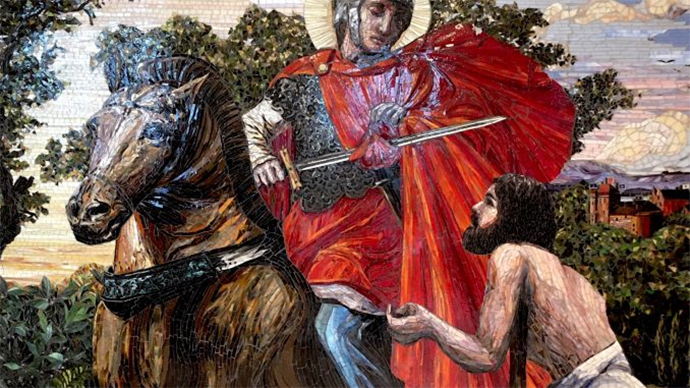
St. Martin of Tours holds a primary place among these spiritual companions. While traditionally recognized as the patron of soldiers and horsemen due to the famous legend of cutting his rich cloak in half to clothe a beggar, St. Martin is also invoked as a patron of recovering alcoholics. Although it is not clear how this patronage came about, it is probably related to his feast day on November 11. That date coincides with a historic German holiday marking the end of the wine harvest and the fermentation of the first batch of wine for that year—a time involving a great deal of overdrinking.
As a matter of historical circumstance, November 11 is also the author’s birthday, drawing an even tighter personal bond to the Bishop of Tours.
The Witness of Thomas More and Family Devotion
Moving beyond personal sobriety, the essay reflects on moral integrity by examining the final moments of Sir Thomas More. On July 6, 1535, an English attorney mounted the scaffold on Tower Hill outside the Tower of London to face execution against nearly the entirety of the clergy, nobility, and statesmen in England. Canonized by Pope Pius XI in May 1935, More famously declared on the scaffold that he died “the King’s good servant, and God’s first.”
The essay notes that much of our understanding of More’s virtue comes from A Man of Singular Virtue, a biography written by William Roper, the husband of More’s daughter, Margaret. Roper spent a significant portion of his life as a Lutheran despite More’s persistent arguments. Eventually, More abandoned direct debate, writing to Margaret that he would simply leave Roper to God and offer prayers for him. Roper later credited his return to the Catholic faith precisely to those prayers.
Drawing a parallel to familial devotion, the essay reflects on Shakespeare’s King Lear, contrasting the insincere praise of Goneril and Regan with the silent, steadfast love of Cordelia. This is likened to St. Joseph, the earthly father of Our Lord, who recorded no spoken words in the Gospels yet demonstrated profound devotion through constant, faithful action.
The essay concludes by noting several figures in this personal communion of saints: St. Martin of Tours, Sir Thomas More, and others who provide comfort and courage along the pilgrim’s way. Monica and Augustine; and St. John Paul II, whom the author has personally touched.