The $11 Million Battle for Minnesota’s 1st District
Southern Minnesota has become the unexpected epicenter of the fight for the U.S. House of Representatives. The congressional race between two-term Republican incumbent Brad Finstad and Democratic challenger Jake Johnson has ballooned into an $11 million contest, drawing national attention and significant out-of-state capital. What was once considered a comfortably safe seat for the GOP has shifted into a high-stakes toss-up, with both parties pouring resources into the region to secure a narrow legislative advantage.
The financial surge shows that when a district becomes competitive, political spending increases. According to reporting from MPR News, this influx of cash is driven by the realization that control of the House may hinge on these specific margins. For the voters of southern Minnesota, this has meant a persistent barrage of advertisements, town halls, and high-profile visits, including an upcoming appearance by Former U.S. Secretary of Transportation Pete Buttigieg alongside Johnson this Sunday.
A Shift in Political Geography
The competitive nature of this race is reflected in the shifting assessments from national analysts. The Cook Political Report recently downgraded the district from “likely Republican” to “leaning Republican,” while Nate Silver’s FiveThirtyEight has identified it as one of the 10 most competitive races in the country. This volatility is largely attributed to localized discontent regarding inflation, energy costs, and the broader impact of current federal policies.
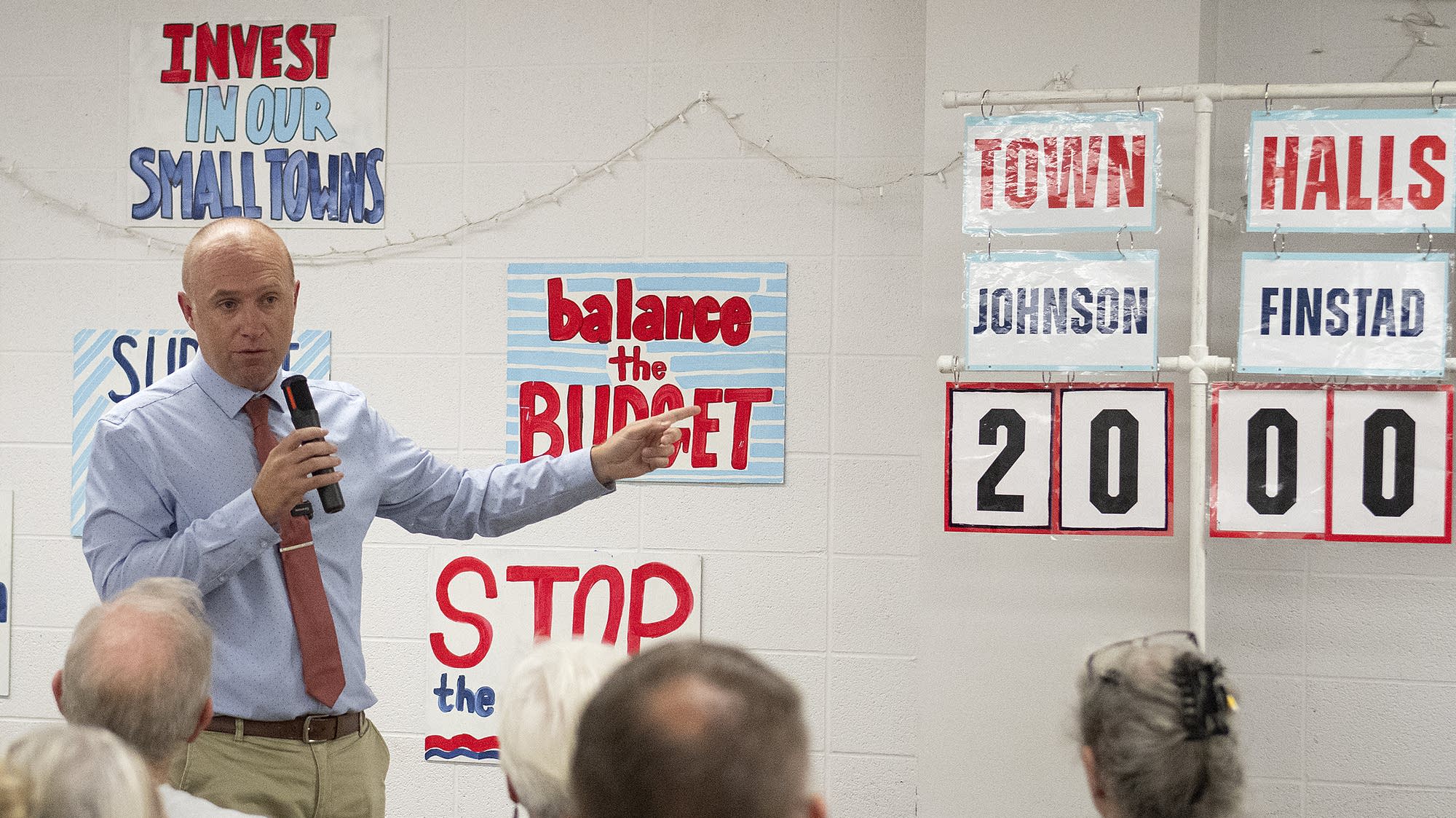
While Finstad is busy trying to rebrand his closed door meetings as town halls, we're busy holding real, public, in-person town halls across southern Minnesota. You, yes YOU, are welcome to join us: https://t.co/a2MKrJS4cT pic.twitter.com/dKPmGoW0lb
“Both parties have a really strong interest in trying to sway [voters] because the margin of the Republicans the last couple years has been razor thin,” said Jim Cottrill, a political science professor at Winona State University. “The fact that the Senate is back in play makes the stakes for the House even higher.”
The Candidates: Common Roots, Divergent Paths
On the surface, the candidates share a similar demographic profile. Both Finstad and Johnson were raised in southern Minnesota, are fathers of large families, and share the local lore of having met their spouses on elementary school buses. However, their campaign strategies offer a stark contrast in priorities.
Finstad, a farmer and current member of the House Committee on Agriculture, has focused heavily on the issue of fraud, frequently linking his opponent to the policies of Tim Walz. He maintains that his legislative work is grounded in the practical needs of the district, pointing to his involvement in the drafting of the recent Farm Bill as evidence of his commitment to his constituents. “I pride myself on being a workhorse and not a show horse,” Finstad told MPR News.
The Democratic Congressional Campaign Committee just officially called southern Minnesota's seat a top target in 2026! More and more are stepping up every day to help @JakeJohnsonMN unseat Rep. Brad Finstad this November. pic.twitter.com/ESom4xA3YL
Johnson, a high school math teacher from Rochester, has taken a grassroots approach to bridge the gap. He has held 21 town hall meetings—covering every county in the district—to address voter frustration directly. His platform centers on the economic impact of federal decisions, specifically targeting Finstad’s support for Trump-era trade policies, Medicaid funding cuts, and military involvement in Iran, which Johnson argues have disproportionately harmed the region’s agricultural economy.
The Human Cost of Policy
The political maneuvering carries real-world consequences for local business owners and families. For individuals like Brandon Kroeger, a 51-year-old construction company owner in New Richland, the impact of federal policy has moved beyond the abstract. Once a longtime Republican voter, Kroeger is backing Johnson this cycle, citing the personal fallout from federal immigration enforcement.
Last year, 27 Republican state legislators – including 7 from southern Minnesota – begged Brad Finstad not to make deep cuts to Medicaid. He voted for nearly $1 trillion in cuts anyway, gutting funding for our small towns and rural clinics. pic.twitter.com/V61HgJ8EQH
The economic stakes are equally high for the region’s farmers. Johnson’s critique of the current trade environment highlights the closure of markets for corn and soybeans, while Finstad defends his legislative record as a series of common-sense measures aimed at tax reduction and stability. As the election approaches, these competing visions for the district’s future will be tested at the ballot box.
With the race currently categorized as a toss-up, the outcome remains uncertain. Whether the district remains a Republican stronghold or flips to help secure a Democratic majority in the House depends on whether voters prioritize the stability offered by the incumbent or the change promised by the challenger.
We did it not just because Brad Finstad has NEVER held a single town hall meeting, but because the people of southern Minnesota deserve a representative who listens to us and answers to us.



