Manhattan Courtroom Battle Follows New York Rent Freeze
Several weeks after New York implemented its rent freeze, the conflict has moved to a Manhattan court where City Hall and landlords are clashing over text messages and whether the mayor exerted pressure on the board that approved it. At the heart of the legal battle is a question of whether the freeze was approved properly. Tenants currently holding leases find their housing costs protected, while prospective renters face a market devoid of newly added units.
For those looking to understand the real-world mechanics of housing supply and price suppression, the evidence sits 1,000 miles west in Minneapolis. There, six years of data from the country’s most closely watched zoning experiment offer a look at what happens when a major municipality changes its rules. What started in January 2020 has now generated enough data to measure its economic footprint on property values and neighborhood affordability.
The Impact of Ending Single-Family Zoning
Before the 2040 Plan took effect, about 70% of Minneapolis residential land allowed one house per lot. The city altered those zoning rules by allowing three, letting bigger apartment buildings rise along the main corridors, and a year later dropped parking minimums. The policy did not mandate construction or force anyone to build; rather, the city simply stopped saying no.
Predicting the outcome beforehand yielded sharp divisions. Mayor Jacob Frey argued during a May 2018 pitch that the plan merely allowed property owners to build “something more affordable” on lots where modest ranch houses were routinely being replaced by mansions. Conversely, the residents’ group Minneapolis for Everyone countered that the policy would “make our city less affordable.”
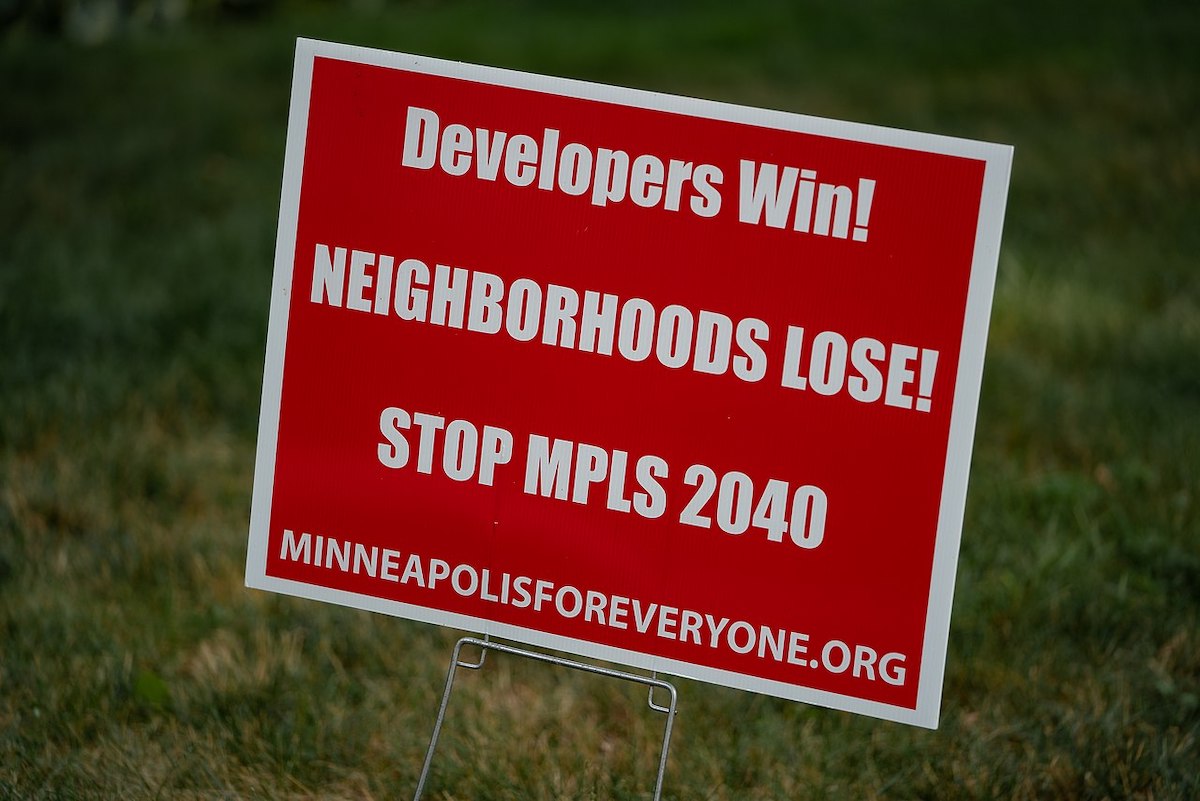
With six years of hindsight, researchers can now evaluate those competing claims. A study tracking Zillow home values across every Minneapolis neighborhood from 2013 through 2024 measured the city against three yardsticks: the 50 cities most similar to Minneapolis, the big cities of the Midwest, and—accounting for the civil unrest following the George Floyd protests in 2020—cities that experienced large protests of their own. Across all three comparisons, the trajectory of home values remained consistent.
Plan Reduced Home Values by Twenty Percent
Over the first five years of the plan, a typical mid-priced home in Minneapolis was worth, on average, something like 15% to 20% less than it would have been without it. Unlike the rest of the housing stock, property values for the least expensive third of homes appreciated continuously instead of seeing their gains taper off. While Zillow puts a typical Minneapolis home at around $330,000 today, researchers estimate those same properties would have cost an additional $60,000 to $80,000 if the plan had never passed—amounting to roughly what a 20% down payment would’ve cost.

To be clear, home prices in Minneapolis did not drop. Between 2019 and 2024, property values grew roughly 15%, whereas the median American city experienced an appreciation rate of about 50%. Existing homeowners kept the equity they had, but they missed out on the run-up most of the country got.
Interestingly, this pricing effect occurred even though very few property owners built a triplex. Figures compiled by the Federal Reserve Bank of Minneapolis indicate that roughly 300 homes have been built within two- to four-unit structures since 2020, representing merely 2% of all apartment units permitted by the city during that period. Rather, the majority of new residential inventory came from larger multi-family housing projects facilitated by that exact same initiative: approximately 21,000 homes were authorized between 2017 and 2022, primarily in buildings containing 20 or more units, which expanded the municipal housing supply by 12%. Because buyers shop across the city line, the suburbs next door, Edina and St. Louis Park, saw prices held down too.
Unusual local factors also warranted scrutiny. Given that 2020 was a strange year in Minneapolis, researchers investigated whether the slow growth in rents and prices stemmed from a Minneapolis-specific drop in demand rather than new supply. Population growth did slow by about a percentage point per year—a shift too modest to drive such steep price divergences on its own. Had local unrest driven residents away, price declines should have materialized first in the vicinity of George Floyd Square, which was not the case. While weaker demand likely explains a slice of the gap, it falls short of explaining the broader economic trend.
Lessons for Other Cities
For municipal leaders elsewhere, the Minneapolis experiment highlights three distinct takeaways. The price response came fast—about 5% in the plan’s first year—and grew from there. Ultimately, the success of the initiative did not depend on its most widely publicized measure; triplexes proved to be a minor element, while the newly permitted larger apartment buildings drove the actual results. Finally, the cooling effect did not stop at the city line.
Most elements driving the cost of a house—interest rates, lumber, wages, and how many people want to move there—are beyond any city’s reach. However, municipal regulations governing construction are fully controllable, and Minneapolis stands out as the first major urban center to relax these constraints and observe the long-term consequences. It spent nothing. It built nothing itself. Families purchasing homes there will avoid needing mortgage financing for an extra $60,000 to $80,000.